
Most investors focus on share price, dividends, and earnings growth. But one of the most powerful drivers of long-term stock returns often works quietly in the background — stock buybacks.
If you’re still building your investing foundation, start with our guide on the psychology of money, which explains why understanding incentives and behaviour matters before choosing stocks.
Many of the best long-term performers didn’t rely on explosive growth. Instead, they steadily reduced their share count — increasing each remaining shareholder’s ownership over time.
Key idea: When a company buys back its own shares, your ownership percentage can increase — even if you never buy more shares.
What Are Stock Buybacks? (Stock Buybacks Explained Simply)
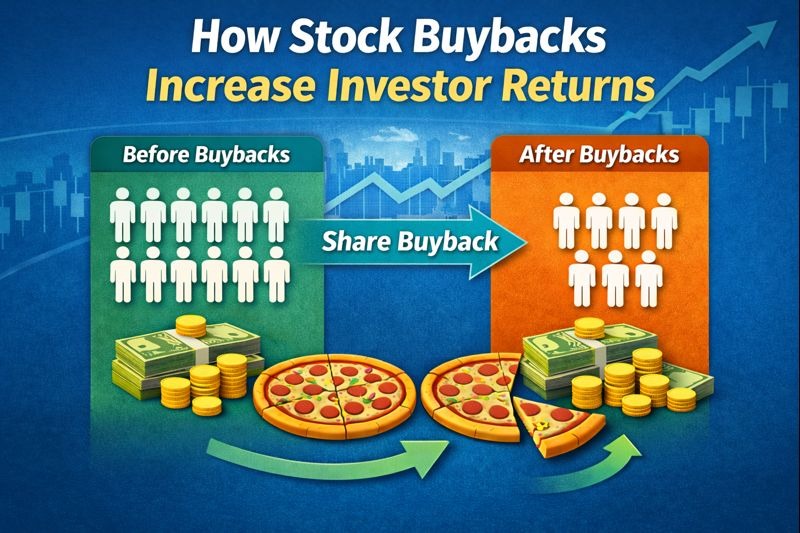
A stock buyback (also called a share repurchase) happens when a company uses its own cash to buy its shares from the market.
Those shares are either cancelled or held as treasury stock. Either way, the total number of shares outstanding goes down.
Think of the company as a pizza. Same pizza — fewer slices. Each slice you own becomes a bigger portion of the whole.
For a formal definition, Investopedia explains stock buybacks (share repurchases) and how companies use them as a capital allocation strategy.
How Stock Buybacks Increase Earnings Per Share (EPS)
Here’s where buybacks become powerful. Even if a company’s total profits stay flat, earnings per share can rise simply because there are fewer shares.
| Scenario | Net Profit | Shares | EPS |
|---|---|---|---|
| Before buyback | $1B | 1B | $1.00 |
| After 20% buyback | $1B | 800M | $1.25 |
No growth. No new products. Yet EPS increases because ownership is spread across fewer shares.
Stock Buybacks vs Dividends: Which Is Better for Investors?
Dividends feel good — cash in hand. But buybacks often outperform over time because:
- They’re usually more tax-efficient
- They compound ownership quietly
- They give management flexibility
The strongest companies often combine both: sustainable dividends and disciplined buybacks.
When Buybacks Are a Red Flag
Not all buybacks create value. In fact, bad buybacks can destroy shareholder wealth.
- Debt-funded buybacks that increase financial risk
- Buybacks at inflated prices near market peaks
- Buybacks that merely offset employee stock compensation
Rule of thumb: Buybacks only work when funded by real free cash flow and supported by a healthy business.
If you want a broader framework for reducing investment mistakes, combine this checklist with our risk assessment checklist — the same principles apply across asset classes.
The Buyback Quality Checklist
| Check | What You Want |
|---|---|
| Free cash flow | Buybacks paid from cash, not debt |
| Debt trend | Stable or declining debt levels |
| Share count | Consistent reduction over 5–10 years |
| Business health | Stable or growing operating income |
How to Use This When Picking Stocks
- Check share count history
- Confirm free cash flow
- Review debt trends
- Compare EPS growth vs revenue growth
- Decide if management is disciplined
Ask yourself: Is management growing the business — or just the optics?
Final Takeaway
Stock buybacks aren’t exciting. They don’t trend on social media. But they quietly increase ownership, improve per-share metrics, and compound returns over time.
Smart investors don’t just chase growth — they understand how ownership works.
Disclaimer: This content is for educational purposes only and does not constitute financial advice.