
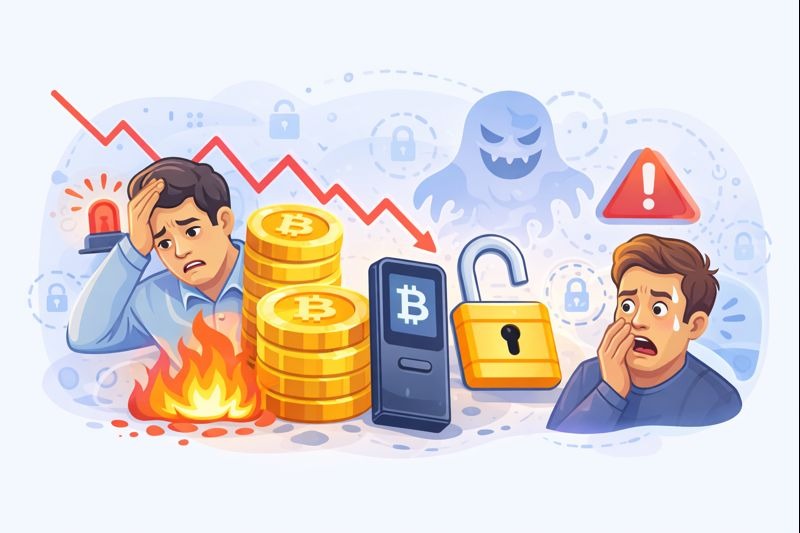
Most people don’t lose money in crypto because the technology failed.
They lose money in moments — emotional, rushed, poorly understood moments where decisions are made without a plan.
Markets go up and down. That’s normal. But the real damage usually happens in predictable situations that repeat themselves over and over again.
Here are the seven moments where most crypto losses actually occur — and how to recognize them before they cost you.
Moment #1: When You Buy Because Everyone Else Is
This is the classic FOMO moment.
A token is pumping. Screenshots are flying in WhatsApp groups. Twitter is loud. Suddenly, it feels irresponsible not to buy.
But buying because others are excited is not a strategy — it’s a reaction.
By the time hype reaches your screen, early buyers are often already planning their exit.
Buying without understanding what you’re buying is usually the first mistake in a chain reaction.
Moment #2: When You Panic Sell Just to Feel Safe
Prices drop. Your portfolio turns red. Anxiety kicks in.
You sell not because your thesis changed, but because the discomfort became unbearable.
This moment is dangerous because it feels like relief — but it often locks in losses permanently.
This behavior is deeply tied to psychology, not logic. If this sounds familiar, understanding how emotions affect money decisions is critical.
We break this down in detail in our guide on the psychology of money and long-term wealth.
Moment #3: When You Leave Funds on an Exchange “Just for Now”
Convenience is one of the most expensive habits in crypto.
Leaving funds on an exchange feels safe — until it isn’t.
History has shown repeatedly that when platforms fail, users don’t get priority access to their assets.
If you don’t control the private keys, you don’t truly own the crypto.
This risk is explained clearly in our breakdown of what happens when crypto exchanges collapse, and how users are affected.
Moment #4: When You Chase Yield Without Understanding the Risk
High APYs are seductive.
“Guaranteed returns.” “Low risk.” “Passive income.”
In many cases, users hand over custody of their funds without understanding where the yield comes from — or what happens if things go wrong.
Yield itself isn’t the problem. Blind yield chasing is.
This is why learning the basics of custody and risk management comes before any income strategy.
Moment #5: When You Ignore Security Because “It Won’t Happen to Me”
Seed phrases stored in screenshots. Clicking links in DMs. Trusting impersonators.
Most hacks aren’t sophisticated — they’re opportunistic.
Security mistakes usually happen when people feel comfortable, not cautious.
Use a clear checklist and treat security as a habit, not a one-time setup. Our DeFi safety checklist exists for this exact reason.
Moment #6: When You Overtrade Instead of Following a Plan
Constant buying. Constant selling. Constant checking.
Overtrading often comes from the belief that doing more leads to better results.
In reality, it usually leads to higher fees, emotional exhaustion, and inconsistent outcomes.
A simple plan followed consistently often outperforms constant activity driven by emotion.
Moment #7: When You Stop Learning
Markets evolve. Risks change. Platforms update.
The moment you assume you “know enough” is the moment blind spots start forming.
Staying informed doesn’t mean chasing every trend — it means understanding the fundamentals well enough to adapt.
Those who treat crypto as a long-term system tend to survive cycles better than those who treat it like a casino.
The Bigger Picture
Crypto doesn’t punish beginners.
It punishes complacency, emotional decision-making, and blind trust.
Every loss has a lesson attached to it — if you’re willing to see it.
Awareness of these moments won’t eliminate risk, but it dramatically improves your odds.
Protect your mindset first. Protect custody second. Strategy comes after.
Further Reading
For a deeper understanding of crypto risk and investor behavior, see Investopedia’s overview of cryptocurrency risks.
You can also explore broader market psychology and decision-making biases at BehavioralEconomics.com.
Join the Weekly SPI Newsletter
Practical insights. Real opportunities. Zero fluff.