

Quick navigation:
- What CARF is
- South Africa timeline
- Crypto is already taxable
- Investor vs trader
- Taxable events
- How to declare on SARS eFiling
- Tools and SA firms
- FAQ + Schema
CARF is coming — and it changes one thing above all: visibility. This guide shows South Africans exactly how crypto tax works, what SARS expects, and how to declare correctly (without stress).
crypto tax South Africa is entering a new era — not because tax is “new”, but because enforcement is becoming far more data-driven. Crypto lived in a grey zone for years: not illegal, not invisible, just misunderstood. Many investors genuinely didn’t know what to declare, while others leaned into the uncertainty.
Now the gap is closing. South Africa is implementing the Crypto-Asset Reporting Framework (CARF), a global reporting standard designed to improve tax transparency for crypto activity. Put simply, crypto platforms will increasingly collect and report user transaction data to tax authorities, and participating countries can exchange that information across borders.
Quick truth (don’t skip this): CARF doesn’t “create” crypto tax in South Africa. Crypto was already taxable. CARF mainly reduces the loopholes by improving the data SARS can verify.
If you’re building long-term wealth mindset first, start here: The Psychology of Money (SPI) . And if you want the safety-first foundation for crypto decisions, read: DeFi Safety Checklist (SPI) .
1) What is CARF (Crypto-Asset Reporting Framework)?
CARF is a reporting standard developed under the OECD’s tax transparency work. It is designed to help tax authorities obtain “tax-relevant” information about crypto transactions that often happen outside traditional financial rails. That’s important because crypto can move between platforms and jurisdictions quickly — and historically, tax authorities struggled to get consistent reporting data.
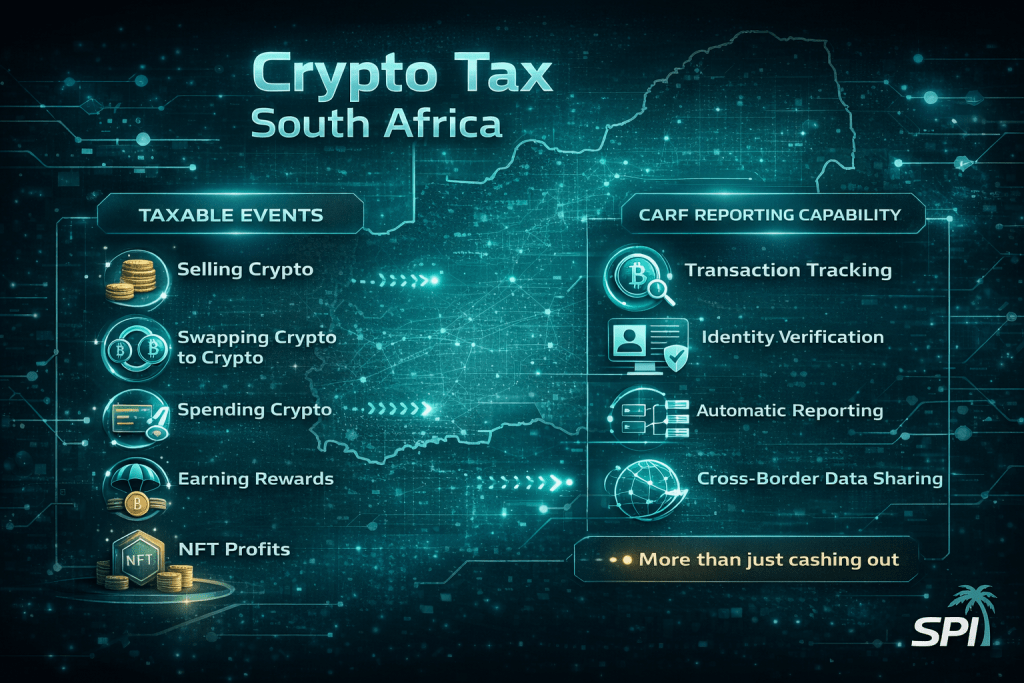
At a high level, CARF requires Reporting Crypto-Asset Service Providers (think exchanges, brokers, custodial platforms and other in-scope intermediaries) to:
- Identify users (including tax residency and taxpayer identification info).
- Track relevant crypto transactions (acquisitions, disposals, swaps, transfers, etc.).
- Report aggregated transaction information to local tax authorities.
- Enable automatic exchange of that information between participating jurisdictions.
Optional reference (official overview): OECD CARF overview .
2) CARF timeline in South Africa (why this matters for crypto tax South Africa)
Here’s the timeline clarity, without the confusion:
- Regulations effective date: Professional summaries of South Africa’s CARF regulations commonly state they become effective on 1 March 2026. This date is also often referenced as the start of the first reporting period.
- First reporting period: A widely-cited first reporting period is 1 March 2026 to 28/29 February 2027 (annual thereafter).
- “September 2026” references: Some industry material indicates that certain operational reporting milestones may ramp up from September 2026. Practically, this can mean platforms start collecting extra information early and tighten systems well before filing deadlines.
What this means for YOU: Whether the “big visible impact” hits you in March 2026 or ramps up from September 2026, the smart move is the same: get your records clean now and track properly going forward.
3) Crypto is already taxable in South Africa (CARF just makes it harder to hide)
SARS has been consistent: normal income tax rules apply to crypto assets. Taxpayers must declare crypto-related gains or income in the tax year it is received or accrued — and failure to do so can lead to penalties and interest. SARS also states that crypto is treated as an intangible asset (not “currency” for tax purposes).
Official starting point: SARS: Crypto Assets & Tax | SARS media release: SARS stance on crypto (2018)
Important: A very common misconception is: “I only pay tax when I withdraw to my bank.” That’s not how it works. Many crypto “disposals” can trigger tax — including swaps (crypto-to-crypto) and spending crypto.
So if you’re searching “crypto tax South Africa” because CARF sounds scary, take a breath: this is mostly about better reporting and verification — not a sudden surprise tax category that never existed.
4) SARS classification: Investor vs Trader (why crypto tax South Africa depends on this)
SARS doesn’t tax you based on the coin. SARS taxes you based on your facts and behaviour. The biggest question is whether your profit is capital (investing) or revenue (trading / income).
Investor (usually Capital Gains Tax)
If you buy crypto with the intention to hold as a longer-term investment and you sell occasionally, If you buy crypto with the intention to hold as a longer-term investment and you sell occasionally, SARS will often treat your gains as capital in nature. In that case, you may fall under Capital Gains Tax (CGT) rules. For individuals, only a portion of net capital gains is included in taxable income (with an annual exclusion), and your effective rate depends on your marginal tax bracket.
Trader (usually Income Tax)
If you trade frequently (short holding periods, repetitive transactions, “in and out” behaviour, consistent profit-seeking, bots, etc.), your profits are more likely to be treated as revenue and taxed as income at your marginal rate. Many professional tax insights also warn that crypto-related profits can be considered revenue in nature in common scenarios like active trading, staking rewards, mining, and airdrops.
Helpful reading: Webber Wentzel: crypto tax overview | Mazars: crypto & SARS insight
SPI rule: If you’re not sure, don’t guess aggressively. A conservative approach + good records + a defensible position beats “hoping SARS sees it your way.”
5) What exactly is “a taxable event” in crypto?
In real life, SARS looks for disposals and receipts/accruals of value. These are common crypto events that can trigger tax implications:
- Selling crypto for ZAR (obvious one).
- Swapping crypto for crypto (e.g., BTC → SOL) — many people forget this.
- Spending crypto (paying for something with crypto).
- Receiving crypto rewards (staking, airdrops, referral rewards, mining).
- NFT profits (especially if frequent or business-like).
SARS also references crypto assets inside the ITR12 guidance: SARS ITR12 guide (PDF)
6) Step-by-step: how to declare crypto tax South Africa on SARS eFiling
The main reason people mess up crypto tax is simple: they try to do it from memory, or from bank deposits only. CARF-era compliance is about one thing: records.
Step 1: Collect your complete transaction history
Pull data from every place you used crypto:
- Exchanges (Binance, Bybit, OKX, Luno, VALR, KuCoin, etc.)
- Wallets (Metamask, Ledger, Trust Wallet, etc.)
- DeFi apps (if you used them)
- On-ramps/off-ramps and payment apps
Most exchanges allow you to export CSVs or connect by API. If you have years of activity, don’t try to “hand-calc” it. You’ll miss swaps and fees.
Step 2: Use a crypto tax calculator to consolidate everything
You want software that can import exchange + wallet data, calculate cost basis, classify transactions, and generate a report. Common global tools used by South Africans include:
What these tools do (and don’t do): They don’t “file” your SARS return for you. They help you produce accurate, consistent numbers and transaction summaries so you can declare correctly.
Step 3: Decide the nature — capital vs income (the part that really matters)
This is where you either get it right… or invite questions. If you actively traded, your profits are more likely income. If you invested long-term, your gains may be capital. If you did both (many people did), you may need separate “buckets” and clean logic.
When in doubt: speak to a tax practitioner who understands crypto. Not a random accountant who treats your wallet like a savings account.
Step 4: Declare using SARS eFiling (ITR12)
Once you have totals from your crypto tax report, you declare them in your normal tax return on SARS eFiling. The specific fields can change year-to-year, but practically you’re declaring either:
- Capital gains/losses (if capital in nature), and/or
- Income (if revenue in nature, including many reward scenarios)
Official SARS starting point: Crypto Assets & Tax (SARS)
7) “Okay but how much tax will I pay?” (simple examples)
Your tax depends on your situation (income level, frequency, nature of gains, etc.). But here are simple examples to make it real:
Example A: Investor (capital gain)
You buy crypto worth R20,000, hold for a long period, then sell later for R50,000. Your capital gain is R30,000 (before considering fees and any other adjustments). CGT works through inclusion rates and an annual exclusion for individuals — meaning you’re not taxed on the full R30,000 in the same way a trader might be.
Example B: Trader (income)
You trade weekly, make R30,000 profit in a year (net of trading fees) and you’re treated as revenue in nature. That profit is added to taxable income and taxed at your marginal rate (which can be materially higher than a CGT effective rate).
Plain-English explanation: Recap: Paying tax on crypto in South Africa
Don’t copy-paste someone else’s “tax rate” from social media: Crypto tax isn’t one flat rate. It depends on your facts, your income bracket, and whether it’s capital or revenue in nature.
8) Who can help you with crypto tax South Africa (tools + SA firms)
If you’ve got a simple buy-and-hold portfolio, software + a careful return may be enough. But if you’ve traded heavily, used DeFi, moved money across exchanges, or you’re unsure how to classify activity — get help. Not because you’re guilty. Because crypto tax is a record-keeping problem before it’s a tax problem.
Crypto tax software (do-it-yourself with strong reporting)
South African services / firms that explicitly support crypto tax
- TaxTim (simple filing workflow; also publishes CARF explainers)
- Crypto Tax Consulting (Tax Consulting SA Group)
- CH Consulting (crypto tax reports)
Note: Always vet providers. Ask them how they handle capital vs revenue classification, cost basis methodology, and SARS audit support.
If you’re also building a compliance-first money stack, you may like: Best Crypto Debit Cards (SPI) .
9) The mistakes that get South Africans in trouble (CARF makes these obvious)
Watch-outs:
- Only declaring “cash-outs” to your bank (ignoring swaps and on-chain activity).
- No records (or missing exchange CSVs from older years).
- Mixing investing + trading in the same wallet and then trying to “explain it later.”
- Ignoring staking/airdrop/referral rewards as taxable income.
- Waiting for SARS to ask first (the worst strategy).
A cleaner approach is simple: track monthly, keep exports, and treat your crypto activity like a business record — even if you’re just an investor.
10) Staying compliant without losing your mind (SPI method)
- Start tracking now — not at tax season.
- Separate wallets: investing wallet vs trading wallet vs DeFi wallet.
- Export monthly (CSV or API sync) so you never “lose history.”
- Save proof: deposits, withdrawals, exchange statements, wallet addresses.
- If you messed up in past years, don’t panic — get professional advice early.
Final takeaway: CARF isn’t “anti-crypto.” It’s crypto growing up. The winners will be the ones who treat crypto like real investing: with records, structure, and discipline.
If you came here because “crypto tax South Africa” feels overwhelming, remember: you don’t need perfection — you need consistent tracking and a defensible method. That’s how you stay calm and compliant.
Frequently Asked Questions About crypto tax South Africa
What is crypto tax in South Africa?
Crypto tax in South Africa refers to the requirement to declare and pay tax on profits or income earned from cryptocurrency activities. SARS treats crypto assets as taxable assets, meaning gains may be taxed as either capital gains or income depending on how the crypto was used.
Is crypto taxable in South Africa even if I don’t withdraw to my bank?
Yes. Crypto can be taxable even if you never withdraw funds to your bank account. Events such as crypto-to-crypto trades, staking rewards, airdrops, and spending crypto can all trigger tax obligations under South African tax law.
How does SARS know about my crypto?
Historically, SARS relied heavily on self-disclosure and limited third-party data. With CARF, crypto platforms and service providers will increasingly report transaction data in a structured way, which improves SARS’ ability to verify disclosures.
What is the Crypto-Asset Reporting Framework (CARF)?
CARF is an international reporting framework developed to improve tax transparency for crypto assets. It requires in-scope crypto service providers to collect user information and report certain transaction data to tax authorities, with cross-border exchange between participating jurisdictions.
When does CARF start in South Africa?
South Africa’s CARF regulations are widely discussed as becoming effective in 2026, with reporting readiness and data collection ramping up through 2026. The practical impact is that compliance expectations and verification ability will increase materially as the framework goes live.
Is crypto taxed as income or capital in South Africa?
It depends on your facts. Long-term investors are generally treated under capital gains rules, while frequent trading activity and many reward-based earnings are often treated as revenue (income) and taxed at your marginal tax rate.
How do I declare crypto to SARS?
You declare crypto gains or crypto-related income through SARS eFiling using your annual ITR12 return. Many taxpayers use crypto tax software to calculate totals from exchanges and wallets, then input those totals into the appropriate fields on eFiling.
What if I didn’t declare crypto in previous years?
If crypto activity was not declared previously, it’s usually better to address it proactively rather than waiting for SARS queries. In complex cases, speak to a tax professional who understands crypto so you can correct past disclosures in a structured way.
Do I need a tax professional for crypto tax?
Not always. A simple buy-and-hold investor may manage with crypto tax software and careful filing. If you traded heavily, used DeFi, have messy wallet history, or aren’t sure about capital vs income classification, professional help is strongly recommended.
Does CARF mean crypto is banned or restricted?
No. CARF is a reporting and transparency framework. It does not ban crypto. It increases reporting visibility so tax compliance can be enforced more consistently.
Disclaimer: This article is educational and not tax advice. Tax outcomes depend on your facts. If you’re unsure, consult a qualified South African tax practitioner.
References worth reading: SARS: Crypto Assets & Tax | SARS stance (2018) | OECD CARF