
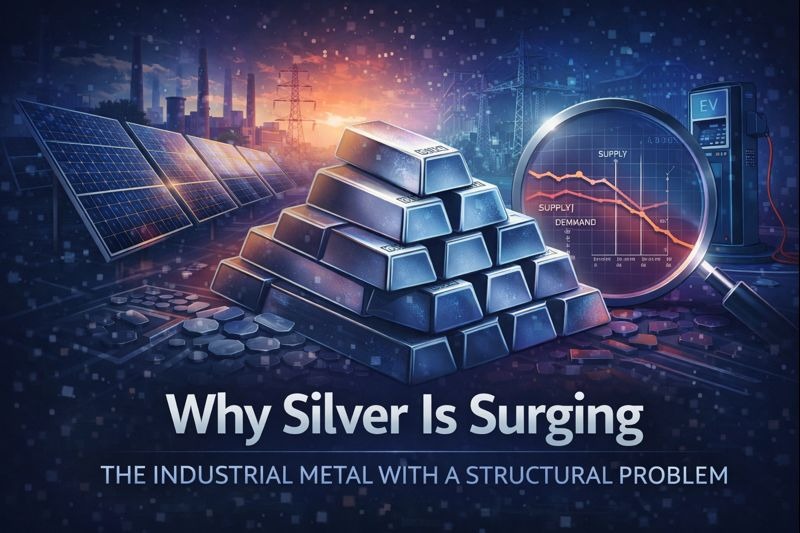
Why is silver suddenly moving so aggressively while gold has already made headlines?
Why silver is surging has become a key question for investors as the metal begins to move far more aggressively than gold. This question has been showing up everywhere — and the answer isn’t simple speculation or hype.
Silver is doing well because it sits at the intersection of money, industry, and supply constraints. When those forces align, silver doesn’t move slowly — it reprices.
This article breaks down exactly why silver has been surging, what makes it different from gold, and why its structure makes volatility unavoidable.
Silver Is Not Just a Precious Metal
Most investors treat silver like “cheaper gold.” That’s a mistake.
Silver has a dual identity:
- Monetary metal: a store of value and hedge during uncertainty
- Industrial metal: a critical input in modern technology
This dual role is the key to understanding why silver behaves differently — and why it can lag for years, then move violently.
Industrial Demand Is No Longer a Side Story
Silver’s industrial use is not optional. It is one of the most conductive metals on Earth, which makes it essential for:
- Solar panels (photovoltaics)
- Electronics and semiconductors
- Electric vehicles and charging infrastructure
- Power grids and electrification
- Data centers and high-performance computing
As global electrification, renewable energy, and data infrastructure expand, silver demand grows structurally — not cyclically.
This is fundamentally different from demand driven purely by investor sentiment.
The Structural Supply Deficit Few People Talk About
Silver has been running persistent supply deficits — meaning demand exceeds new supply.
Here’s the crucial nuance:
- Most silver is mined as a byproduct of other metals (copper, lead, zinc)
- Silver supply does not respond quickly to higher silver prices
- Inventory drawdowns quietly fill the gap — until they can’t
When investment demand increases on top of an already tight physical market, price adjustments can be sharp.
This supply reality is tracked by the Silver Institute’s supply and demand data, which shows repeated deficits in recent years. Understanding why silver is surging requires looking at both industrial demand and long-term supply constraints.
Why Silver Is More Volatile Than Gold (By Design)
Silver is a smaller market than gold. That matters.
Because the market is thinner:
- It takes less capital to move price
- Liquidity can dry up faster
- Moves are often exaggerated in both directions
This is why silver can feel “dead” for long periods — then suddenly feel unstoppable.
Volatility is not a bug in silver. It’s a feature.
What Changed Recently?
Silver’s recent strength is not random. Several forces lined up:
- Renewed investment interest following gold’s breakout
- Growing recognition of industrial demand growth
- Ongoing supply deficits
- Rising awareness that silver may be structurally undervalued relative to gold
Once silver starts moving, momentum traders and investors often pile in quickly — amplifying the move. This combination of forces explains why silver is surging now, rather than slowly drifting higher like gold.
Silver vs Gold: The Key Difference (Preview)
Gold is driven primarily by:
- Central bank behavior
- Currency dynamics
- Macro uncertainty
Silver adds an additional engine: industrial necessity.
This difference explains why silver often lags gold — and then tries to catch up aggressively.
We’ll break this comparison down fully in a dedicated follow-up piece.
How Investors Typically Get Exposure
This is not financial advice, but common exposure routes include:
- Physical silver: direct ownership, storage considerations apply
- ETFs/ETCs: liquid access, understand structure and fees
- Silver miners: leveraged exposure, but with operational risk
Each option carries different risk profiles — especially in a volatile metal like silver.
Risks to Understand Before Getting Involved
- Sharp pullbacks are normal
- Silver can underperform gold for extended periods
- Momentum-driven rallies can overshoot fundamentals short term
The goal is not to predict tops or bottoms — it’s to understand what actually moves the metal. Is It Too Late to Buy? The Rally Entry Playbook
Final Thought
Silver is not just “cheap gold.”
It is a critical industrial input with a constrained supply base — layered on top of its role as a monetary metal.
When those forces align, silver doesn’t creep higher.
It reprices.
Disclaimer: This article is for educational purposes only and does not constitute financial advice.