
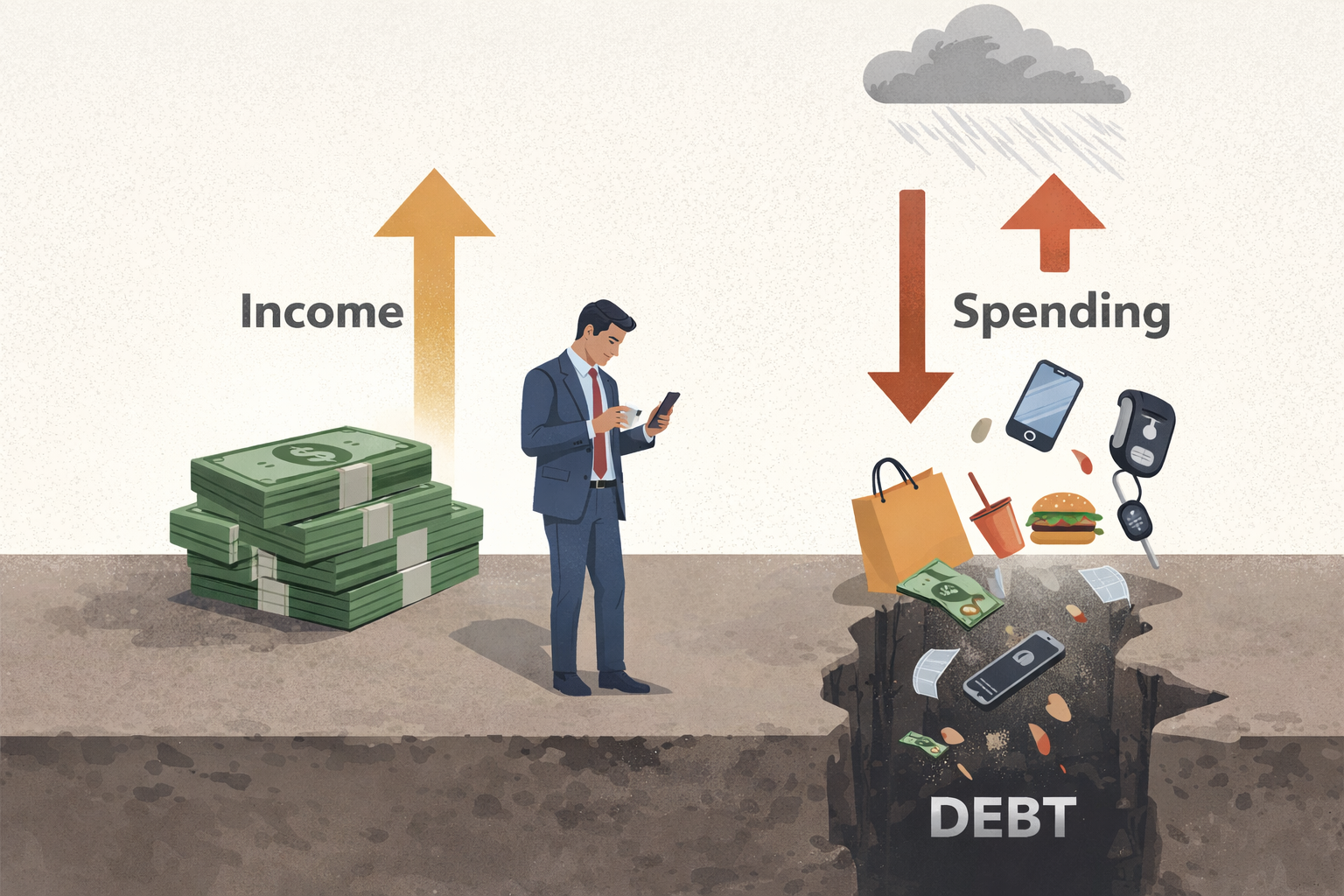
Understanding why people stay broke is not as simple as saying they don’t earn enough. There are people earning decent money every single month who still feel like they are constantly behind.
They are not reckless. They are not irresponsible. In fact, many of them are doing what they believe are the “right things.” They go to work, they earn consistently, and they try to manage their expenses.
And yet, the outcome rarely changes. The money comes in, it gets absorbed by life, and by the end of the month there is very little left to show for it.
This creates a cycle that feels almost impossible to escape. You earn, you spend, you reset. Then you do it again the next month, hoping that somehow things will improve over time.
So the real question is not just how to earn more money. The deeper question is this:
Why do so many people stay broke even when their income improves?
The answer is uncomfortable, but it is also empowering. Because once you understand what is really happening, you can actually change it.
Income Helps… But It Does Not Solve the Core Problem
When people first start earning more, there is a genuine sense of relief. It feels like things are finally going to open up. You imagine that more income will automatically create stability, breathing room, and maybe even progress.
And at first, it often does.
You are able to cover your bills more comfortably. You might stop stressing about small expenses. There is a sense that you are finally moving forward.
But then something subtle begins to happen, and most people do not notice it until it is too late.
Your lifestyle quietly expands to match your income.
You upgrade small things first. Better food, more convenience, a few extra subscriptions, slightly nicer experiences. None of these decisions feel irresponsible on their own. In fact, they often feel justified. After all, you are earning more now.
However, when these small upgrades stack on top of each other, they absorb your income almost completely.
This is what people refer to as lifestyle inflation. But calling it that almost makes it sound harmless. In reality, it is one of the main reasons financial progress stalls, even as income increases. According to research from Investopedia, lifestyle inflation is one of the key reasons people struggle to build long-term wealth despite increasing income.
If you never create space between what you earn and what you spend, then more income does not create wealth. It simply creates a more expensive version of the same situation.
Why People Stay Broke Without a Financial System
Most people do not actually have a financial system. They have income, they have expenses, but there is no structure connecting the two. Studies discussed by NerdWallet also show that lack of structure, not income, is often the biggest financial problem.
Money flows in, and then it flows out based on whatever feels urgent, necessary, or appealing at the time. There is no clear direction, only reaction.
This is why the common advice of “just save what’s left” rarely works in real life. Because in most cases, there is nothing left.
Spending naturally expands to fill available income. So if saving or investing happens last, it usually does not happen at all.
A more effective approach flips that order completely.
Instead of treating saving as an afterthought, it becomes a priority. You decide in advance what portion of your income goes toward your future, and you move that amount before anything else has a chance to claim it.
This is not about being restrictive. It is about being intentional. Without that intention, money will always drift toward immediate needs and short-term comfort.
This is one of the hidden reasons why people stay broke, even when their income increases over time.
Why People Stay Broke in the Consumption Trap
Another major factor is how money is used once it is earned.
A large portion of income goes toward things that feel productive or deserved, but do not actually build long-term value. These include constant upgrades, convenience spending, and recurring expenses that quietly accumulate over time.
None of these are inherently bad. The problem is not spending money. The problem is spending in a way that leaves nothing behind.
If every rand or dollar that comes in is immediately consumed, then there is nothing left to grow, nothing left to compound, and nothing left to create future income.
This is where the shift toward investing becomes important. Not as something complicated or intimidating, but as something consistent and deliberate.
If you are not sure how to start building that habit, you can read How to Invest in AI to see a practical example of how structured investing actually works in the real world.
The “I’ll Start Later” Mindset
One of the most common beliefs people hold is that financial discipline can wait.
They tell themselves they will start saving or investing once they earn more, once life settles down, or once things feel more stable.
The problem is that this moment almost never arrives.
Because habits do not suddenly improve when income increases. They tend to stay the same. In many cases, they actually become more expensive.
If you are used to spending everything at a lower income level, you are very likely to do the same at a higher income level, just with bigger numbers.
This is why starting small matters so much. It is not about the amount. It is about building the behaviour early enough that it scales with you instead of working against you.
A Practical Example That Puts It Into Perspective
Imagine two people earning the same income.
The first person spends almost everything they earn, upgrading their lifestyle gradually as their income grows. They feel comfortable, but they are always starting from zero at the end of each month.
The second person sets aside a small percentage from the beginning. It is not dramatic. It might only be 10% or even less. But it happens consistently, every single month.
After one year, the difference might not look massive. But after three, five, or ten years, the gap becomes significant.
Not because one person earned more, but because one person directed their money, while the other reacted to it.
This is the part many people underestimate. Wealth is not only about income. It is about what you consistently do with that income over time.
The Shift That Changes Everything
There is a simple shift in thinking that can completely change how you approach money.
Instead of asking, “What can I afford right now?” you begin asking, “What do I want this money to do for me over time?”
This question introduces direction.
It turns money from something you react to into something you actively use as a tool.
And once that shift happens, investing no longer feels optional. It becomes part of how you build stability and future flexibility.
Once you understand why people stay broke, you can begin to change the patterns that keep you stuck.
Final Thoughts: It’s Not Just About Earning More
It is easy to believe that the solution is simply to earn more. While income does matter, it is only one part of the equation.
Without structure, awareness, and consistency, higher income often leads to higher spending, not greater financial progress.
However, with the right approach, even a modest income can begin to build momentum over time.
That is where real change begins. Not in one big breakthrough, but in small, repeated decisions that start to compound quietly in the background.
And once that momentum builds, you are no longer just earning money.
You are building something with it.