
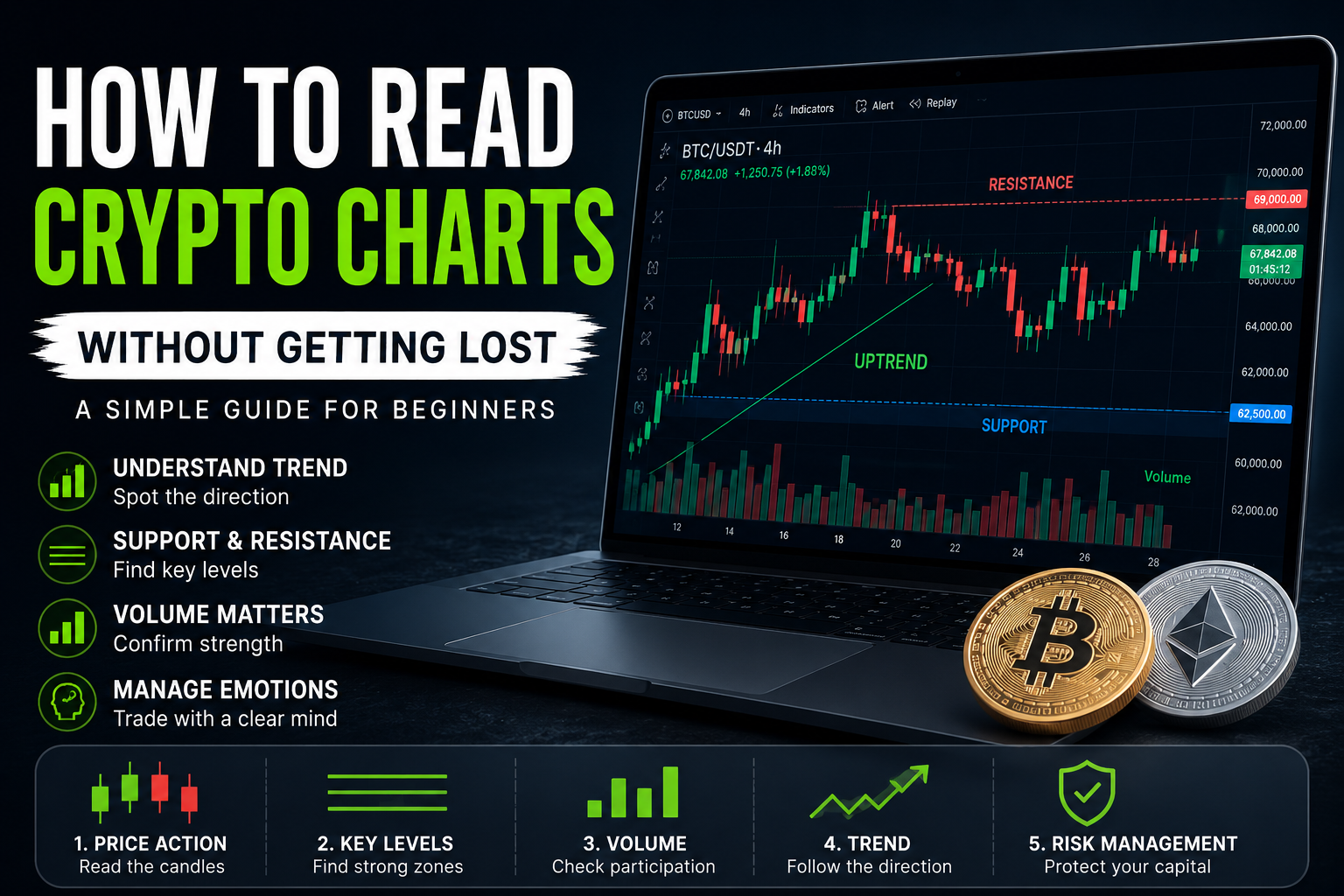
How to read crypto charts is one of the biggest challenges beginners face when entering crypto.
At first, charts feel chaotic.
Candles move aggressively. Prices rise and collapse within hours. Social media reacts emotionally to every move, and suddenly everyone online sounds like an expert.
For beginners, this becomes overwhelming very quickly.
That usually leads to two mistakes.
Some people avoid charts completely because they seem too complicated.
Others overload their screens with dozens of indicators they barely understand.
Neither approach helps.
The truth is, crypto charts become much easier once you stop trying to predict every move perfectly and start understanding how markets actually behave.
Because charts are not magic.
They are visual representations of human behaviour.
Fear.
Greed.
Panic.
Excitement.
Confidence.
Uncertainty.
All of it appears directly on the chart.
Once you understand that, crypto charts start making much more sense.
What Crypto Charts Really Show
Many beginners assume charts exist to predict the future perfectly.
That mindset creates frustration very quickly.
Charts are not crystal balls.
Instead, they help you understand:
- Market behaviour
- Momentum
- Liquidity
- Risk
- Participation
- Emotional reactions
That is a much healthier way to approach crypto investing.
For example, when price moves aggressively upward, the chart is not simply showing green candles.
It is showing rising excitement, aggressive buying pressure, increasing participation, and emotional momentum entering the market.
Likewise, sharp drops often reflect fear, panic selling, liquidations, and emotional reactions.
This is one reason experienced investors often remain calmer during volatility.
They understand what the chart is actually communicating.
Why Beginners Struggle With Crypto Charts
One of the biggest reasons beginners struggle is because they search for certainty.
They want charts to tell them exactly what happens next.
Unfortunately, markets do not work that way.
Crypto is probabilistic.
No setup works every time.
No indicator predicts the future consistently.
Even experienced traders lose trades.
The goal is not perfection.
The goal is improving decision-making and managing risk more intelligently over time.
That mindset shift changes everything.
Understanding Candlesticks Without Overcomplicating It
Candlesticks are the foundation of chart reading.
Fortunately, beginners do not need to memorise dozens of complicated patterns immediately.
Focus on understanding behaviour first.
What a candlestick represents
- The opening price
- The closing price
- The highest price reached
- The lowest price reached
Simple.
However, the shape of the candle tells a deeper story.
Large candles
Large candles usually show strong momentum or emotional participation.
A massive green candle often reflects excitement and aggressive buying pressure.
However, emotional candles can also become exhaustion moves.
This is where beginners often get trapped emotionally.
They see a large move and assume price will continue rising forever.
Meanwhile, experienced investors may already be reducing exposure into that excitement.
This connects directly to our earlier guide on exit liquidity in crypto.
Long candle wicks
Long wicks often show rejection or volatility.
For example, if price pushes upward aggressively but leaves a long upper wick, it may show sellers stepping in strongly.
That context matters more than memorising fancy candle names.
Support and Resistance: The Core of Chart Reading
Support and resistance are some of the most important concepts in crypto chart analysis.
Ironically, they are also among the simplest.
What is support?
Support is an area where buyers tend to step in.
Price often reacts there because demand increases.
What is resistance?
Resistance is an area where sellers tend to step in.
Price often struggles there because selling pressure increases.
Why this matters psychologically
Many beginners think support and resistance are exact lines.
They are not.
Markets usually react within zones rather than perfect levels.
Understanding this helps reduce emotional decision-making.
For example, beginners often panic sell directly into support after a small breakdown.
Meanwhile, calmer investors may recognise the broader structure is still intact.
Trend Matters More Than Prediction
Many beginners become obsessed with calling exact tops and bottoms.
That usually creates frustration.
Instead, focus on understanding trend.
Simple trend structure
- Higher highs and higher lows usually indicate an uptrend
- Lower highs and lower lows usually indicate a downtrend
This sounds simple because it is simple.
Crypto becomes dangerous when people overcomplicate obvious things.
A strong trend often continues longer than emotional investors expect.
Likewise, weak markets can remain weak longer than people hope.
Sometimes the smartest decision is simply respecting the broader direction of the market.
Volume: The Missing Piece Many Beginners Ignore
Volume measures participation.
In simple terms, it shows how much activity is happening during a move.
This matters because price alone does not tell the full story.
Simple example
Imagine Bitcoin breaks above resistance.
If volume is strong, the breakout may have conviction behind it.
However, if volume is weak, the move may struggle to sustain momentum.
This is why experienced investors study both price and participation.
Resources like TradingView make it easier to study chart structure and volume together.
Why Lower Timeframes Trap Beginners Emotionally
This is one of the biggest problems in crypto.
Many beginners constantly watch:
- 1-minute charts
- 5-minute charts
- 15-minute charts
That creates emotional chaos.
Lower timeframes contain large amounts of noise.
Price moves rapidly, fake breakouts happen constantly, and emotions become amplified.
A healthier beginner approach
Start with:
- 4-hour charts
- Daily charts
- Weekly charts
Higher timeframes usually provide cleaner structure and reduce emotional overtrading.
This alone can improve decision-making dramatically.
The Truth About Indicators
Many beginners assume profitable traders use dozens of indicators.
That belief creates cluttered charts and confusion.
Indicators are tools.
They are not magic answers.
What beginners often do
- Add RSI
- Add MACD
- Add Bollinger Bands
- Add moving averages
- Add random signals from YouTube
Eventually the chart becomes unreadable.
A better approach
Focus first on:
- Trend
- Price structure
- Support and resistance
- Volume
- Risk management
Those concepts already provide enormous value.
Indicators should support your thinking, not replace it.
Join the Weekly SPI Newsletter
Practical insights. Real opportunities. Zero fluff.
What Beginners Should Ignore
A lot of crypto content online creates unnecessary confusion.
Beginners should be careful about:
- Overconfident price predictions
- Guaranteed setups
- Influencers calling exact tops and bottoms
- Excessive leverage culture
- Constant low timeframe trading
- Charts overloaded with complexity
Complexity does not automatically equal intelligence.
In many cases, simple frameworks outperform emotional over-analysis.
How On-Chain Analysis Improves Chart Reading
This is where things become much more powerful.
Charts show price behaviour.
On-chain analysis shows capital behaviour.
Together, they provide stronger context.
For example:
- Charts may show a breakout forming
- Exchange outflows may be increasing
- Whale wallets may be accumulating quietly
- Stablecoins may be entering exchanges
That combination becomes far more meaningful than watching candles alone.
If you missed our previous guide, read:
You can also explore blockchain data platforms like Glassnode and CryptoQuant to better understand market behaviour.
The Emotional Side of Chart Reading
This is where many people struggle most.
Charts trigger emotions constantly.
Green candles create excitement.
Red candles create fear.
Fast moves create urgency.
That emotional pressure leads to poor decisions.
Common emotional mistakes
- Chasing pumps emotionally
- Panic selling during volatility
- Entering trades out of boredom
- Overtrading after losses
- Becoming addicted to chart watching
This is why emotional discipline matters more than complicated indicators.
Without emotional control, even strong analysis becomes difficult to execute properly.
A Simple Crypto Chart Reading Framework
Beginners often ask what they should actually look at before entering a trade or investment.
Keep it simple.
Before making decisions, ask:
- What is the overall trend?
- Where are key support and resistance zones?
- Is volume confirming the move?
- Am I chasing emotionally?
- What is the downside risk?
That framework already puts you ahead of many emotional market participants.
Risk Management Matters More Than Accuracy
This is one of the biggest mindset shifts in crypto.
Beginners often obsess over being right.
Experienced investors focus more on protecting capital.
Why?
Because even strong setups fail sometimes.
Risk management helps you survive long enough to keep learning.
Simple risk management ideas
- Avoid emotional position sizing
- Do not chase aggressive candles
- Think about downside before upside
- Accept uncertainty instead of fighting it
Good risk management reduces emotional pressure significantly.
The Goal Is Clarity, Not Complexity
One of the biggest misconceptions in crypto is that successful investors use extremely complicated systems.
That is not always true.
Many profitable investors use relatively simple frameworks consistently.
They focus on:
- Trend
- Liquidity
- Market behaviour
- Risk
- Patience
Simplicity creates clarity.
Clarity improves decision-making.
And better decisions usually matter more than complicated analysis.
Final Thoughts
Learning how to read crypto charts takes time.
However, it becomes much easier once you stop trying to master everything immediately.
Focus on understanding behaviour first.
Learn candles, trend, support and resistance, volume, and emotional control.
Then build gradually from there.
You do not need to become a professional trader overnight.
You simply need enough understanding to make calmer, more informed decisions.
That alone already separates you from many emotional market participants.