
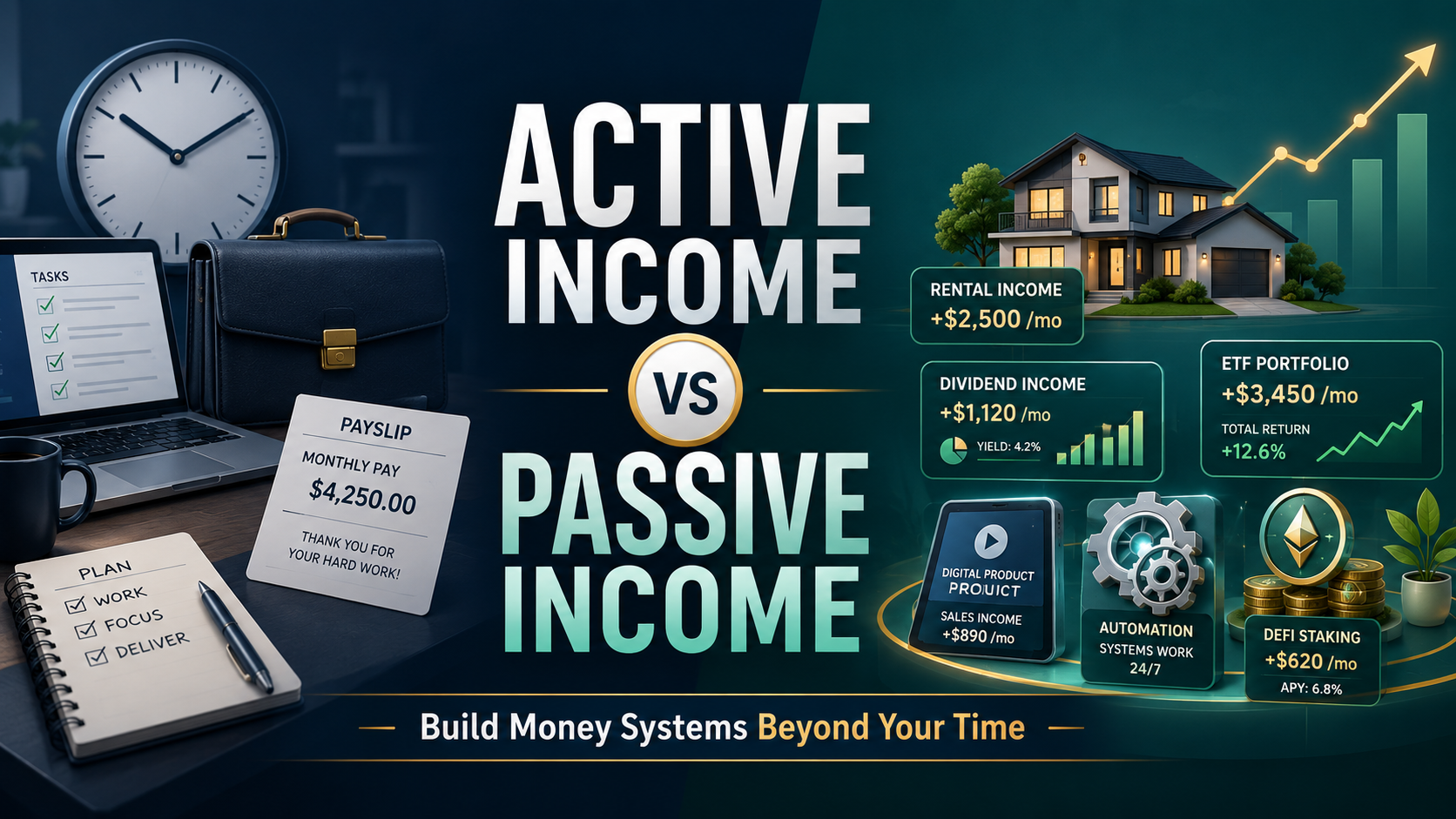
Active income vs passive income is one of the most important money concepts to understand if you want to build long-term financial freedom.
At first, the difference sounds simple.
Active income is money you earn by working directly.
Passive income is money that can continue after the main work, capital, or system has already been put in place.
However, that basic explanation does not tell the full story.
The real difference is not only about where money comes from. Instead, it is about how your time, skills, assets, and systems work together.
When you rely only on active income, your earning power is closely connected to your available hours. Once you stop working, the money often stops too.
With passive income, the goal is different. You are trying to build assets or systems that can keep producing value even when you are not actively working every minute.
Still, many beginners misunderstand the topic.
Passive income does not mean free money. More importantly, it does not mean income without effort or guaranteed returns.
In many cases, passive income starts with active work, upfront learning, capital, risk, patience, and ongoing maintenance.
That is why this guide matters.
In this SPI article, we are going to break down active income, passive income, and the practical path between the two. Along the way, we will look at jobs, freelancing, investing, ETFs, rental property, crypto, DeFi, digital products, content, and online income systems.
More importantly, we will separate real passive income thinking from hype.
Disclaimer: This article is for educational purposes only and does not constitute financial advice. Income examples are simplified and should be adapted to personal circumstances, tax rules, risk tolerance, and local regulations.
What Is Active Income?
Active income is money earned through direct work.
In simple terms, you give your time, skill, effort, or attention, and someone pays you for it.
This can include a salary, wages, commissions, freelance work, consulting fees, overtime, tips, or business income that depends heavily on your daily involvement.
For example, an employee earns a salary because they show up and perform a role. A freelancer earns money when they complete client work. A consultant earns income by selling expertise.
Similarly, a shop owner may earn business income. Yet, if the business depends completely on that owner being present every day, much of that income still behaves like active income.
Active income is not bad.
In fact, active income is often the starting point for wealth building.
It pays the bills, builds skills, creates investment capital, and teaches discipline. In addition, it can provide the foundation you need before building passive income streams.
The problem is not active income itself.
Instead, the problem begins when active income remains your only income source forever.
What Is Passive Income?
Passive income is income that continues after the main work, investment, or system has already been created.
Common examples include rental income, dividends, interest, royalties, digital product sales, automated online systems, certain business systems, and investment income.
In the crypto world, people may also talk about staking rewards, DeFi yield, stablecoin yield, or other blockchain-based income opportunities.
However, crypto income should be treated carefully because it often comes with higher risk and more technical complexity.
The key point is this:
Passive income usually requires something upfront.
That “something” may be money, time, skill, content, property, software, or a business system. In some cases, it may also be an investment portfolio that took years to build.
Once that foundation exists, the income may become less dependent on your daily effort.
That is the real attraction.
Passive income gives you the possibility of earning beyond your available hours.
Active Income vs Passive Income: The Simple Difference
The simplest way to compare active income vs passive income is to ask one question:
What happens if I stop working today?
If the income stops almost immediately, it is probably active income.
By contrast, if the income can continue because an asset, system, investment, or structure is already in place, it may be passive or semi-passive income.
| Income Type | How It Works | Main Limitation |
|---|---|---|
| Active income | You earn by directly working | Limited by time, energy, and availability |
| Passive income | An asset or system produces income | Requires upfront work, capital, risk, or maintenance |
| Semi-passive income | Some systems run partly on their own | Still needs management, updates, or oversight |
This table matters because many income streams are not fully passive.
For example, rental property needs maintenance, guest communication, repairs, cleaning, insurance, taxes, and management.
Dividend investing requires research, portfolio building, patience, and risk management.
Digital products need creation, marketing, updates, customer support, and traffic.
Meanwhile, crypto and DeFi income require platform research, wallet safety, smart contract awareness, and risk control.
Therefore, instead of asking, “Is this completely passive?” it is often better to ask:
How much time, capital, skill, and risk does this income stream require?
Passive Income Is Usually Built From Active Income
One of the biggest truths about passive income is that it usually starts with active income.
This is where beginners often get misled.
They see the final result, but they do not see the foundation.
For instance, someone may see a property investor earning rental income. However, they may not see the years of saving for a deposit, learning property markets, dealing with maintenance, managing guests, or paying expenses.
Another person may see dividend income and assume it was easy. Yet, behind that income there may be years of contributions, market volatility, research, and patience.
A creator selling digital products may look like they are earning while they sleep. Behind the scenes, though, that person may have spent hundreds of unpaid hours building content, creating trust, testing offers, and learning marketing.
In crypto, the same pattern appears. People may notice attractive yield, but they often miss the protocol risk, smart contract risk, depeg risk, liquidation risk, exchange risk, wallet risk, and regulatory uncertainty.
As a result, passive income is often the reward for active effort that was invested earlier.
That is not a bad thing.
It simply means you should not feel discouraged if your first step is active work. In fact, active income can become the fuel that builds passive income later.
Join the Weekly SPI Newsletter
Practical insights. Real opportunities. Zero fluff.
Why Active Income Still Matters
Active income gets criticized too easily in passive income conversations.
That is a mistake.
A strong salary, freelance income, business income, or professional skill can give you options.
For example, it can help you pay off debt, build an emergency fund, invest consistently, avoid desperate decisions, and take calculated risks without threatening your basic survival.
For many people, the goal should not be to hate active income.
A better goal is to use active income wisely.
Active income can fund assets.
Over time, those assets can create passive income.
Eventually, passive income can create more freedom.
That is the bridge.
When you understand this, your job or business becomes more than a way to pay bills. Instead, it becomes a tool for building future income systems.
The Four Building Blocks of Passive Income
Most passive income streams are built from four main ingredients.
1. Capital
Capital means money you can invest.
Examples include buying ETFs, investing in dividend-paying shares, purchasing rental property, providing liquidity, staking crypto, or funding a business system.
Capital-based passive income can be powerful. However, it usually requires patience and risk management because investments can rise and fall in value.
2. Skills
Skills can also become income-producing assets.
Writing, design, coding, marketing, video editing, financial education, property management, and sales can all be used to build systems.
At first, a skill may create active income. Later, that same skill can help you build products, content, courses, tools, communities, or businesses.
3. Assets
An asset is something that can produce value.
This could be property, shares, ETFs, crypto assets, intellectual property, a website, a YouTube channel, a digital product, a newsletter, or a business process.
The stronger the asset, the less you may need to rely only on hours worked.
4. Systems
Systems make income more repeatable.
A system could be a booking process for a rental property, an email sequence for a digital product, a content workflow, an investment contribution plan, or a business process that does not require constant personal involvement.
Without systems, many “passive income” ideas become stressful side jobs.
Examples of Active Income
Active income is easy to recognize once you know what to look for.
- Salary from employment
- Hourly wages
- Overtime pay
- Freelance writing
- Graphic design client work
- Consulting
- Coaching sessions
- Sales commissions
- Manual service work
- A business that depends entirely on the owner showing up daily
These income streams can be valuable.
They are especially useful when they help you build savings, reduce debt, improve skills, and invest consistently.
However, active income usually depends heavily on your time.
If your time is the only engine, your income has a ceiling.
Examples of Passive and Semi-Passive Income
Passive income can look different depending on your skills, country, capital, and risk tolerance.
Common examples include:
- Rental property income
- Dividend income
- ETF growth and distributions
- Interest from savings or fixed-income products
- Royalties from books, music, or intellectual property
- Digital product sales
- Affiliate income from content
- Online courses
- Software subscriptions
- Automated business systems
- Crypto staking rewards
- DeFi yield strategies
Some of these are more passive than others.
For example, owning a diversified ETF portfolio may require less daily work than managing a short-term rental property.
Nevertheless, the ETF still requires investment decisions, contributions, patience, and risk management.
A rental property may produce income while you sleep. However, repairs, vacancies, guest issues, maintenance, cleaning, insurance, taxes, and platform rules still matter.
That is why it is often more honest to call many income streams semi-passive.
Where Investing Fits Into Passive Income
Investing is one of the most common paths toward passive income.
When you invest, your goal is to put money into assets that may grow, pay income, or do both over time.
Examples include ETFs, shares, bonds, money market funds, real estate investment trusts, retirement funds, and certain crypto assets.
Investor.gov provides helpful education on compound interest and long-term investing tools. Their compound interest calculator is useful for understanding how contributions and time can affect future growth: Investor.gov Compound Interest Calculator.
The power of investing is not only that money can grow.
Instead, the real power is that growth can begin to build on itself.
When returns are reinvested, your money may start working on top of previous growth. That is the basic idea behind compounding.
Compounding is not guaranteed, and markets can move down as well as up. Still, the concept explains why time, consistency, and patience matter so much in wealth building.
Related SPI reads:
- Best ETFs for Beginners in 2026
- How Much Do You Need to Retire in South Africa?
- How to Take Profits in Crypto Without Regret
Where Real Estate Fits Into Passive Income
Real estate is one of the classic passive income examples.
Rental income can be powerful because property can produce monthly cash flow while also potentially appreciating over time.
That said, real estate is rarely completely passive.
Long-term rentals may require tenant screening, maintenance, insurance, municipal costs, repairs, legal compliance, and vacancy planning.
Short-term rentals may require even more operational effort. Guest communication, cleaning, reviews, pricing, platform rules, security, maintenance, and occupancy management all matter.
Therefore, real estate can be an excellent income system, but it should be treated like a business, not a magic money machine.
For South African readers, tax also matters. SARS explains that rental income from residential accommodation is subject to income tax. You can read their official page here: SARS: Tax on Rental Income.
A practical rental property plan should include:
- Expected rental income
- Bond or financing costs
- Rates and utilities
- Maintenance budget
- Insurance
- Vacancy periods
- Cleaning or management costs
- Taxes
- Platform fees for short-term rentals
- Emergency repairs
When people ignore these costs, rental income looks better on paper than it feels in real life.
A proper passive income plan counts the expenses before celebrating the income.
Where Crypto Fits Into Passive Income
Crypto has created new income opportunities, but it has also created a lot of confusion.
Some crypto income ideas can look passive from the outside.
Examples include staking, lending, liquidity pools, stablecoin yield, token rewards, node rewards, and DeFi strategies.
However, crypto income often carries risks that beginners underestimate.
- Token price volatility
- Smart contract exploits
- Protocol failure
- Liquidity risk
- Stablecoin depeg risk
- Exchange risk
- Wallet security risk
- Regulatory risk
- Unsustainable token emissions
In South Africa, crypto assets have also become part of a more formal regulatory conversation. The Government Gazette notice declared crypto assets as financial products under the Financial Advisory and Intermediary Services Act framework. You can view the declaration here: Declaration of a Crypto Asset as a Financial Product.
This does not mean crypto is bad.
Rather, it means crypto income should be approached with research and risk awareness.
SPI has covered this in more detail here:
- 10-Step DeFi Safety Checklist
- Stablecoins Explained
- Exit Liquidity in Crypto
- Crypto Bull Market Mistakes
Crypto can play a role in a passive income strategy for some investors, but it should not replace common sense.
If you do not understand where the yield comes from, you do not understand the risk.
Where Digital Products and Content Fit In
Digital products are another powerful passive income category.
Examples include ebooks, templates, online courses, paid communities, software tools, newsletters, YouTube content, affiliate content, and downloadable resources.
This type of income can be attractive because the product can be created once and sold many times.
However, the income is not automatic.
You need a useful product. In addition, you need an audience, trust, traffic, customer support, updates, marketing, and consistent content.
A digital product without distribution is just a file sitting online.
That is why content-based passive income often starts as active work.
You create articles, videos, guides, tutorials, social posts, and educational resources. Over time, those assets can build traffic and trust. Eventually, some of that traffic may support income through products, services, affiliate links, advertising, sponsorships, or subscriptions.
This is one of the reasons financial literacy content matters.
The OECD highlights financial education as an important part of helping people make better money decisions. You can view their financial education topic page here: OECD: Financial Education.
Good content is not only about making money.
It can also help people avoid bad decisions.
The Passive Income Ladder
Building passive income becomes easier when you think in stages.
You do not need to jump from zero to financial freedom overnight.
A more practical path looks like this:
| Stage | Main Focus | Example |
|---|---|---|
| Stage 1 | Earn active income | Job, freelancing, consulting, business work |
| Stage 2 | Stabilize your finances | Budget, emergency fund, debt reduction |
| Stage 3 | Build capital | Save and invest consistently |
| Stage 4 | Buy or build assets | ETFs, rental property, digital products, content |
| Stage 5 | Create systems | Automation, management, processes, reinvestment |
| Stage 6 | Scale carefully | Diversify income streams and reduce dependence on one source |
This ladder is simple, but it is realistic.
Many people want stage six results while skipping stages one to three.
As a result, they often run into frustration, scams, or risky decisions.
Financial strength is built in layers.
Why “Easy Passive Income” Is Usually a Red Flag
Whenever someone promises easy passive income, slow down.
Real income has a source.
Rental income comes from tenants or guests. Dividends come from company profits. Interest comes from lending money or holding certain financial products.
Digital product income comes from customers.
Similarly, DeFi yield comes from a mechanism inside a protocol.
If someone cannot explain where the income comes from, that is a problem.
Be especially careful when an opportunity includes:
- Guaranteed returns
- Pressure to act quickly
- Vague explanations
- Unusually high yields
- No clear risk disclosure
- Heavy referral incentives
- No real product or service
- Complicated language used to avoid simple answers
Passive income should make you curious, not careless.
The more exciting an opportunity sounds, the more calmly you should research it.
Active Income vs Passive Income in Real Life
Let us make this practical.
Imagine someone earns R25,000 per month from active income.
At first, most of that income may go toward living costs, transport, debt, food, family responsibilities, and emergencies.
Nothing feels passive yet.
Then the person starts improving the system.
They reduce high-interest debt. After that, they build a small emergency fund. Next, they start investing R1,000 per month. Later, they increase contributions. Over time, those investments begin to grow.
Maybe they also build a side income skill.
That skill becomes freelance income. Some of the freelance income goes into ETFs. Another portion helps fund a small digital product. Later, the digital product starts producing occasional sales.
After a few years, the person may have:
- A salary
- A small investment portfolio
- Some dividend or distribution income
- A digital product
- A small emergency fund
- Better financial habits
That is not overnight success.
Instead, it is a system forming over time.
This is how passive income often works in real life. It starts slowly, then becomes more meaningful as the assets and systems improve.
The Role of Reinvestment
Reinvestment is one of the most important parts of building passive income.
If every bit of income gets spent immediately, the system may not grow.
However, when some income gets reinvested, the system has a chance to compound.
For example, dividends can buy more shares. Rental profits can fund maintenance, upgrades, or another property deposit. Digital product income can pay for better tools, design, marketing, or content production.
Crypto profits can also be handled carefully. Instead of chasing the next risky trade, part of the profit might move into stablecoins, fiat, ETFs, emergency savings, or other long-term goals.
This connects closely to the SPI article on crypto profit-taking strategy.
Profit becomes more powerful when it has a purpose.
How to Start Building Passive Income as a Beginner
Beginners often overcomplicate passive income.
You do not need ten income streams on day one.
A better starting point is to build one strong foundation.
Step 1: Understand Your Current Active Income
Start by looking at what you earn now.
How stable is it?
Can you increase it?
Do you have skills that could raise your income over time?
Could a side income help you build capital faster?
Step 2: Reduce Financial Leaks
Before chasing passive income, check where money is leaking.
High-interest debt, unnecessary subscriptions, lifestyle inflation, and poor planning can destroy progress.
Passive income cannot fix bad money habits on its own.
Step 3: Build a Basic Safety Buffer
An emergency fund gives you breathing room.
Without a buffer, you may be forced to sell investments at the wrong time or take desperate risks.
Step 4: Start Investing Consistently
Consistent investing can help you build capital over time.
This might include ETFs, retirement products, savings vehicles, or other suitable investments depending on your personal situation.
Step 5: Choose One Income System to Build
Do not chase everything at once.
Pick one system you can understand and manage.
That might be an investment portfolio, a rental property plan, a digital product, a content platform, or a carefully researched crypto strategy.
Step 6: Learn Before You Scale
Small experiments can teach valuable lessons.
Scaling too early can turn small mistakes into expensive ones.
Start carefully, track results, and improve the system before putting more money or time into it.
Best Passive Income Ideas by Skill Level
Not every passive income idea suits every beginner.
Some require capital. Others require skills. A few require both.
| Idea | Best For | Difficulty | Main Risk |
|---|---|---|---|
| High-interest savings or money market products | Beginners building safety | Low | Inflation and lower returns |
| ETFs | Long-term investors | Low to medium | Market volatility |
| Dividend shares | Investors who can research companies | Medium | Company and market risk |
| Rental property | People with capital and management ability | Medium to high | Vacancy, maintenance, financing, tax |
| Digital products | Creators and educators | Medium | No traffic or poor product-market fit |
| Affiliate content | Content creators | Medium | Traffic dependence and trust risk |
| Crypto staking or DeFi | Risk-aware crypto users | High | Volatility, platform, and smart contract risk |
This table is not a recommendation.
Rather, it is a way to think clearly about fit.
A good passive income idea for one person may be a bad fit for someone else.
The Real Goal: Income Systems, Not Random Income Streams
Many people collect income ideas without building income systems.
That creates confusion.
One month they are interested in crypto staking. The next month they want rental property. Then they want dropshipping, ETFs, affiliate marketing, trading, dividend stocks, and online courses.
Curiosity is good.
Constant jumping is not.
An income system has structure.
It has a purpose, a process, rules, risk management, and a way to measure progress.
For example, an ETF system may include monthly contributions, annual reviews, diversification rules, and a long-term goal.
A rental system may include pricing, guest screening, maintenance budgets, cleaning processes, insurance, and tax records.
A content system may include keyword research, publishing schedules, email capture, monetization, and trust-building.
Meanwhile, a crypto system may include asset selection rules, wallet security, profit-taking, stablecoin management, and DeFi risk checks.
The system matters more than the idea.
Final Thoughts
Active income vs passive income is not really about choosing one and rejecting the other.
Instead, it is about understanding how they work together.
Active income helps you survive today.
Used wisely, it can also fund the assets that support tomorrow.
Passive income can create more freedom, but it usually starts with active effort, capital, learning, and patience.
The goal is not to chase easy money.
Instead, the goal is to build money systems that become less dependent on your daily time.
That may start with a salary. It may grow through investing. Later, it may expand through property, content, digital products, crypto, DeFi, or business systems.
Whatever path you choose, the principle stays the same:
Build assets. Understand risk. Create systems. Stay patient.
That is how passive income becomes more than a buzzword.
It becomes a real financial strategy.