
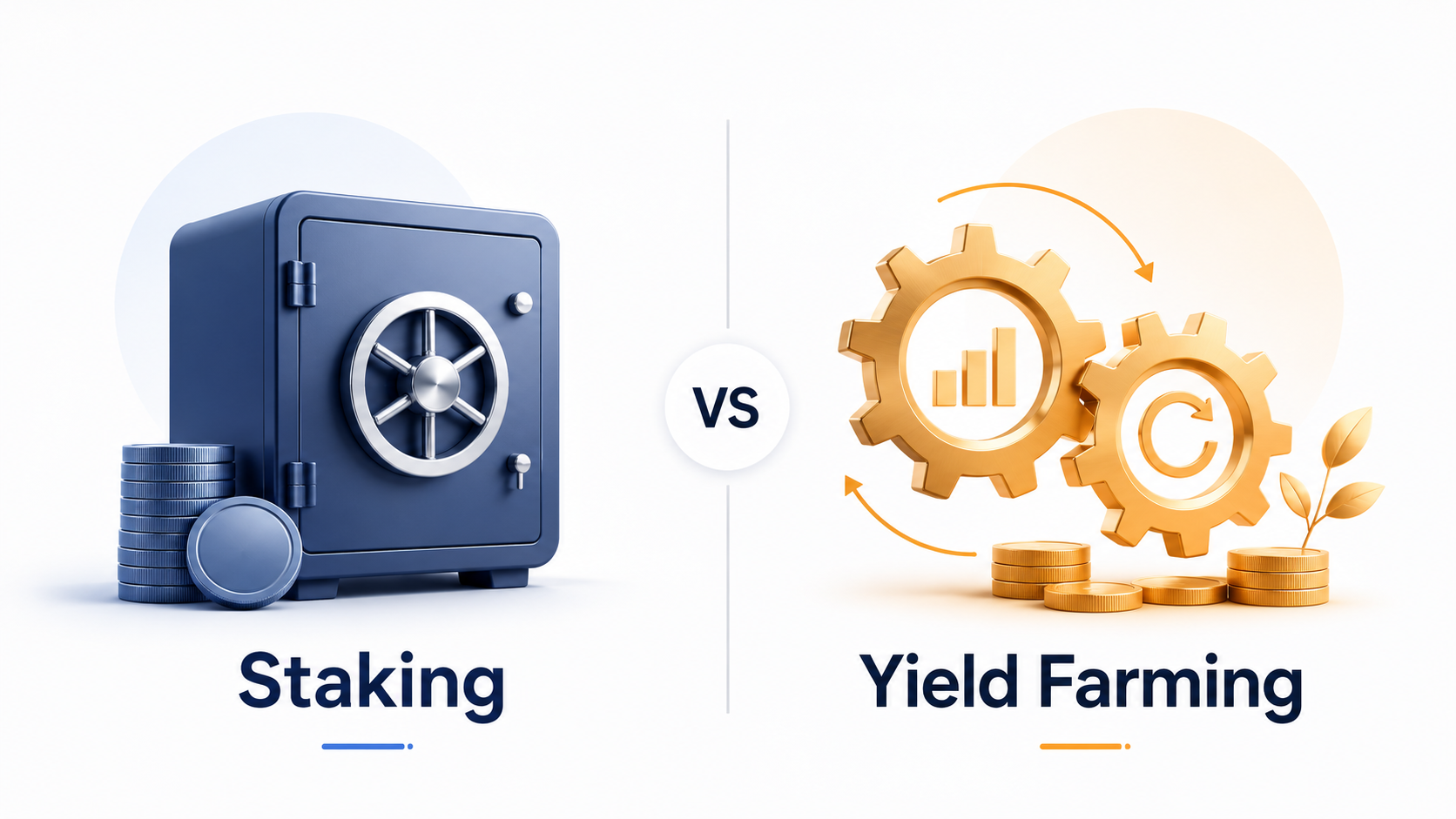
Staking vs farming is one of the first DeFi comparisons beginners need to understand before trying to earn yield from crypto assets.
At first, staking and farming can look similar because both may offer rewards.
Both can appear on DeFi dashboards.
Both can involve locking or depositing crypto assets.
Both are often discussed in passive income conversations.
However, staking and farming are not the same thing.
Staking usually helps secure a blockchain network or support a specific protocol mechanism. Yield farming usually involves moving assets into DeFi opportunities such as liquidity pools, lending markets, vaults, or incentive programs to earn rewards.
That difference matters because the risk is different.
A beginner who treats staking and farming as the same thing may misunderstand where rewards come from, what can go wrong, and how much attention the strategy requires.
This guide will explain staking vs farming in a practical way. You will learn what staking is, how yield farming works, why liquidity pools matter, what impermanent loss means, how rewards are generated, and how beginners can compare both approaches without getting overwhelmed.
This article also connects naturally with other Simple Passive Income guides, including the DeFi Essentials Guide, 10-Step DeFi Safety Checklist, DeFi Lending Protocols Explained, and Best On-Chain Crypto Tools.
Why Staking vs Farming Matters for Beginners
Many beginners enter DeFi by looking for the highest APY.
That is understandable.
A dashboard showing 4%, 12%, 30%, or 80% can immediately grab attention.
However, the displayed APY is only the surface.
The more important question is where the reward comes from.
Staking rewards may come from network issuance, transaction fees, validator rewards, protocol incentives, or a combination of these depending on the asset and setup.
Farming rewards may come from trading fees, lending interest, token incentives, liquidity incentives, or automated vault strategies.
Those sources are not equal.
A staking reward on a major proof-of-stake network is different from a farming reward paid in a new token from a new DeFi protocol.
That does not automatically make one good and the other bad.
It simply means beginners need to compare the engine behind the reward, not only the number shown on the screen.
That is why staking vs farming deserves a full beginner-friendly breakdown.
What Is Staking?
Staking is the process of locking, delegating, or committing crypto assets to support a blockchain network or protocol process.
Most people associate staking with proof-of-stake blockchains.
In a proof-of-stake network, validators help secure the blockchain, process transactions, and maintain consensus. In return, the network may reward validators and delegators according to its rules.
Ethereum explains staking as depositing ETH to activate validator software, which helps secure the network. You can learn more from the official Ethereum staking page here: Ethereum staking.
For beginners, the simple explanation is this:
Staking is usually about helping support a network or protocol and receiving rewards for that participation.
Different staking systems work differently.
Some require running validator infrastructure.
Others allow delegation, where users delegate tokens to a validator without running the validator themselves.
Liquid staking platforms may issue a token that represents the staked position.
Because staking can take different forms, beginners should always understand the exact staking method before committing funds.
A Simple Staking Example
Imagine Thabo owns a proof-of-stake crypto asset.
He wants to hold it long term and is not planning to trade it daily.
Instead of leaving the asset idle in his wallet, he studies whether the asset can be staked.
If the network allows delegation, Thabo may delegate his tokens to a validator.
The validator helps secure the network.
If the validator performs properly, Thabo may receive staking rewards over time.
This sounds simple, but several details matter.
Thabo needs to understand whether the tokens are locked, how long unstaking takes, what fees the validator charges, whether slashing exists, and how reward rates may change.
He also needs to remember that staking rewards are paid in crypto assets.
If the token price falls sharply, the staking reward may not offset the drop in asset value.
This is one of the first staking lessons beginners should learn:
Earning more tokens does not automatically mean your portfolio value increases.
What Is Yield Farming?
Yield farming is the process of placing crypto assets into DeFi strategies to earn rewards.
Those strategies may include liquidity pools, lending markets, incentive programs, vaults, or other smart contract-based opportunities.
Yield farming is usually more active and more complex than basic staking.
Instead of simply supporting a network, the user may be providing liquidity, taking smart contract risk, accepting token price risk, managing impermanent loss, collecting rewards, or moving between opportunities as conditions change.
One common form of yield farming happens through decentralized exchanges.
On a decentralized exchange, users can supply tokens to liquidity pools so other people can trade. In return, liquidity providers may earn a share of trading fees and sometimes additional token incentives.
Uniswap, one of the most well-known decentralized exchange protocols, provides documentation about how its protocol and liquidity pools work. You can read more here: Uniswap documentation.
The simple explanation is this:
Yield farming is usually about putting assets into DeFi markets to earn rewards from trading fees, lending demand, incentives, or strategy activity.
A Simple Yield Farming Example
Imagine Lerato has USDC and ETH.
She decides to provide liquidity to an ETH and USDC pool on a decentralized exchange.
The pool needs both assets because traders use it to swap between ETH and USDC.
Lerato deposits both tokens into the pool.
When traders use that pool, they pay swap fees.
A portion of those fees may go to liquidity providers like Lerato.
At first, this sounds attractive.
However, Lerato is not simply earning a passive reward.
She is taking a liquidity provider position.
The value of ETH can change compared to USDC.
The pool can rebalance as traders buy and sell.
Fees may rise or fall depending on trading volume.
In addition, the smart contract itself must function properly.
This is why yield farming requires more active understanding than simple staking.
Staking vs Farming: The Core Difference
The core difference between staking vs farming is the role your assets play.
With staking, assets usually help support a blockchain network, validator system, or protocol process.
With farming, assets usually help provide liquidity, support DeFi market activity, or participate in incentive structures.
That difference changes the risk.
Staking risk often includes token price risk, validator risk, slashing risk, lock-up periods, and platform risk if a third-party service is used.
Farming risk can include smart contract risk, impermanent loss, reward token risk, liquidity risk, market volatility, and strategy complexity.
| Category | Staking | Farming |
|---|---|---|
| Main purpose | Support a blockchain or protocol process | Provide liquidity or participate in DeFi strategies |
| Reward source | Network rewards, fees, or protocol incentives | Trading fees, lending interest, token rewards, or vault strategies |
| Beginner difficulty | Usually easier to understand | Usually more complex |
| Main risk | Token price, lock-up, validator, and slashing risk | Impermanent loss, smart contract, liquidity, and reward token risk |
| Management level | Can be lower maintenance | Often requires more monitoring |
| Best beginner use | Learning how proof-of-stake participation works | Learning how DeFi liquidity and incentives work |
This table shows why staking vs farming should not be treated as one decision based only on APY.
The better comparison is based on understanding, risk, maintenance, reward source, and personal experience level.
How Staking Rewards Are Generated
Staking rewards depend on the design of the network or protocol.
In many proof-of-stake systems, rewards may come from new token issuance, transaction fees, priority fees, or other network-level reward mechanisms.
The exact model depends on the blockchain.
This is why a staking rate should not be viewed in isolation.
Beginners should ask several questions before staking.
- Where do the staking rewards come from?
- Are rewards paid from new token issuance?
- Are fees part of the reward?
- Is there a lock-up or unstaking period?
- Can the validator be penalized?
- Does the staking platform charge fees?
- What happens if the token price falls?
These questions help beginners understand the reward source.
They also prevent the common mistake of assuming a staking reward is similar to a bank interest rate.
Staking is crypto-native participation, not a guaranteed savings account.
How Farming Rewards Are Generated
Farming rewards usually come from DeFi market activity or protocol incentives.
For example, a liquidity pool may generate trading fees when users swap tokens.
A lending market may generate interest when borrowers pay to access liquidity.
A protocol may also distribute extra rewards to attract users and liquidity.
That last point is important.
Sometimes farming APY looks high because the platform is paying users with reward tokens.
If those reward tokens fall in value, the real return can change quickly.
In other cases, farming returns may depend heavily on trading volume or borrowing demand.
If activity slows, rewards may fall.
Before farming, beginners should ask:
- Does the yield come from real trading fees?
- Does it come from borrower interest?
- Does it depend on token incentives?
- Is the reward token liquid?
- Can the APY drop quickly?
- What happens if users leave the pool?
These questions are not negative.
They are practical.
Yield farming can be educational, but it should not be approached blindly.
The Biggest Farming Risk: Impermanent Loss
Impermanent loss is one of the most important concepts in yield farming.
It usually affects liquidity providers who deposit two or more assets into a liquidity pool.
Impermanent loss happens when the price relationship between the deposited assets changes after you enter the pool.
The pool automatically rebalances as traders interact with it.
As a result, your final position may be worth less than simply holding the original tokens separately.
The word “impermanent” can be confusing.
The loss may be called impermanent because it depends on price movement and may change if prices return to the original ratio.
However, once you withdraw from the pool, the result becomes real.
That is why beginners should not ignore it.
Impermanent Loss Example in Simple Numbers
Let us use a simple example.
Imagine a pool contains ETH and USDC.
You deposit 1 ETH and 100 USDC when 1 ETH is worth 100 USDC.
At the time of deposit, your total value is 200 USDC.
Now imagine ETH rises from 100 USDC to 400 USDC.
If you had simply held 1 ETH and 100 USDC in your wallet, your position would now be worth 500 USDC.
The 1 ETH would be worth 400 USDC, and the 100 USDC would still be 100 USDC.
Inside a liquidity pool, the position behaves differently.
As traders buy ETH from the pool, the pool rebalances.
You may end up with less ETH and more USDC than you started with.
Your position may still increase in value, but it may be worth less than simply holding the original assets.
This difference is the impermanent loss effect.
Trading fees may help reduce or offset the impact.
In some cases, fees may be enough to make liquidity provision worthwhile.
In other cases, fees may not compensate for the difference.
This is why farming requires more research than simply looking at the APY.
Staking Risk: What Beginners Should Understand
Staking is often viewed as the simpler option, but it still carries risk.
Beginners should understand the main staking risks before committing assets.
Token Price Risk
The token being staked can fall in value.
If you earn 5% in staking rewards but the token price falls 40%, the reward does not protect you from the overall decline.
Lock-Up or Unstaking Risk
Some staking systems require an unstaking period.
During that time, you may not be able to move or sell the asset immediately.
This matters during volatile markets.
Validator Risk
If you delegate to a validator, the validator’s performance matters.
A poor validator may reduce rewards, miss blocks, or create other problems depending on the network.
Slashing Risk
Some networks penalize validators for certain failures or bad behaviour.
This is known as slashing.
Delegators may be affected depending on the network rules.
Platform Risk
If you stake through a third-party service, liquid staking platform, or exchange, you also rely on that service.
That adds another layer beyond the blockchain itself.
This is why beginners should understand whether they are staking directly, delegating, using liquid staking, or staking through a centralized platform.
Farming Risk: What Beginners Should Understand
Yield farming can offer interesting opportunities, but it usually has more moving parts than staking.
Beginners should understand the main farming risks before depositing assets into any strategy.
Impermanent Loss
Liquidity providers can perform worse than simply holding the original tokens if prices move significantly.
This is one of the biggest risks in liquidity pool farming.
Smart Contract Risk
Farming usually involves smart contracts.
If the contract has a bug or exploit, funds can be at risk.
Audits help, but they do not remove all risk.
Reward Token Risk
Some farms pay rewards in a protocol token.
If that token falls in value, the displayed APY may become less meaningful.
Liquidity Risk
It may be difficult to exit a small or weak pool at a fair price.
Low liquidity can also increase slippage.
Strategy Complexity
Some farms involve multiple steps, vaults, bridges, reward claims, auto-compounding, or token conversions.
Each extra step can add another layer of risk.
For beginners, simple strategies are easier to understand than complicated ones.
Staking vs Farming: Which One Is Easier for Beginners?
For most beginners, staking is usually easier to understand than farming.
That does not mean staking is risk-free.
It simply means the basic staking model can be more straightforward.
A user holds an asset, stakes or delegates it, and may receive rewards if the system performs as expected.
Farming often requires more active understanding.
The user may need to understand liquidity pools, token pairs, impermanent loss, trading fees, reward emissions, pool depth, smart contract risk, and exit timing.
That can be a lot for someone new to DeFi.
A practical beginner path may look like this:
- Learn wallet security first.
- Understand staking basics.
- Study stablecoins and decentralized exchanges.
- Learn how liquidity pools work.
- Study impermanent loss with examples.
- Explore farming only after the mechanics make sense.
This path allows beginners to build knowledge gradually.
It also reduces the chance of treating DeFi like a guessing game.
When Staking May Make More Sense
Staking may make more sense when a user already wants to hold the asset long term and understands the staking rules.
For example, someone who believes in a proof-of-stake network may decide to stake instead of leaving the token idle.
That person should still understand validator selection, lock-up periods, reward variability, and token price risk.
Staking may be more suitable for beginners who want a simpler introduction to crypto rewards.
However, the decision should still begin with research.
A reward percentage alone is not enough.
The asset quality, network design, staking process, and user’s own risk tolerance all matter.
When Farming May Make More Sense
Farming may make more sense for users who understand DeFi mechanics and are comfortable managing more active positions.
A person who understands liquidity pools, token pairs, trading fees, impermanent loss, and smart contract risk may choose to farm with a carefully researched strategy.
For example, an experienced user may provide liquidity to a large, established pool with strong trading volume and clear risk assumptions.
Even then, farming should be monitored.
Pool returns can change.
Token prices can move.
Incentives can end.
Fees can rise or fall.
Smart contract or platform conditions can change.
That is why farming is usually not a true set-and-forget strategy.
How to Compare Staking vs Farming Before Depositing Funds
Before choosing between staking vs farming, beginners should use a simple comparison checklist.
| Question | Why It Matters |
|---|---|
| Where do the rewards come from? | Shows whether rewards come from network activity, fees, incentives, or another source. |
| What asset am I exposed to? | Helps you understand token price risk. |
| Can I exit easily? | Reveals lock-up, unstaking, liquidity, or withdrawal issues. |
| What can go wrong? | Forces you to think beyond the APY number. |
| How much monitoring is required? | Shows whether the strategy is low-maintenance or active. |
| Do I understand the platform? | Protects beginners from using tools they cannot explain. |
| Have I tested with a small amount? | Allows learning before committing meaningful funds. |
This checklist will not guarantee success.
However, it helps beginners slow down and think clearly.
That is often the difference between learning DeFi and rushing into unnecessary mistakes.
Want more beginner-friendly DeFi breakdowns like this? Join the Simple Passive Income newsletter for practical guides on staking, farming, wallets, stablecoins, DeFi tools, and safer crypto habits.
Join the Weekly SPI Newsletter
Practical insights. Real opportunities. Zero fluff.
A Beginner Scenario: Choosing Between Staking and Farming
Imagine Naledi is new to DeFi.
She has been learning about wallets, stablecoins, and decentralized exchanges.
Now she wants to understand staking vs farming.
Her first option is staking a token she already plans to hold.
The process looks simple, but she checks the unstaking period, validator fees, reward history, and token price risk before doing anything.
Her second option is farming in a liquidity pool.
The APY looks higher, but the pool requires two assets.
She studies trading volume, pool depth, impermanent loss, smart contract risk, and whether rewards are paid in a separate incentive token.
After comparing both options, Naledi realizes something important.
The higher APY is not automatically the better choice.
For her current knowledge level, staking may be easier to understand.
Farming may still be worth learning, but she decides to study it more before depositing funds.
This is a strong beginner decision.
Not because staking is always better.
Rather, because Naledi chose the strategy she understood better.
Useful Tools for Researching Staking and Farming
Beginners should not rely only on social media posts or screenshots when researching DeFi yield.
Good research requires better tools.
DeFiLlama
DeFiLlama is a widely used DeFi data platform that helps users track total value locked, protocols, chains, yields, and ecosystem activity.
It can help beginners compare DeFi protocols and understand where liquidity is moving.
Official Protocol Documentation
Before using any staking or farming platform, read the official documentation.
Documentation can explain how rewards work, what risks exist, and how the protocol is designed.
Block Explorers
Block explorers allow users to verify transactions, wallet activity, token contracts, and smart contract interactions.
This helps beginners move beyond screenshots and marketing claims.
SPI On-Chain Tool Guide
The SPI guide on Best On-Chain Crypto Tools can help beginners learn which tools are useful for tracking wallets, protocols, liquidity, and blockchain activity.
Better tools do not remove risk.
They simply help users ask better questions.
Common Mistakes Beginners Make With Staking vs Farming
Many beginner mistakes come from focusing on rewards before understanding the mechanics.
Here are some common errors to avoid.
Mistake 1: Choosing Only by APY
APY is not the whole story.
A lower reward with clearer mechanics may be more understandable than a high reward with unclear risks.
Mistake 2: Ignoring the Underlying Token
Rewards do not help much if the underlying asset falls heavily in value.
Always understand the token being staked or farmed.
Mistake 3: Forgetting Impermanent Loss
Liquidity pool farming can behave differently from simply holding tokens.
Impermanent loss should be studied before providing liquidity.
Mistake 4: Using a Main Wallet for Experiments
Experimental DeFi activity should not happen from a wallet holding long-term assets.
Wallet separation is a basic security habit.
Mistake 5: Not Testing With Small Amounts
Small test transactions help beginners learn without putting too much at risk.
This is especially useful when using a new platform, network, or wallet.
Mistake 6: Ignoring Exit Conditions
Before entering any staking or farming strategy, understand how to leave.
Check lock-ups, withdrawal rules, unstaking periods, liquidity, and fees.
The Simple Passive Income Approach
At SPI, the goal is not to make DeFi sound like easy money.
The goal is to make DeFi easier to understand.
Staking vs farming is a perfect example of why education matters.
Two opportunities may both show yield, but the mechanics underneath can be completely different.
Staking may involve network participation, validator selection, lock-ups, and token price risk.
Farming may involve liquidity pools, token pairs, trading fees, impermanent loss, and incentive rewards.
Once beginners understand that difference, they stop comparing only the APY number.
They begin asking better questions.
- Where do the rewards come from?
- Which asset am I exposed to?
- Can I exit easily?
- What risk am I accepting?
- Do I understand the strategy well enough to explain it?
That mindset is far more valuable than chasing the highest yield on a dashboard.
Final Thoughts
Staking vs farming is not only a comparison between two DeFi yield methods.
It is a lesson in how crypto rewards work.
Staking is usually the simpler starting point because it often supports a blockchain network or protocol process.
Farming is usually more complex because it may involve liquidity pools, trading fees, token incentives, impermanent loss, and more active management.
Neither option is automatically good or bad.
The right approach depends on understanding, risk tolerance, asset quality, platform quality, and how much attention the strategy requires.
For beginners, the strongest move is to slow down.
Learn the mechanics first.
Understand where the rewards come from.
Study the risks.
Use small test amounts when you are ready.
Keep wallet security at the centre of everything.
DeFi can be useful, but only when the user understands the system they are entering.
When you understand staking vs farming, you stop chasing yield blindly and start reading the mechanics behind the reward.