
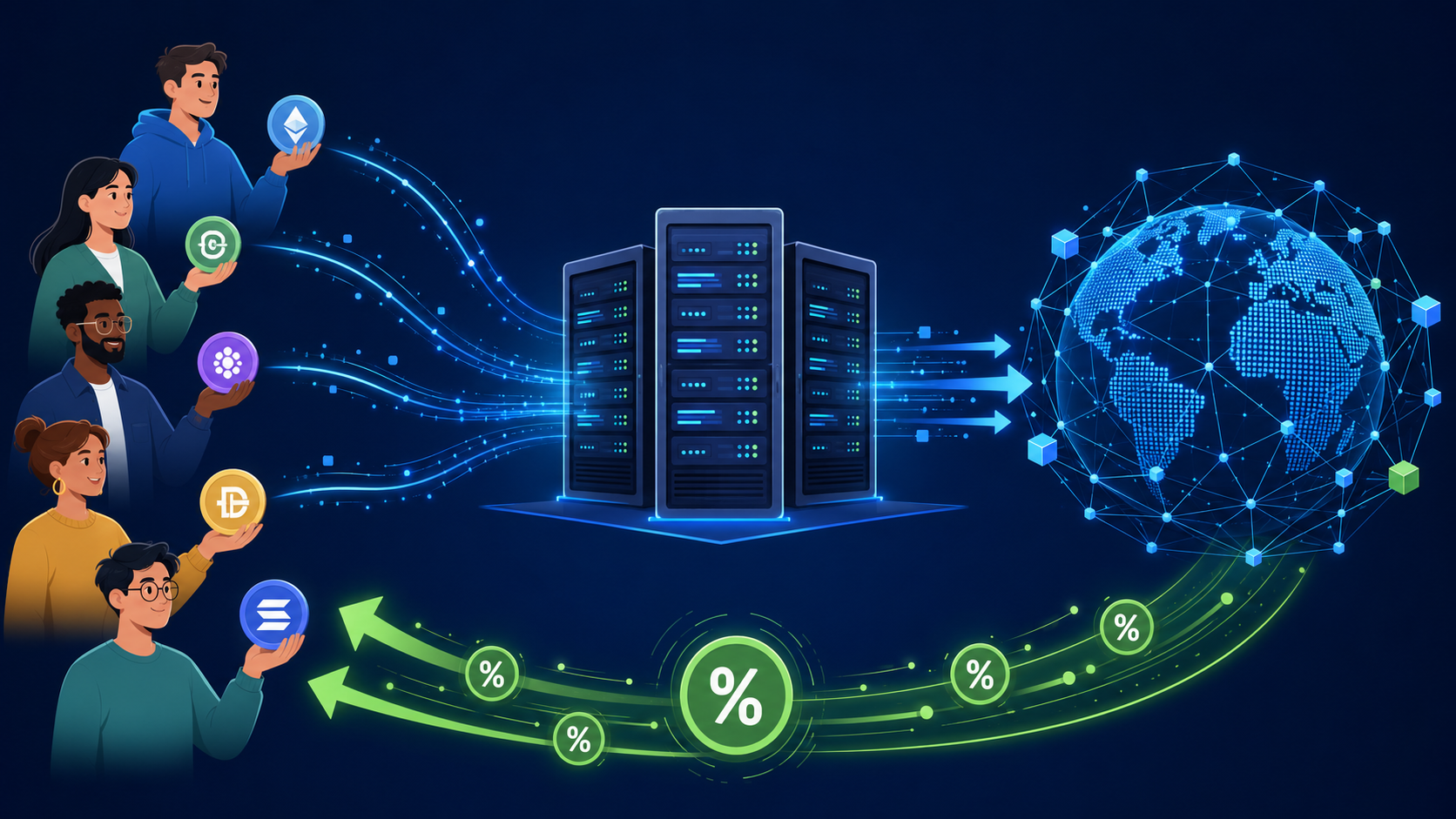
When the gold rush hit California, successful entrepreneurs sold picks and shovels. They made consistent fortunes while miners took massive risks. Today, we apply this exact logic to decentralized finance. Specifically, Web3 middleware delegating represents one of the smartest ways to build reliable passive income. You do not need to guess which meme coin or consumer application will go viral. Instead, you simply earn a steady yield by supporting the background infrastructure.
In addition, we recently explored exciting digital concepts like DePIN hardware. Furthermore, we covered the massive growth of Real World Assets (RWAs). Consequently, both of those massive sectors require flawless, real-time data to operate securely. Delegating allows everyday investors to provide critical economic security to the networks moving that data.
Fortunately, you can participate in this infrastructure economy without buying expensive computer hardware. Below, let us dive deep into the mechanics of this strategy. Ultimately, we will explore four massive infrastructure networks and provide a step-by-step guide to maximizing your yields.
What Is Web3 Middleware Delegating?
To begin with, you must first understand middleware before you can understand delegating. Blockchains like Ethereum cannot talk to the outside world natively. For example, they cannot check the stock market. Moreover, they cannot verify real-world weather data. In fact, they cannot even search their own internal history efficiently. Middleware protocols solve these massive problems entirely. Therefore, they act as the vital digital plumbing connecting smart contracts to external data and applications.
These protocols rely on decentralized node operators to fetch, index, and transmit information. However, the network must ensure these node operators remain honest. To achieve this, the network uses a staking system to align financial incentives. Node operators must lock up crypto tokens as collateral. If an operator submits fake data, the network destroys their collateral immediately.
Running a professional server node requires intense technical expertise and 24/7 maintenance. Fortunately, you do not need to run a server to earn money. Instead, delegating allows you to stake your tokens alongside a professional node operator. You assign your voting power and financial backing directly to them. As a result, the operator shares a percentage of their network fees with you in exchange. Overall, you provide the capital security, and you collect the passive income.
Earning Yield Through Chainlink (LINK) Web3 Middleware Delegating
Currently, Chainlink acts as the dominant decentralized oracle network in Web3. Oracles fetch real-world financial data and deliver it securely to blockchain applications. For instance, decentralized exchanges rely on Chainlink to know the real-time prices of tokens. Without Chainlink, DeFi applications simply cannot function safely.
Chainlink staking allows token holders to back the performance of these oracle services. In doing so, staking provides cryptographic guarantees for the data feeds. Additionally, Chainlink offers Delegated Proof of Stake (DPoS) mechanisms. Under this framework, users delegate their LINK tokens to trusted, enterprise-grade node operators. Consequently, this third-party delegation pools capital from thousands of individual stakers.
This aggregated capital enables node operators to meet strict minimum stake requirements. Furthermore, it guarantees that operators maintain sufficient collateral for their operational duties. In fact, the network design heavily protects community delegators. However, the protocol requires a firm long-term commitment from participants.
As a result, you cannot withdraw your tokens instantly during market crashes. Instead, the network utilizes a dynamic unbonding mechanism to ensure economic stability. Ultimately, this requirement prevents sudden capital flight from destabilizing critical financial data feeds.
How The Graph (GRT) Generates Delegator Yield
While Chainlink brings external data into the blockchain environment, The Graph organizes data already sitting on public blockchains. Specifically, developers rely on this protocol as the primary search engine for Web3. It indexes raw blockchain data into neat, searchable categories called subgraphs. Meanwhile, the network relies on technical participants called Indexers to manage these data pipelines.
Fortunately, you can easily delegate your GRT tokens to these Indexers using a standard crypto wallet. Consequently, this process increases the Indexer’s capacity to process queries and earn rewards. In return, you receive a direct share of these indexing rewards. However, Indexers control two critical commission parameters that affect your wallet:
- Indexing Reward Cut: First, this represents the percentage of protocol inflation rewards that the Indexer keeps for themselves.
- Query Fee Cut: Second, this is the percentage of actual client search fees that the Indexer retains before sharing the rest with delegators.
Therefore, you must compare these commission rates carefully before delegating your tokens. Additionally, you should utilize the best on-chain crypto tools to verify their historical performance. Furthermore, the protocol enforces a strict 28-day unbonding period when you decide to undelegate. As a result, your tokens do not earn rewards during this mandatory cooldown period.
Join the Weekly SPI Newsletter
Practical insights. Real opportunities. Zero fluff.
EigenLayer and Restaking for Web3 Middleware Delegating
Recently, EigenLayer introduced a revolutionary concept called restaking to the Ethereum ecosystem. This feature allows users to reuse their staked ETH across multiple protocols simultaneously. Consequently, this system creates massive new opportunities for Web3 middleware delegating. Specifically, here is exactly how the system functions:
- First, users restake their liquid staking tokens (LSTs) or native staked ETH into EigenLayer smart contracts.
- Next, users delegate these restaked assets to professional operators who run specialized software.
- Then, these operators use the shared security to validate Actively Validated Services (AVSs), such as bridges or data availability layers.
- Finally, AVSs distribute validation rewards back to the operators and their loyal delegators once a week.
In fact, this structure allows investors to earn multiple layers of yield on a single capital allocation. Operators earn a fee for managing the complex software. Specifically, operators currently retain a fixed 10% portion of the rewards. Afterward, the protocol automatically distributes the remaining 90% back to the delegators. However, unstaking EIGEN tokens includes a mandatory 7-day waiting period.
Pocket Network (POKT): Decentralized RPC Infrastructure
Every time you open a crypto wallet or swap a token, your application sends an RPC (Remote Procedure Call) request to the blockchain. Traditionally, applications rely on centralized companies like Infura or Alchemy to handle these requests. However, Pocket Network provides a fully decentralized alternative.
Specifically, Pocket Network incentivizes thousands of independent node operators to route these data requests. Developers pay for bandwidth, and node operators earn POKT tokens for servicing these data relays. Through gateway delegating, everyday users can easily back these node clusters.
By delegating your POKT tokens to established gateways, you help ensure that Web3 applications remain online 24/7 without censorship. In return, you receive a percentage of the network’s relay fees. Ultimately, this provides a pure “utility-based” yield generated from real internet traffic rather than speculation.
How to Choose the Right Node Operator: A 4-Step Checklist
Delegating your tokens is simple, but selecting the wrong operator can reduce your returns significantly. Therefore, follow this simple 4-step checklist before committing your capital:
1. Check the Self-Bond Ratio: First, look for operators who stake a significant amount of their own money alongside their delegators. Operators with high “skin in the game” are much less likely to act recklessly or shut down their servers unexpectedly.
2. Analyze Uptime Metrics: Second, node operators must maintain nearly 100% server uptime. If an operator’s server goes offline frequently, they miss network validation rounds, which directly slashes the passive income flowing to your wallet.
3. Evaluate Commission Rates: Third, compare fee cuts across multiple operators. An operator charging a 5% commission might offer better server performance than a 0% commission operator who runs their setup on a cheap home computer.
4. Review Slashing History: Finally, check on-chain explorer tools to see if the operator has ever suffered a slashing penalty. Slashing occurs when an operator breaks network rules, resulting in the permanent destruction of staked tokens.
Tax Implications and Risk Management
While Web3 middleware delegating offers exceptional utility, you must manage your risks and obligations carefully. In fact, ignoring risk management remains a fatal crypto bull market mistake.
First, you must plan for liquidity constraints. Unbonding periods protect infrastructure networks from sudden capital flight. However, these 7-day to 28-day lock-ups prevent you from panic-selling during market crashes. Therefore, treat delegating like purchasing a digital certificate of deposit rather than an liquid day trade.
Second, you must track token inflation versus enterprise demand. Protocols print new tokens to pay initial staking rewards. If the inflation rate heavily exceeds your yield, your true purchasing power decreases. Consequently, you should always track smart money to ensure institutional clients actually pay real query fees on the network.
Finally, consider the tax implications. In many jurisdictions, tax authorities treat daily or weekly delegation rewards as ordinary income at the exact moment you receive them. When you eventually sell those reward tokens for fiat currency, you may also trigger a capital gains tax event. Therefore, keep detailed records of all claim transactions for your annual filing.
Overall, investing in the infrastructure layer requires long-term patience. Yet, it removes the daily stress of chart-watching. Ultimately, by delegating your assets to crucial middleware protocols, you build a resilient, real-world digital income stream for the future.
Leave a Reply