
Most people approach passive income as a shopping list.
They look for a dividend stock, a rental property, a staking opportunity, a digital product or another asset that might produce money. Then they assess each idea separately. If one does not generate meaningful income quickly, they abandon it and move to the next.
That approach often creates activity without creating momentum.
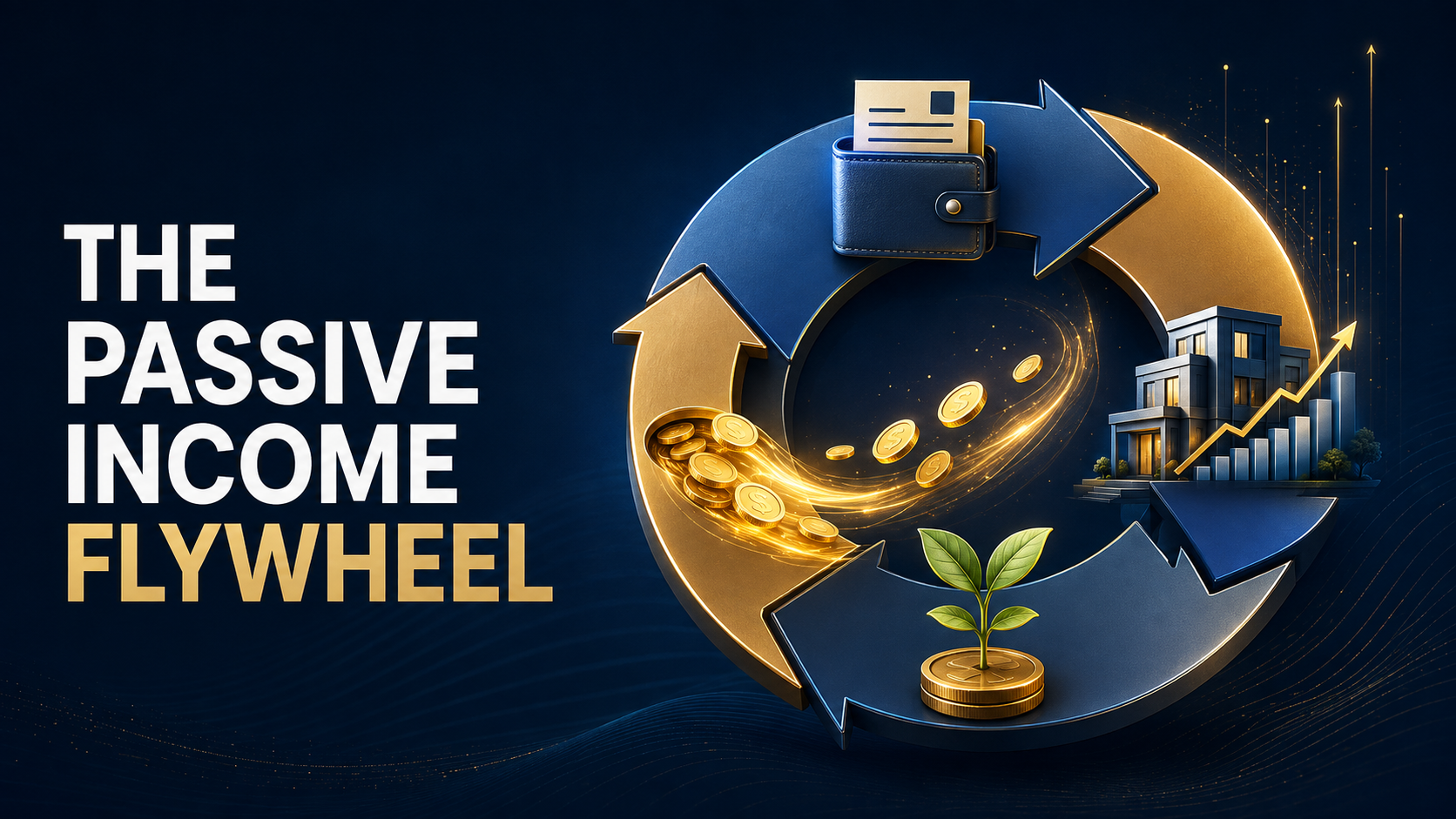
A stronger approach is to build a passive income flywheel: a connected system in which earned income buys productive assets, those assets generate cash flow, and part of that cash flow helps acquire more productive assets. As the system grows, it becomes less dependent on new money from your salary or business.
The goal is not to make money appear without effort. Instead, the goal is to use effort, capital and reinvestment so that producing the next rand gradually demands less fresh effort.
A flywheel normally begins slowly. During the early months, most growth comes from your own contributions. Later, the system’s income starts making a visible contribution. Eventually, if the assets remain productive and you control the risks, yesterday’s income can help fund tomorrow’s income.
In this guide, you will learn how that system works, why many passive-income plans fail before gaining momentum and how a beginner can build a realistic flywheel without relying on exaggerated returns.
What Is a Passive Income Flywheel?
A flywheel is a heavy wheel that is difficult to start turning but becomes easier to keep moving once it has momentum. The passive income version follows the same principle.
At the beginning, you supply most of the force. That force may come from a salary, freelance work, business profit or savings created by reducing unnecessary expenses. You then direct part of the surplus into an asset or system capable of producing income.
When the asset pays you, you make a deliberate decision about the cash flow. For example, you may keep one portion as a reserve and use another for current needs. You can then reinvest the remainder into the same asset or use it to build another productive income source.
The basic cycle looks like this:
- Earn active income.
- Create a reliable monthly surplus.
- Build a financial safety buffer.
- Acquire or improve an income-producing asset.
- Collect the net cash flow.
- Reinvest part of that cash flow.
- Increase the productive capacity of the system.
- Repeat the process.
This cycle can operate inside a single investment. For example, an investor can use dividends to purchase additional shares, which may generate more dividends in the future.
It can also connect several different income streams. Profit from a small digital product might finance equipment for a content business. The content business might attract customers to a service. Part of the service income could then build a diversified investment portfolio.
The important feature is not the number of income streams. It is the way capital moves between them.
Why Collecting Random Income Streams Is Not a Strategy
At first glance, owning several assets may look like diversification. Yet a collection of disconnected activities can become expensive and difficult to manage.
For example, imagine someone who simultaneously launches an online course, starts affiliate marketing, buys several speculative tokens and attempts to run a short-term rental. Every project requires money, attention, administration and learning. Consequently, none receives enough resources to become reliable.
As a result, this person has not built a flywheel. They have created four separate wheels, each waiting for someone to push it.
A genuine flywheel has a clear order:
| Random income collection | Passive income flywheel |
|---|---|
| Starts several ideas at once | Builds one reliable engine before expanding |
| Chases the highest advertised return | Prioritises durability, cash flow and understandable risk |
| Spends each payout without a rule | Assigns every payout to reinvestment, reserves or personal use |
| Measures gross revenue | Measures net income after expenses, tax and losses |
| Adds complexity whenever growth slows | Improves the existing system before adding another layer |
| Depends constantly on fresh capital | Gradually increases the contribution from existing assets |
For this reason, the best first income stream is rarely the most exciting one. It is usually the one you can understand, fund consistently, measure accurately and maintain through an ordinary month.
The Six Parts of a Strong Passive Income Flywheel
1. The Cash Engine
First, every flywheel needs an initial source of energy. In personal finance, that source is usually active income.
For example, a salary can act as the cash engine. So can freelance income, consulting, a small business, commissions or paid work performed after hours. Active income is not the enemy of passive income. In most cases, it is the capital source that makes passive income possible.
As a result, you start to view a job or business differently. It does more than pay current bills. It can also finance assets that may produce future income.
The cash engine does not need to be enormous. In fact, reliability matters more than drama. Contributing R500 every month creates more usable momentum than contributing R5,000 once and abandoning the plan.
The first objective is therefore not to escape active work immediately. It is to convert a portion of active income into productive ownership.
2. The Surplus
Revenue only becomes investable capital after you pay the related expenses.
If a person earns R20,000 and spends R20,000, the flywheel receives nothing. If the same person creates a sustainable R1,000 monthly gap, that surplus becomes fuel.
You can create a surplus in two ways:
- Increase income without increasing expenses at the same rate.
- Reduce low-value expenses without making the plan so restrictive that you quickly abandon it.
The second point matters. Therefore, build the flywheel on a repeatable contribution rather than a temporary period of financial punishment.
For a business or side hustle, calculate the surplus after direct costs. R8,000 in sales with R6,500 in advertising, software, delivery and contractor costs produces R1,500 before tax—not R8,000 of usable profit.
3. The Shock Absorber
A financial reserve may appear to slow the flywheel because emergency cash does not chase aggressive returns. In practice, however, a reserve can stop one bad month from dismantling the entire system.
If an unexpected repair, income interruption or urgent household expense occurs, a person without a buffer may have to sell investments, withdraw money from a business or use expensive debt. Consequently, the flywheel starts moving backwards.
The Consumer Financial Protection Bureau describes an emergency fund as a cash reserve set aside for unplanned expenses or financial emergencies. The exact amount required depends on the household, income stability, dependants and insurance protection.
Therefore, do not confuse the safety buffer with investment capital. They have different jobs:
| Safety buffer | Investment capital |
|---|---|
| Protects against unexpected costs | Attempts to produce income or growth |
| Prioritises access and stability | May accept volatility or a lock-up period |
| Should not depend on selling at a favourable price | May rise or fall in market value |
| Prevents forced withdrawals from productive assets | Expands the flywheel over time |
The reserve is not idle money. It is structural support.
4. The Productive Asset
A productive asset is something that can generate cash flow, increase its earning capacity or support another income-producing activity.
Examples include:
- Shares in profitable companies that distribute dividends
- Interest-bearing investments appropriate to the investor’s circumstances
- A rental property with positive net cash flow
- A useful digital product that customers can buy repeatedly
- Intellectual property that earns royalties or licensing income
- A content library that attracts customers or advertising revenue
- Equipment that expands the capacity of a profitable business
- A carefully evaluated staking or lending position that produces net income after costs and risk
Not everything that increases in price is producing income. A collectible, commodity or non-income-producing token may appreciate, but there is no automatic cash flow to reinvest. Such assets can have a place in a broader portfolio, but they do not power a passive income flywheel in the same way.
Ultimately, the correct asset depends on your capital, knowledge, risk tolerance, time horizon and access. A beginner should not force a property strategy with insufficient capital or use a complex crypto protocol merely because it displays a high annual percentage yield.
5. The Reinvestment Rule
A flywheel gains momentum only when you return some of its output to the system.
For instance, reinvestment can happen automatically or manually. Dividends may purchase additional units. Rental profit may fund improvements that raise occupancy or reduce operating costs. Meanwhile, digital-product revenue may finance better distribution, customer support or a second useful product.
The mathematics resembles compounding. Investor.gov describes compound interest as interest earned on both the original principal and previously accumulated interest. Similarly, a flywheel uses returns to expand the productive base that may generate future returns.
However, reinvesting 100% forever is not automatically wise. A practical rule may direct cash flow into several buckets:
- Reinvestment: expands productive assets.
- Reserves: covers future repairs, vacancies, defaults or business costs.
- Tax provision: prevents tax obligations from consuming operating capital.
- Personal income: allows the system to support current goals once it is sufficiently stable.
During the early stages, the reinvestment percentage may be high because the cash flow is small and the main objective is growth. As the system matures, the owner may gradually take more income without stopping reinvestment completely.
6. The Measurement System
However, what looks like momentum may actually hide wasteful spending.
A short-term rental can produce higher monthly revenue after an expensive renovation while generating a poor return on the additional capital. A digital product may attract more sales while advertising costs rise faster than profit. A crypto position may distribute more tokens while the value of those tokens falls.
Therefore, measure the flywheel using net figures.
At minimum, track:
- Total fresh capital added
- Gross income received
- Operating expenses and platform fees
- Taxes or the amount reserved for them
- Net income
- Amount reinvested
- Amount withdrawn for personal use
- Current value of productive assets
- Debt attached to the system
- Time spent maintaining the income stream
People frequently ignore that final measurement. For instance, an income stream producing R2,000 per month but requiring 35 hours of work is not passive. It may still be a worthwhile business, but you should classify it honestly.
How the Flywheel Changes Over Time
A healthy passive income flywheel normally moves through three stages.
Stage 1: Contribution-Driven
Initially, most of the growth comes from your own money. Asset income is small and may feel insignificant.
Consequently, this is where many people quit. They invest R500, receive a small distribution and conclude that passive income does not work. Yet the problem is not necessarily the asset. The productive base is simply too small to create a meaningful payment.
Therefore, the priorities during this stage are consistency, education, cost control and avoiding major losses.
Stage 2: Shared Growth
At this point, your contributions remain important, but asset income begins to make a visible difference. Reinvestment purchases additional units, reduces debt, improves a property or expands business capacity.
The system is gaining momentum, although it may still be vulnerable to interruptions.
Stage 3: Asset-Driven
Eventually, existing assets contribute more to growth than new money from your salary or business. At this stage, the system may support partial withdrawals while continuing to expand.
However, reaching this point can take years. The timeline depends on contribution size, asset performance, expenses, taxes, withdrawals and losses. There is no universal date on which passive income suddenly replaces active work.
| Stage | Main source of growth | Primary objective | Common mistake |
|---|---|---|---|
| Contribution-driven | Salary or business contributions | Build the base consistently | Quitting because early income is small |
| Shared growth | Contributions plus reinvested income | Improve efficiency and resilience | Expanding too quickly |
| Asset-driven | Existing productive assets | Balance income, preservation and growth | Assuming the system no longer needs oversight |
A Realistic 12-Month Example Starting With R500
For example, consider a beginner who can allocate R500 per month. The person has no emergency reserve and wants to start building an income-producing portfolio.
A reckless plan might invest the entire amount immediately and assume a very high return. By contrast, a more resilient plan can use the first three months to build a starter buffer of R1,500, then begin investing R500 per month.
For illustration only, assume the investment produces an average net return of 0.5% per month and the investor reinvests every return. In reality, returns will not arrive in a smooth line. Some months could be positive, negative or unchanged.
| Month | Action | Reserve balance | Investment balance | Illustrative monthly return |
|---|---|---|---|---|
| 1 | Add R500 to starter reserve | R500 | R0 | R0 |
| 2 | Add R500 to starter reserve | R1,000 | R0 | R0 |
| 3 | Add R500 to starter reserve | R1,500 | R0 | R0 |
| 4 | Invest R500 | R1,500 | R502.50 | R2.50 |
| 5 | Invest R500 and reinvest return | R1,500 | R1,007.51 | R5.01 |
| 6 | Invest R500 and reinvest return | R1,500 | R1,515.05 | R7.54 |
| 7 | Invest R500 and reinvest return | R1,500 | R2,025.13 | R10.08 |
| 8 | Invest R500 and reinvest return | R1,500 | R2,537.75 | R12.63 |
| 9 | Invest R500 and reinvest return | R1,500 | R3,052.94 | R15.19 |
| 10 | Invest R500 and reinvest return | R1,500 | R3,570.70 | R17.76 |
| 11 | Invest R500 and reinvest return | R1,500 | R4,091.06 | R20.35 |
| 12 | Invest R500 and reinvest return | R1,500 | R4,614.01 | R22.96 |
What the First Year Actually Achieves
At the end of 12 months, the person has contributed R6,000 in total. Approximately R1,500 remains in the starter reserve, while the illustrative investment balance is R4,614.01. Overall, the combined amount is roughly R6,114.01.
At first glance, that result is not dramatic, and that is precisely why it is useful.
Nevertheless, the flywheel has produced something valuable without promising financial freedom in one year: a basic safety buffer, an investment habit, a growing productive base and a monthly return that is gradually increasing.
During month four, the hypothetical return was R2.50. By comparison, month twelve produced R22.96. The contribution still does most of the work, but the assets have started assisting.
If the person increases the monthly contribution when income rises, keeps fees low and continues for several years, the asset-generated part of the growth may become more meaningful. If the person stops after one year, the flywheel never receives enough time or capital to demonstrate its full purpose.
This table is an educational model, not a forecast or promise. It excludes market volatility, taxes, transaction costs and product-specific fees.
Join the Weekly SPI Newsletter
Practical insights. Real opportunities. Zero fluff.
Four Different Flywheels in the Real World
1. The Salaried Beginner
A salaried beginner creates a R750 monthly surplus. The first portion builds an emergency reserve. After reaching the initial reserve target, the monthly contribution moves into a diversified long-term investment appropriate to the person’s circumstances.
The investor reinvests every distribution. Moreover, when the person receives a salary increase, part of the increase lifts the monthly contribution rather than disappearing into lifestyle inflation.
The flywheel is simple:
Salary surplus → diversified productive assets → reinvested income → larger asset base.
Consistency is the main advantage. The risk is becoming impatient and replacing a sensible plan with speculative opportunities promising faster results.
2. The Content Creator
A content creator publishes useful videos or articles that continue attracting an audience after publication. The content leads readers to a carefully designed digital product or another legitimate revenue source.
Instead of spending all sales income, the creator allocates it between tax, operating reserves and reinvestment. Reinvestment might pay for editing, improved sound, useful software, better research or distribution.
Those improvements increase the quality and reach of future content, which can generate more product sales and audience growth.
The flywheel becomes:
Useful content → audience trust → product revenue → better content and distribution → larger audience.
This model is not fully passive. Content requires maintenance, customer support and regular updates. Nevertheless, the model offers scalability because one useful resource may serve many customers without the creator rebuilding it for each sale.
3. The Short-Term-Rental Owner
A short-term rental generates booking revenue. The owner first deducts cleaning, utilities, platform fees, maintenance, insurance, rates, management costs and tax provisions.
Part of the remaining cash flow goes into a property reserve. Another part funds improvements with a measurable purpose, such as better photography, durable furniture, preventative maintenance or a guest-experience upgrade that supports stronger reviews and occupancy.
The flywheel becomes:
Bookings → net operating cash flow → reserve and targeted improvements → stronger guest experience → improved booking performance.
The owner must measure net cash flow rather than celebrating gross booking revenue. The South African Revenue Service explains that rental income is generally subject to income tax and identifies certain expenses that may be deductible, subject to the applicable requirements. Property owners can review the official SARS guidance on rental income and obtain professional advice for their own circumstances.
For a broader look at different property-income models, see Short-Term Rentals vs REITs vs Tokenized Real Estate.
4. The Crypto Investor
A crypto flywheel requires particularly strict risk controls because high advertised yields can conceal token inflation, smart-contract vulnerabilities, unstable collateral, liquidity problems and severe price volatility.
A cautious educational model might separate long-term holdings, income-producing positions, stable reserves and speculative capital. In addition, the investor should measure every reward in rand or another consistent accounting currency after fees and changes in token price.
The flywheel might be:
Realised profits or external contributions → carefully sized productive positions → verified net rewards → reserves and selective reinvestment.
The dangerous version is different:
Borrowed money → high-yield token → rewards paid in the same falling token → more exposure to the same risk.
That is not healthy compounding. Instead, concentrated risk is creating the appearance of growth.
Readers exploring decentralised finance can use the Simple Passive Income DeFi hub to build their understanding before evaluating individual opportunities.
The Capital Allocation Rule: Where Should the Next Rand Go?
A flywheel needs a rule that decides where new money and cash flow should go.
Without a rule, people tend to send money toward whichever opportunity feels most exciting that week. Therefore, a simple priority order can improve discipline:
- Protect essential obligations. Current living costs, contractual obligations and appropriate insurance come before speculative investment.
- Build or restore the safety buffer. A damaged reserve weakens every other part of the system.
- Address destructive debt. High-cost debt can drain cash faster than a reasonable asset is likely to produce it.
- Maintain existing productive assets. Repairing a revenue-producing asset may be more valuable than buying a new one.
- Add to the highest-quality opportunity you already understand. Expansion should follow evidence, not novelty.
- Diversify when concentration becomes material. Do not allow one company, property, protocol, customer or platform to control the entire outcome.
Diversification does not guarantee a profit or prevent every loss. However, it can reduce dependence on one outcome. Investor.gov defines diversification as spreading money among different investments so that strength in one area may help offset weakness in another.
You can also apply the principle outside a securities portfolio. For example, a rental owner can avoid relying on one booking channel. Likewise, a creator can avoid depending entirely on one social-media platform, while a business can reduce dependence on one large customer.
How a Flywheel Can Spin Backwards
Reinvestment is powerful in both directions. A strong system can build momentum, while a weak system can compound losses.
Lifestyle Inflation
Income increases, but expenses rise by the same amount or more. The cash engine becomes larger without sending additional fuel to productive assets.
Reinvesting Before Building Reserves
The owner reinvests every payout while ignoring maintenance, tax and emergency obligations. As a result, the first unexpected expense forces the owner to sell assets or borrow.
Chasing Unsustainable Yield
The investor mistakes a high return for rapid momentum. Next, the investor expands the position without understanding where the yield comes from. When rewards fall or the asset price collapses, the loss can damage both income and capital.
Using Debt as Artificial Momentum
Borrowing can make a flywheel look larger, but repayments continue even when income weakens. Leverage may be appropriate in some business or property structures, yet it increases the consequences of vacancies, market declines and income interruptions.
Ignoring Fees
Small recurring fees can materially reduce long-term results. Therefore, include trading charges, platform fees, property-management costs, fund expenses, gas fees, foreign-exchange spreads and withdrawal costs in every calculation.
The SEC’s Investor.gov guidance on fees and expenses demonstrates how different fee levels can change the long-term value of a hypothetical portfolio.
Expanding Faster Than the System Can Support
The owner treats one successful month as proof of permanent demand. Consequently, the owner adds fixed costs, debt or staff before the income stream has survived different conditions.
Confusing Revenue With Profit
The owner reinvests gross receipts before accounting for expenses and taxes. Eventually, the apparent growth creates a cash-flow shortage.
Depending on One Point of Failure
All income depends on one tenant, one borrower, one protocol, one customer, one social platform or one exchange. A single disruption stops the wheel.
A Simple Flywheel Scorecard
Review the system monthly or quarterly using a small scorecard. The purpose is not to create complicated accounting. It is to detect whether the flywheel is becoming stronger or merely larger.
| Question | Healthy sign | Warning sign |
|---|---|---|
| Is net income increasing? | Income rises after all relevant costs | Revenue rises while profit falls |
| Is the reserve adequate? | Expected disruptions can be absorbed | Every surprise requires debt or asset sales |
| Is fresh capital still doing all the work? | Asset income contributes gradually more | Growth stops immediately when contributions stop |
| Is risk becoming concentrated? | Exposure limits are defined and reviewed | One asset or platform controls the outcome |
| Is the system becoming easier to operate? | Processes, records and automation improve | Each rand requires more time and complexity |
| Are fees and taxes included? | Net figures drive decisions | Only gross payouts are tracked |
| Can the income source be explained? | A real customer, tenant, borrower or business pays | The explanation depends on hype or new participants |
A flywheel does not need every number to increase each month. Markets fluctuate, properties need repairs and businesses have seasonal periods. Look for a durable direction across a meaningful period.
How to Build Your Own Passive Income Flywheel
Step 1: Map the Current Money Flow
Write down monthly income, essential expenses, debt payments, irregular costs and the amount currently available for saving or investing.
Use actual statements rather than estimates. A flywheel built on imaginary surplus will fail as soon as the first debit order arrives.
Step 2: Choose a Sustainable Starting Contribution
Select an amount you can maintain in an ordinary month. Then increase it later when your cash flow allows.
A small automatic contribution creates a behaviour and a data trail. It also reveals whether the budget can genuinely support the plan.
Step 3: Establish the Safety Layer
Set an initial reserve target based on your circumstances. Keep it accessible and separate from speculative capital.
You can build the target in stages. After all, a starter buffer gives you more protection than waiting until you can complete a large final target at once.
Step 4: Select One Understandable Productive Asset
Define the source of income in one sentence:
“This asset can pay me because ______ pays ______ for ______.”
Examples include tenants paying rent for accommodation, customers paying for a useful digital product or profitable companies distributing part of their earnings.
If you cannot complete the sentence clearly, conduct more research before committing money.
Step 5: Define the Reinvestment Split Before Income Arrives
Decide what percentage of net income you will reinvest, hold for expenses, reserve for tax or withdraw.
The rule should fit the asset. A rental property requires a meaningful maintenance reserve. A digital business may need a refund and operating buffer. A market investment may require no direct repair budget but can still face volatility and tax consequences.
Step 6: Automate the Repetitive Parts
Automation can reduce the risk of forgetting contributions and simplify record-keeping. Furthermore, regular contributions can reduce the temptation to wait for the “perfect” market moment.
Investor.gov describes dollar-cost averaging as investing equal portions at regular intervals regardless of market movements. It can support a consistent process, although it cannot guarantee gains or protect against every loss.
Step 7: Review Quarterly, Not Emotionally
Set a regular review date. Examine income, costs, risk, time spent and whether the original reason for owning the asset remains valid.
Do not rebuild the strategy after every market headline. Make changes when evidence shows that the assumptions, economics or personal circumstances have materially changed.
Step 8: Add a Second Engine Only When the First Is Stable
A second income source should reduce concentration or use an existing advantage. It should not merely add complexity.
For example, a creator with a useful content library may add a digital guide that serves the same audience. Similarly, a rental owner with reliable reserves may explore a complementary listed property investment instead of purchasing another property immediately.
The strongest expansion often grows from something the system already knows how to do.
Should You Reinvest or Take the Income?
The answer depends on the stage and purpose of the flywheel.
Reinvestment may be appropriate when:
- The safety buffer is adequate
- High-cost debt is under control
- The asset remains attractive at its current price
- The system has sufficient operating and tax reserves
- You do not need the income for essential expenses
- Concentration remains within acceptable limits
Taking some income may be sensible when:
- You built the flywheel to support a current financial goal
- Reinvestment would create excessive exposure to one asset
- The underlying opportunity has become less attractive
- Personal cash-flow needs have changed
- You need to restore a reserve or meet a tax obligation
There is no prize for reinvesting every cent while personal finances become unstable. The system should serve a defined purpose.
Tax Is Part of the Flywheel
Tax affects the amount available for reinvestment. Ignoring it can make a strategy look more profitable than it is.
Different forms of income may receive different tax treatment. Therefore, do not assume that rental income, interest, dividends, business profit and crypto-related income follow identical tax rules.
South Africa also offers approved tax-free investment products. According to SARS, amounts earned within qualifying tax-free investments are free from income tax, dividends tax and capital gains tax, subject to the rules and contribution limits.
However, that does not mean every product carrying “tax-free” in its marketing qualifies. Use authorised providers, verify current rules and obtain professional guidance where appropriate.
Good tax planning improves net efficiency. Aggressive tax assumptions create future liabilities.
The Most Important Number Is Not the Yield
Yield attracts attention because it compresses an opportunity into one percentage. Unfortunately, it can hide almost everything that determines whether an income system survives.
A 12% advertised yield may be less useful than a 7% yield if the first option has higher fees, unstable capital value, poor liquidity, uncertain tax treatment or a greater chance of permanent loss.
Instead of asking only, “What does it pay?”, examine:
- Where the income originates
- Whether the capital value can fall
- How stable the payer is
- Which fees the provider deducts
- How easily you can sell the asset
- How much time the system requires
- Whether the income is diversified
- What happens in a bad month
- Whether the return is sustainable without new participants
Ultimately, the net result after risk, costs and interruptions builds the flywheel—not the largest number on a dashboard.
The Financial Sector Conduct Authority emphasises that informed financial consumers can protect themselves more effectively against fraud, scams and similar misconduct. Therefore, before using any South African financial provider, verify its regulatory status where applicable and understand what protection the relevant framework does and does not provide.
Final Thoughts
Marketers often present passive income as an escape from work. However, a passive income flywheel offers a more useful idea: convert part of today’s work into assets and systems that can assist with tomorrow’s income.
The early stage is rarely impressive. Most of the momentum comes from discipline, not returns. You create a surplus, protect it with a reserve, acquire something productive and reinvest part of the net cash flow.
Over time, the source of growth can begin to shift. Your salary or business remains important, but the assets start contributing. Reinvested income purchases more capacity. Improved systems reduce friction. Diversification lowers dependence on one result.
In short, one line summarises the process:
Earn deliberately, keep a surplus, protect the base, buy productive assets, reinvest intelligently and repeat.
The goal is not to collect the most passive-income ideas. It is to build a financial system in which each strong part supports the next.
When yesterday’s income begins helping to produce tomorrow’s income, the flywheel is finally turning.
This article is for educational purposes only and does not constitute financial, investment, tax or legal advice. No investment guarantees a return, and every investment can involve loss. The examples are hypothetical and do not represent the expected performance of any specific product. Research every opportunity independently and consider obtaining advice from an appropriately qualified professional.
Leave a Reply