
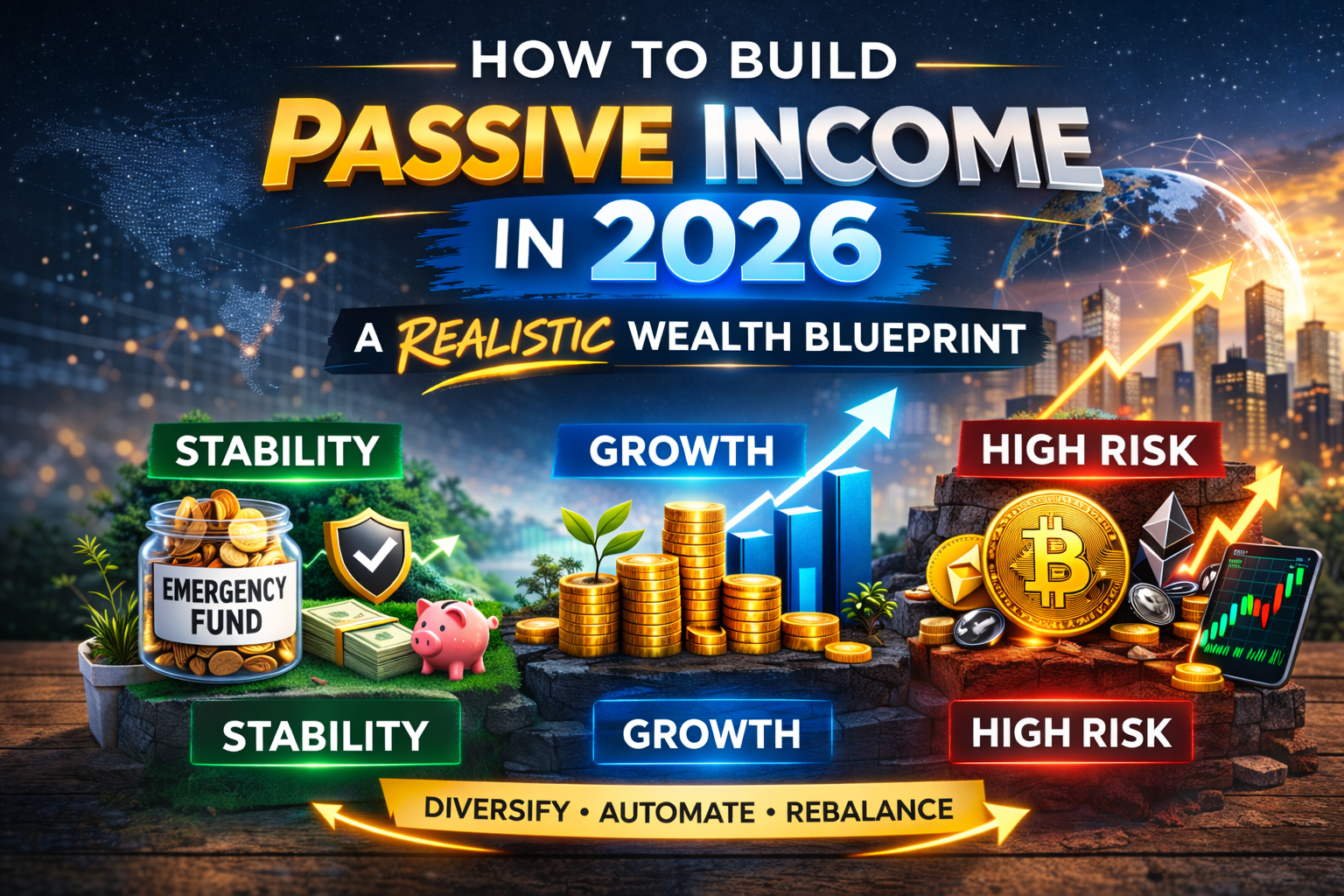
Passive income sounds simple. In reality, it’s structured, deliberate, and built on disciplined systems — not hype cycles or lucky timing.
If you’re serious about building sustainable wealth in 2026, you need more than inspiration. You need a repeatable framework that survives volatility, economic uncertainty, and your own emotions.
Disclaimer: This article is for educational purposes only and does not constitute financial advice. All investing involves risk, including potential loss of capital.
What Passive Income Actually Means (And What It Doesn’t)
Passive income is often misunderstood. It does not mean “effortless” income. It means income generated by systems you built earlier.
In practical terms, passive income usually falls into three categories:
1. Asset-Based Income
This includes dividends from stocks, interest from savings instruments, rental income from property, or yield from structured investments. These assets work in the background while you focus on other activities.
2. Equity Growth That Produces Future Income
Not all passive income starts immediately. Some investments compound silently for years before they begin generating meaningful cash flow.
3. Risk-Compensated Returns
Higher returns generally require accepting higher uncertainty. Regulatory bodies consistently remind investors that higher expected returns typically come with higher volatility and risk exposure. You can read more about diversification principles via Investor.gov.
If an investment promises high returns with little or no risk, that’s usually a warning sign — not an opportunity.
The Three-Layer Passive Income Framework
To avoid catastrophic mistakes, your passive income plan should not rely on a single asset class.
Layer 1: Stability & Liquidity
This layer protects your long-term strategy from short-term chaos.
- Emergency savings (ideally 1–3 months minimum)
- Cash reserves for near-term expenses
- Low-volatility holdings
Without this layer, market dips often trigger panic decisions.
Layer 2: Long-Term Growth Core
This is where wealth typically compounds. Broad exposure to diversified markets has historically outperformed concentrated speculation over long time horizons.
The goal here is not excitement. It’s steady compounding over years.
Layer 3: High-Risk Allocation (Optional)
This may include crypto assets, early-stage opportunities, or higher-volatility positions.
However, position sizing is critical. A small allocation can meaningfully impact upside potential without threatening your financial stability.
Step-by-Step Blueprint to Implement This Strategy
Step 1: Define Your Time Horizon
Money needed within 12 months should generally not be exposed to high volatility. Long-term goals (5–10+ years) allow for more calculated risk.
Step 2: Choose an Allocation
Your allocation determines your risk exposure more than any individual investment choice.
Example structure (illustrative only):
- 20–40% Stability
- 50–70% Growth Core
- 5–15% High Risk
Step 3: Automate Contributions
Automation reduces emotional interference. Scheduled contributions create discipline regardless of market sentiment.
Step 4: Rebalance Periodically
Rebalancing forces discipline — trimming overperformers and adding to underweighted assets. This helps maintain your intended risk level.
Join the Weekly SPI Newsletter
Practical insights. Real opportunities. Zero fluff.
Common Passive Income Mistakes in 2026
1. Overexposure to Trending Assets
Market cycles rotate. Concentration risk is one of the biggest portfolio destroyers.
2. Ignoring Fees
Expense ratios, spreads, and transaction costs compound negatively over time.
3. Emotional Trading
Buying at peaks and selling at lows often results from reacting to headlines rather than following a structured plan.
4. Poor Security Practices (Especially in Crypto)
If you are using self-custody or DeFi protocols, always implement strong security measures. You can review SPI’s DeFi Safety Checklist for structured guidance.
How Long Does It Take to Build Meaningful Passive Income?
Passive income is typically a long-term process. Compounding becomes noticeable only after consistent contributions over time.
The first year often feels slow. Years three to five often feel transformative. Beyond that, momentum becomes increasingly visible.
Final Thoughts: Structure Over Excitement
In 2026, the investors who win long term are not the loudest. They are the most consistent.
Write your allocation. Automate your contributions. Diversify intelligently. Rebalance with discipline.
That is how passive income becomes sustainable wealth.
Leave a Reply