
Let’s get one thing out the way first:
You do not fix your finances with motivation.
Instead, real progress comes from clarity, structure, and small decisions repeated consistently.
Most people think the answer is a bigger salary. However, in reality, financial stress is often made worse by something else:
- Not knowing where your money is going
- Making emotional decisions under pressure
- Letting small leaks pile up quietly
- Having no system to follow when life gets messy
As a result, that is why so many people can earn “decent” money and still feel like they are drowning.
This article is not about hype. It is not one of those “change your life overnight” posts.
This is a real 30-day financial reset — a practical plan to help you stop the chaos, get your bearings, and build a system that actually works in everyday life.
If you follow this properly, the goal is not to become rich in 30 days.
The goal is something more important first:
control.
What “Fixing Your Finances” Actually Means
Before we jump into the plan, let’s define the target properly.
Fixing your finances does not mean:
- becoming debt-free in one month
- saving huge amounts instantly
- never spending money on enjoyment again
- building a perfect budget you never break
What it does mean is:
- knowing exactly what is coming in
- knowing exactly what is going out
- stopping the most damaging habits first
- creating enough breathing room to make better decisions
- putting a repeatable money system in place
Ultimately, that is the real win.
Because when your money stops feeling random, your stress starts dropping. And when your stress drops, your decisions improve. And when your decisions improve, progress becomes possible again.
This is also why official consumer finance tools place so much emphasis on tracking spending and understanding cash flow before trying to “fix” everything at once. If you can see your money clearly, you can finally do something useful with it. The Consumer Financial Protection Bureau has a simple explanation of this here.
The 30-Day Financial Reset Plan
We are going to break this into four weeks.
Each week has a job.
- Week 1: Awareness
- Week 2: Control
- Week 3: Stability
- Week 4: Growth
Do not try to do everything on day one.
The reason most people fail with money plans is because they go from chaos to extreme discipline overnight. That almost never lasts. What works better is building control step by step.
Week 1: Awareness (Tell the Truth)
To begin with, this is the uncomfortable phase.
Not because it is difficult technically, but because it forces honesty.
For many people, money stress lives in the fog. They know things feel tight, but they do not know exactly why. And because they do not know why, they cannot fix it properly.
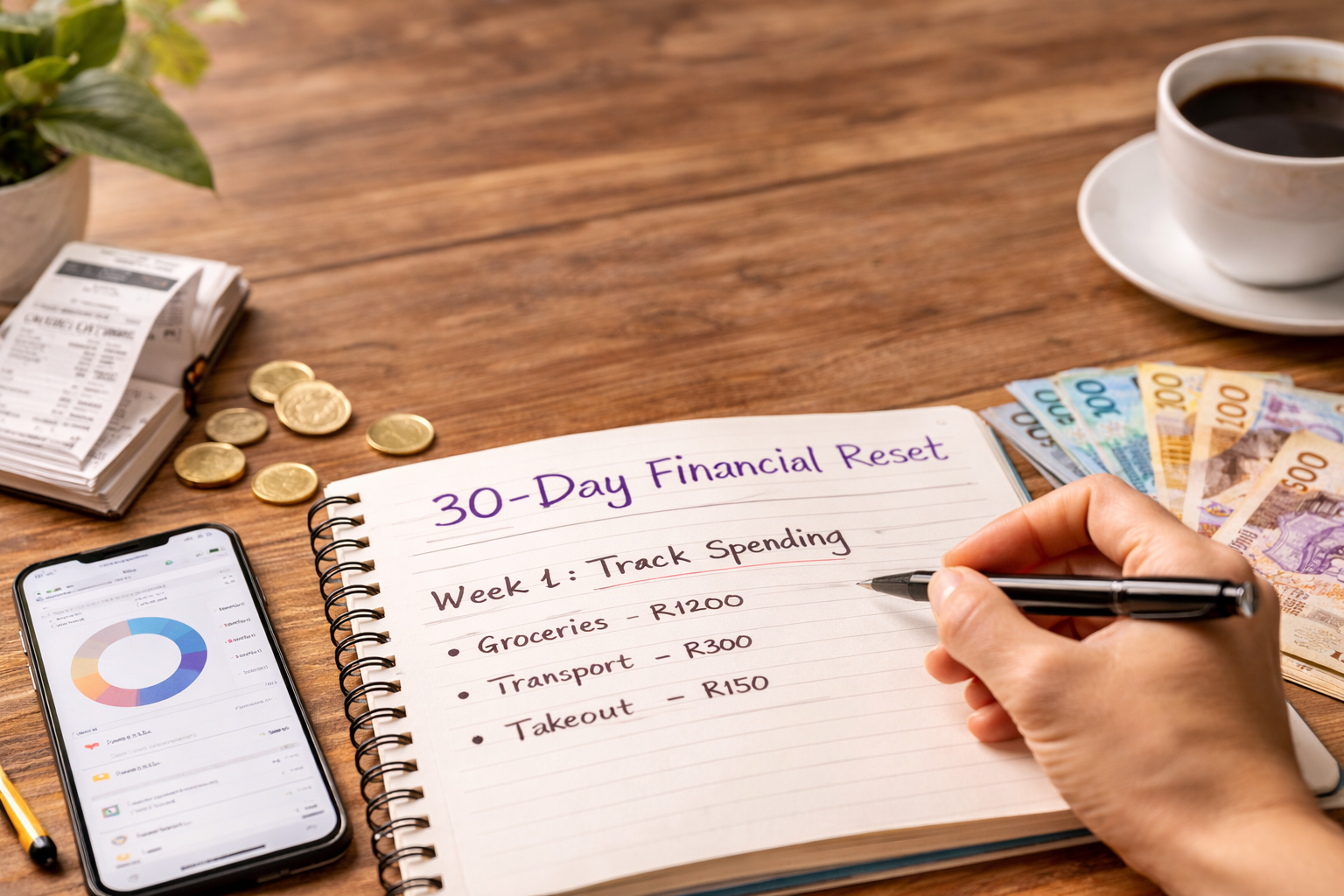
Step 1: Track everything for 7 days
For the next week, write down every expense.
Yes — every one.
- Groceries
- Fuel or taxi money
- Streaming subscriptions
- Takeaways
- Data
- Quick “just this once” purchases
Importantly, this is not about guilt.
Instead, this is about visibility.
At this stage, you are gathering evidence, not attacking yourself.
If you want help with the structure, the CFPB has a simple spending tracker tool that can help you capture where your money is actually going.
Step 2: Categorize your spending
At the end of that first week, group your expenses into three buckets:
- Needs: rent, groceries, transport, utilities, school costs
- Lifestyle: eating out, entertainment, subscriptions, convenience purchases
- Leaks: impulse buys, duplicate spending, mindless swipes, recurring things you barely use
This is where the truth usually shows up. In most cases, it’s not dramatic — it’s subtle.
Most people do not discover that they are reckless.
They discover that they have been spending on autopilot.
That is a very different problem — and a much more fixable one.
Step 3: Work out your monthly burn rate
Your burn rate is how much money you need each month to keep life going as it currently is.
More importantly, this matters because it tells you:
- how much pressure your income is under
- how fragile your current setup is
- how much room you actually have to save or invest
A lot of people obsess over income but ignore burn rate.
That is backwards.
You can earn more and still feel broke if your money has no structure. But once you understand your burn rate, you start seeing the game differently.
Real example: what this looks like in practice
Let’s say someone earns R15,000 per month.
- Rent: R5,000
- Transport: R1,500
- Groceries: R2,500
- Data, airtime, and subscriptions: R1,200
- Eating out and convenience spending: R1,800
- Family support / miscellaneous: R1,500
- Random swipes and “small” spending: R1,200
That is already R14,700.
And that is exactly how people end up saying, “I make money, but I never seem to get ahead.”
Not because they are hopeless.
Because the money is disappearing in ways that do not feel dramatic in the moment.
Now imagine they tighten just R1,500 to R2,000 of unnecessary leakage per month.
That is suddenly the beginning of an emergency fund, debt relief, or seed capital for something better.
For this reason, that is why awareness matters so much. The problem is often not one giant disaster. It is 20 small unplanned decisions adding up every month.
Week 2: Control (Stop the Bleeding)
Once you have told the truth, the next move is not to become perfect. Instead, the focus shifts to control.
It is to regain control.
This week is about reducing pressure fast.
Step 4: Cut the obvious waste first
Do not start by cutting the things that make life bearable.
Start with the stuff that adds little value.
Things like:
- subscriptions you forgot about
- repeat convenience spending that has become habit
- multiple small swipes that bring no real benefit
- buying to relieve stress, boredom, or frustration
Notice what we are doing here: not punishment, but pressure relief.
You are not trying to build a miserable life.
You are trying to stop funding chaos.
Step 5: Build a simple spending plan
Forget complicated budgeting apps for now.
Use a structure simple enough to follow when you are tired:
- 50–60% Essentials
- 20–30% Flexible lifestyle spending
- 10–20% Savings, debt reduction, or investing
This is not a law. It is a starting point.
Your percentages may look different depending on your income and responsibilities. That is okay. The point is to tell each rand where it belongs before you spend it.
If you want a basic official worksheet to compare your income and expenses, the CFPB also has a monthly budget tool that can help.
Step 6: Separate your money
In fact, this is one of the most underrated fixes in personal finance.
If all your money sits in one account, everything feels available.
And when everything feels available, overspending becomes much easier.
A simple structure can change that:
- Main account: income lands here
- Spending account: daily swipes and normal use
- Savings account: emergency buffer and future goals
This creates friction in the right places.
And friction is good when you are trying to protect your future self from impulse decisions.
If this is the first time you are seeing your money clearly, you are already ahead of where most people stay for years.
Most never get this far.
Join the Weekly SPI Newsletter
Practical insights. Real opportunities. Zero fluff.
Week 3: Stability (Create Breathing Room)
Now we move from control into protection. More importantly, this is where things start to feel stable.
At this point, this is where your finances stop feeling so fragile.
Step 7: Start an emergency buffer
You do not need a massive emergency fund in the first month.
You need a beginning.
A first target like R500 to R1,000 is enough to matter.
That money can prevent a small problem from becoming a crisis.
- unexpected transport
- urgent medication
- a school cost you forgot about
- a sudden household expense
Without a buffer, every inconvenience becomes an emergency. And emergency mode is expensive.
Step 8: Automate something small
Automation matters because discipline is unreliable when life gets hard.
Even a small automatic transfer helps:
- R50 per week
- R100 after payday
- a fixed amount to savings before lifestyle spending starts
The amount matters less than the behavior.
You are teaching your money to move with intention instead of emotion.
Step 9: Identify your stress spending triggers
This part is huge, and most articles skip it.
Money problems are rarely just math problems. In fact, they are often behavioral and emotional.
They are behavior problems, pressure problems, habit problems, and emotional problems too.
Ask yourself honestly:
- Do I spend more when I am stressed?
- Do I buy convenience because I feel too tired to think?
- Do I spend to keep up socially?
- Do I avoid checking my bank account because it makes me anxious?
The American Psychological Association has written about how money stress affects people’s decisions and wellbeing, and that matters here. You do not need to “win” the emotional side of money in one month. But you do need to notice the patterns that keep pulling you backwards.
Because once you can name the trigger, you can start building around it.
Week 4: Growth (Start Moving Forward)
This is where the article shifts from survival mode to progress mode. At this point, momentum starts building.
And that shift matters.
You are not doing all this work just to stay stuck more comfortably. You are doing it so you can create forward movement.
Step 10: Identify one income upgrade
Pick one realistic way to improve income over time.
Not five. One.
For example:
- freelance work based on a skill you already have
- selling a service locally
- commission-based side income
- digital work you can start small
- a weekend hustle that does not require big startup capital
The point is not to build a seven-figure business in 30 days.
The point is to stop believing your salary is your only financial option.
Step 11: Give saved money a job
The money you stop wasting should not just sit around waiting to be swallowed by the next random month.
Give it a role.
It can go toward:
- your emergency fund
- debt repayment
- a small investment plan
- learning a skill that improves your earning power
Money without a job gets absorbed.
Money with a mission starts changing your life.
Step 12: Build a weekly money check-in
This might be the habit that changes the most over the long term.
Once a week, sit down for 15 minutes and ask:
- What came in?
- What went out?
- What surprised me?
- Where did I slip?
- What do I need to adjust this week?
That is it.
Not a three-hour budgeting session. Not a dramatic reset every month. Just a short, honest check-in that keeps you connected to your money.
That is how you prevent drift.
What Changes After 30 Days?
If you do this properly, here is what usually changes first:
- You stop guessing where your money went
- You notice spending patterns faster
- You feel less panicked at the end of the month
- You make fewer emotional decisions
- You start building momentum instead of restarting constantly
And that last point matters more than most people realize.
Because personal finance is not won by one perfect month. Instead, it is built through consistency over time.
It is won when you stop living in financial whiplash.
That is what this 30-day plan is really about.
Why This Matters So Much
Financial literacy is not just for “finance people.” It is basic life protection.
That is one reason the Financial Sector Conduct Authority and broader financial education initiatives in South Africa keep emphasizing financial capability and consumer education. If people do not understand how money works in their own lives, they are easier to pressure, easier to mislead, and more likely to stay stuck. You can see one of those financial literacy efforts here.
That is why this article is not just about budgeting.
Instead, it is about reducing chaos, building self-trust, and proving to yourself that your money can be managed on purpose — even before everything is perfect.
Where This Fits in the Bigger SPI Funnel
This article sits right in the middle of an important transition:
money psychology → financial control → income building → passive income
That is why this piece matters so much.
It connects mindset to action.
If your last read was:
Why Most People Stay Broke (Even With Good Income)
Then this is your bridge article — the one that turns recognition into a plan.
And after this, the next logical step is not more guilt.
It is momentum.
Once your money is under control, the next step is to make it start working for you.
Next: How to Build Your First R1,000 Passive Income Stream
And if you are moving into higher-risk areas like crypto or DeFi later, make sure you understand the risk side first:
Final Thought
You do not need a brand-new life to fix your finances.
At the core of it all is a better system.
What actually moves the needle is fewer hidden leaks, fewer emotional swipes, fewer avoidable mistakes, and more visibility.
That is what gives you back your power.
Not motivation. Not hype. Not pretending everything is fine.
Instead, it comes down to one thing: structure.
Because structure does something motivation never can:
it keeps working even when you are tired.