
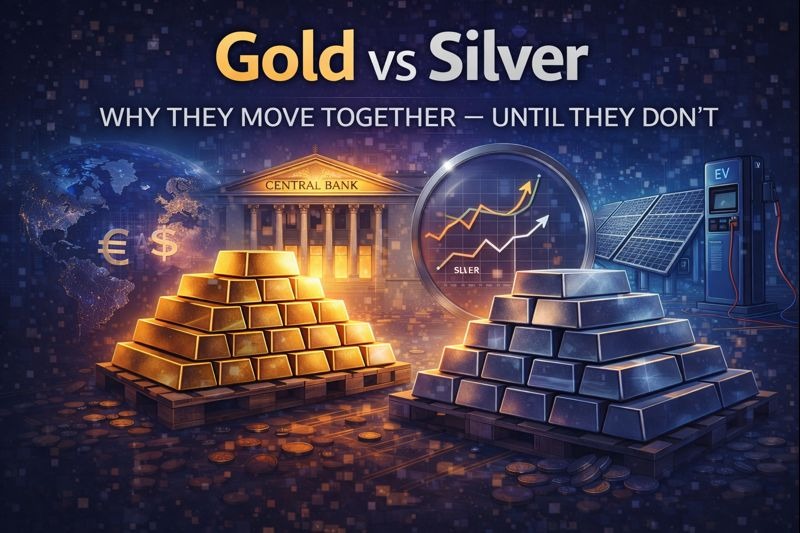
Gold vs silver is one of the most misunderstood relationships in financial markets.
At first glance, they look similar. They’re both precious metals, both considered hedges, and often discussed in the same breath.
Yet over time, their price behavior regularly diverges — sometimes dramatically.
This article explains why gold and silver often move together, why they eventually separate, and what actually drives the difference.
Gold vs Silver: Why They Often Move Together
Gold and silver tend to rise together when the monetary backdrop shifts.
Shared drivers include:
- Falling or peaking interest rates
- Currency debasement concerns
- Increased demand for hard assets
- Rising macro uncertainty
In these environments, capital flows into precious metals broadly — and silver often follows gold’s lead.
This is why silver frequently begins moving after gold breaks out.
Why Gold Leads and Silver Lags
The reason gold leads is simple: gold is a reserve asset.
Gold is bought first because it is:
- Held by central banks
- Used as a monetary hedge
- Less volatile
- Deeply liquid
When macro conditions shift, gold absorbs institutional demand early.
Silver, on the other hand, tends to lag because it is not primarily a reserve metal.
This distinction is explored in detail in our gold deep dive: Why Gold Keeps Rising.
Gold vs Silver: The Industrial Demand Factor
This is where the gold vs silver relationship breaks down.
Silver is not just a monetary metal — it is a critical industrial input.
Silver demand is tied to:
- Solar panels
- Electronics and semiconductors
- EVs and electrification
- Data centers and grid upgrades
Gold does not have this dependency.
As a result, silver is influenced by both macro conditions and real-world industrial demand — which introduces volatility.
This dual role is explained fully in our silver deep dive: Why Silver Is Surging.
Why Silver Can Explode After Gold Moves
Once gold establishes a trend, attention often shifts to silver.
Several things happen:
- Silver appears undervalued relative to gold
- Investment demand increases
- Silver’s smaller market amplifies moves
Because silver has:
- Less liquidity
- Structural supply deficits
- Higher beta
Price adjustments tend to be faster and more aggressive.
This is why silver often feels “quiet” — until it suddenly isn’t.
Gold vs Silver During Market Stress
During severe market stress, gold typically outperforms silver.
Why?
- Gold is a pure safe-haven
- Silver is partially tied to economic activity
In recessions or liquidity events, industrial demand for silver can temporarily weaken — even if gold remains strong.
This explains why silver can underperform during sharp downturns, then rebound aggressively later.
How Central Banks Change the Equation
Central banks play a key role in the gold vs silver dynamic.
They buy gold — not silver.
This creates a constant institutional bid for gold that silver does not enjoy.
According to research from the World Gold Council, central bank demand has become one of the strongest structural drivers of gold prices.
This is why gold behaves more steadily, while silver remains reactive.
What This Means for Investors
Understanding gold vs silver is not about choosing one “winner.”
It’s about understanding roles:
- Gold: stability, reserves, macro hedge
- Silver: volatility, growth exposure, industrial demand
Gold tends to lead cycles.
Silver tends to amplify them.
Confusing those roles is where many investors get shaken out.
Final Thought
Gold and silver move together when money flows into hard assets.
They separate when their underlying drivers take over.
Understanding why they diverge is what turns confusion into clarity.
Disclaimer: This article is for educational purposes only and does not constitute financial advice.