
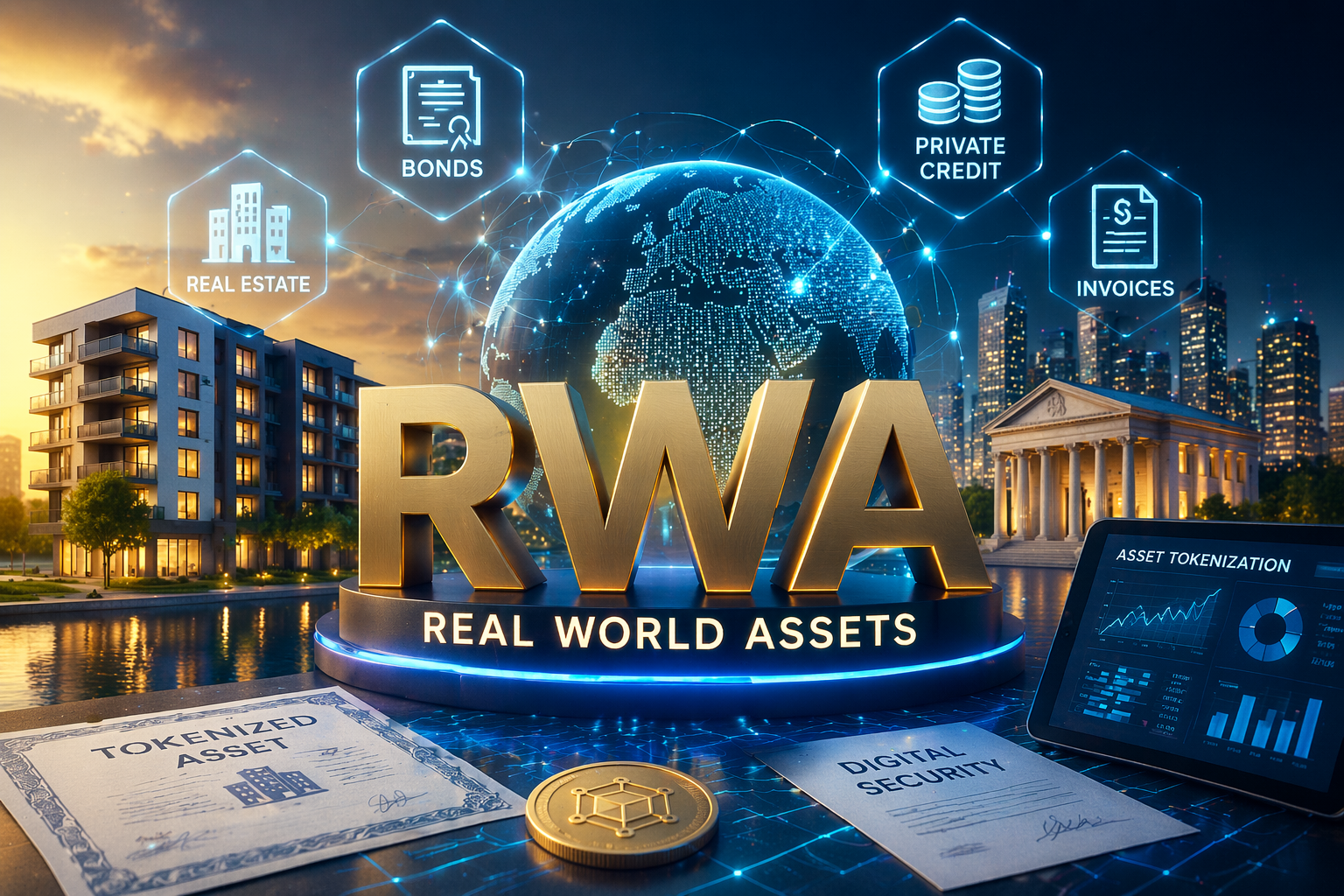
RWA investing is becoming one of the most important conversations in crypto, DeFi, and modern finance.
At first, the term can sound technical.
Real-world assets. Tokenization. Blockchain settlement. Digital ownership. On-chain finance.
However, the basic idea is easier to understand than the language around it.
RWA investing is about connecting real-world assets, such as property, bonds, private credit, commodities, invoices, or fund products, to blockchain-based systems.
Instead of crypto being used only for speculative tokens, RWA projects try to bring assets with real-world value into digital financial infrastructure.
That is why the topic matters.
Still, beginners need to be careful. Tokenization does not automatically make an investment safe, liquid, regulated, or easy to understand.
Disclaimer: This article is for educational purposes only and does not constitute financial advice. RWA investing, tokenized assets, crypto assets, DeFi platforms, and blockchain-based financial products can carry risk. Always do your own research and consider your personal circumstances before making financial decisions.
Why RWA Investing Deserves a Careful Explanation
For years, many people viewed crypto mainly through price charts, Bitcoin cycles, meme coins, NFTs, trading, and DeFi yield.
Meanwhile, a quieter conversation has been developing around how blockchain technology could connect to traditional assets.
This conversation is important because traditional finance already has large markets for property, bonds, credit, funds, commodities, and other assets.
Blockchain systems may help some of these markets become more programmable, more transparent, or easier to access in certain situations.
However, this does not mean every RWA project is strong.
A tokenized asset can still have legal risk, custody risk, platform risk, valuation risk, regulatory risk, and liquidity problems.
Because of that, RWA investing should be approached with research first, not excitement first.
If you are still building your crypto safety foundation, also read the SPI guides on crypto project vetting checklist, the 10-step DeFi safety checklist, and stablecoins explained.
What Does RWA Mean in Crypto?
RWA stands for Real-World Assets.
In crypto and DeFi, the term usually refers to assets from the traditional economy that are represented, financed, tracked, or traded through blockchain-based systems.
These assets can include:
- Real estate
- Government bonds
- Private credit
- Commodities
- Invoices
- Money market products
- Business financing agreements
- Tokenized funds
- Asset-backed securities
In simple terms, the key idea is representation.
A real-world asset exists outside the blockchain. Then a token, smart contract, or blockchain record represents some kind of claim, exposure, ownership interest, access right, or financial agreement connected to that asset.
For example, a tokenized property product may not mean you personally own the physical building in your own name.
Instead, the token may represent exposure through a legal structure, company, fund, platform, or contractual arrangement.
That difference matters.
Beginners should never assume that holding a token automatically means they legally own the underlying asset in the same way they would own a house, bond, share, or fund unit through traditional channels.
With RWA investing, the legal structure is just as important as the technology.
What Is Tokenization?
Tokenization is the process of representing an asset or claim as a digital token on a blockchain or distributed ledger.
In simple terms, it turns some form of ownership, exposure, or financial right into a digital unit that can be recorded and transferred through blockchain infrastructure.
Although this sounds new, the broader concept is not completely foreign.
Traditional finance already uses records, contracts, units, certificates, shares, and account balances to represent ownership or claims.
Tokenization changes the infrastructure that records and moves those claims.
The Bank for International Settlements describes token arrangements as systems that use digital tokens and programmable platforms to support financial market functions. You can read more from BIS here: BIS: Tokenisation in the Context of Money and Other Assets.
The OECD has also discussed tokenisation as the representation of real assets on distributed ledgers or the issuance of traditional asset classes in tokenized form. You can read their report here: OECD: Tokenisation of Assets and Distributed Ledger Technologies in Financial Markets.
For beginners, the easiest way to understand tokenization is this:
Tokenization is not always the asset itself. It is usually a digital representation or structure connected to the asset.
That is why due diligence is so important.
Why RWA Investing Is Getting Attention
RWA investing is gaining attention because it connects two worlds that used to feel separate.
On one side, traditional finance has assets such as bonds, real estate, credit markets, funds, invoices, and commodities.
On the other side, blockchain technology offers programmable records, faster settlement, transparent transactions, global access, and smart contracts.
When these two worlds meet, people start asking important questions.
- Can financial assets settle faster?
- Can ownership records become more transparent?
- Can smaller investors access assets that were previously difficult to reach?
- Can markets operate with fewer manual processes?
- Can DeFi connect to assets with real-world cash flows?
These questions are serious.
However, serious does not mean risk-free.
Many RWA markets are still young. Liquidity may be limited. Regulation may be unclear. Legal structures may differ by country. Platforms may also rely heavily on trusted third parties.
In some cases, the token may be easy to buy but difficult to sell.
Therefore, RWA investing should be studied carefully before money is committed.
RWA Investing Is Not Just Another Crypto Narrative
Crypto markets often move through narratives.
One season may focus on DeFi. Another may focus on NFTs. Later, attention may shift to AI tokens, gaming tokens, meme coins, liquid staking, Bitcoin layer-2s, or real-world assets.
Because of that, some beginners treat every new narrative like a quick trade.
That approach can be dangerous.
RWA investing is not only about finding a token that may increase in price.
More importantly, the deeper idea is about financial infrastructure.
If tokenization develops responsibly, it could affect how assets are issued, recorded, transferred, financed, and settled.
That is a much bigger topic than short-term speculation.
At the same time, a good long-term trend can still contain bad projects.
A strong narrative does not protect you from weak platforms, poor tokenomics, unclear legal rights, low liquidity, exaggerated claims, or bad risk management.
For that reason, RWA investing should be approached as research first, not excitement first.
Examples of Real-World Assets That Can Be Tokenized
Different RWA projects focus on different types of assets.
Some are easier for beginners to understand than others.
| Asset Type | What It Means | Beginner Caution |
|---|---|---|
| Real estate | Property exposure represented through tokens, funds, companies, or legal structures | Check ownership rights, fees, liquidity, rental assumptions, and legal structure |
| Government bonds | Tokenized exposure to government debt instruments or treasury-backed products | Understand issuer risk, custody, redemption terms, and jurisdiction |
| Private credit | Loans or financing arrangements issued to businesses or borrowers | Credit risk, default risk, and transparency matter |
| Invoices | Short-term business receivables financed through digital platforms | Check borrower quality and collection risk |
| Commodities | Tokenized exposure to assets such as gold or other physical commodities | Custody, audits, redemption, and storage must be clear |
| Tokenized funds | Fund units represented through blockchain-based infrastructure | Regulation, eligibility, fees, and custody need careful review |
This table shows why RWA investing cannot be treated as one simple category.
Tokenized real estate is not the same as tokenized treasuries.
Private credit is not the same as tokenized gold.
Invoice financing is not the same as a tokenized fund.
Each asset has its own risks, rules, cash flows, and legal structure.
How RWA Investing Works in Practice
RWA investing usually involves several layers.
Beginners often focus only on the token, but the token is just one part of the system.
A typical RWA structure may include:
- The real-world asset
- A company, fund, trust, or legal entity
- A custodian or asset holder
- A platform that issues or manages the token
- A blockchain network
- A smart contract
- Investors or token holders
- Rules for income, redemption, transfer, and compliance
That means the investor is not only trusting the blockchain.
They may also be trusting the issuer, the custodian, the legal documents, the platform, the auditor, the smart contract, and the jurisdiction where the structure operates.
This is why “it is on-chain” is not enough.
Blockchain transparency can help, but it does not automatically prove that the underlying real-world asset is safe, properly owned, fairly valued, or legally enforceable.
The Main Benefits People See in RWA Tokenization
RWA tokenization attracts interest because it may improve parts of traditional finance.
Still, these benefits should be understood as potential benefits, not guaranteed outcomes.
1. Smaller Entry Points
Tokenization may allow assets to be divided into smaller units.
For example, a large property or bond product may be difficult for small investors to access directly. A tokenized structure could create smaller participation units.
However, smaller entry does not remove risk.
A small investment in a risky product is still risky.
2. Faster Settlement
Traditional financial markets can involve several steps before a transaction fully settles.
Blockchain-based systems may help shorten some settlement processes by using shared ledgers and programmable transactions.
Nevertheless, settlement speed depends on the full system, not only the token.
If the project still depends on manual off-chain processes, the benefit may be limited.
3. More Transparency
On-chain transactions can make certain records easier to inspect.
That can help users see token transfers, supply, wallet activity, and smart contract interactions.
However, real-world assets still need off-chain verification.
A blockchain can show token movement, but it may not prove property condition, borrower quality, legal ownership, rental performance, or asset valuation by itself.
4. Programmability
Smart contracts can automate certain rules.
For example, a system may automate distributions, transfers, compliance checks, or redemption processes.
Even so, code cannot solve every real-world issue.
Legal disputes, defaults, asset damage, fraud, regulatory changes, and valuation problems may still require human processes and legal enforcement.
5. Global Access
Some tokenized assets may become easier to access across borders.
That can increase market reach.
At the same time, global access creates regulatory complexity.
Investors must understand whether they are allowed to participate, which laws apply, and what protections they actually have.
The Biggest Risks in RWA Investing
RWA investing can sound safer than other crypto areas because the assets are connected to the real world.
That assumption can be misleading.
Real-world exposure may reduce some types of risk, but it introduces others.
1. Legal Structure Risk
The most important question is not only “What asset backs this token?”
A better question is:
What legal right does the token holder actually have?
Some tokens may represent direct ownership. Others may represent a claim through a company, fund, trust, or contractual structure. In certain cases, the token may mainly provide economic exposure rather than direct asset ownership.
If the legal structure is unclear, the risk is higher.
2. Custody Risk
Real-world assets need to be held, managed, verified, or controlled by someone.
For example, tokenized gold needs custody. Tokenized real estate needs legal ownership and property management. Tokenized credit needs borrower oversight. Tokenized funds need administrators and custodians.
If the custodian or issuer is weak, the token can become risky even if the asset sounds attractive.
3. Liquidity Risk
Liquidity means the ability to buy or sell without major difficulty.
Many RWA products sound liquid because they are tokenized.
However, tokenization and liquidity are not the same thing.
A token can exist on-chain and still have few buyers, low trading volume, transfer restrictions, long redemption periods, or limited secondary markets.
This is one of the biggest beginner misunderstandings.
4. Valuation Risk
Some real-world assets are difficult to value.
Property, private credit, invoices, private funds, and specialised assets may not have clear daily market prices.
As a result, the displayed token value may depend on estimates, issuer reports, appraisals, or models.
Beginners should ask how the asset is valued and who checks the numbers.
5. Regulatory Risk
Tokenized assets can sit at the intersection of securities law, crypto regulation, property law, tax rules, cross-border restrictions, and financial services regulation.
That creates complexity.
A product may be available in one country but restricted in another. Rules may also change over time.
South African readers should also remember that crypto assets have been declared financial products under the Financial Advisory and Intermediary Services Act framework. You can read the Government Gazette declaration here: Declaration of a Crypto Asset as a Financial Product.
6. Platform Risk
Even if the underlying asset is real, the platform can still create risk.
The platform may have weak security, poor disclosures, bad governance, unclear withdrawal rules, limited support, or unrealistic marketing.
That is why platform due diligence matters.
Related SPI read: Crypto Project Vetting Checklist.
RWA Investing vs Traditional Investing
RWA investing does not automatically replace traditional investing.
In many cases, it is better to view it as a possible extension of financial markets.
| Area | Traditional Investing | RWA Investing |
|---|---|---|
| Asset access | Through brokers, banks, funds, property deals, or financial institutions | Through tokenized platforms, blockchain networks, or digital asset structures |
| Settlement | Often handled through traditional market infrastructure | May use blockchain or distributed ledger systems |
| Transparency | Depends on reports, statements, and regulated disclosures | May include on-chain data plus off-chain reporting |
| Legal rights | Usually defined through traditional contracts, securities law, or property law | Depends on token structure, issuer documents, and jurisdiction |
| Liquidity | Can range from highly liquid to very illiquid | Can also range from liquid to highly restricted |
| Risk | Market, credit, liquidity, inflation, and management risk | Traditional risks plus smart contract, custody, platform, and regulatory risks |
Ultimately, the important point is balance.
RWA investing may offer useful innovation, but it also adds new layers of complexity.
A beginner should not assume that newer automatically means better.
RWA Investing vs DeFi Yield
RWA investing and DeFi yield can overlap, but they are not the same thing.
DeFi yield often comes from on-chain lending, liquidity pools, staking, incentives, borrowing demand, or protocol activity.
RWA yield may come from real-world sources such as interest payments, rental income, credit repayments, bond yields, invoice financing, or fund income.
That difference matters because the risk source changes.
| Question | DeFi Yield | RWA Yield |
|---|---|---|
| Where does yield come from? | On-chain activity, incentives, lending, liquidity, or protocol mechanics | Real-world income, credit, bonds, rent, invoices, or asset returns |
| Main risk | Smart contract, token, liquidity, oracle, and protocol risk | Credit, legal, custody, liquidity, platform, and valuation risk |
| What needs checking? | Contracts, audits, liquidity, TVL, tokenomics, withdrawal rules | Legal documents, asset backing, issuer, custodian, valuation, redemption rules |
| Beginner danger | Chasing high APY without understanding risk | Assuming real-world backing makes everything safe |
Both areas require research.
In fact, RWA products may require even more off-chain due diligence because the asset, issuer, and legal structure matter so much.
How Beginners Can Research RWA Projects
RWA research should be structured.
Do not rely only on social media threads, influencer posts, or impressive dashboards.
Start with basic questions.
1. What Is the Underlying Asset?
Identify the real-world asset behind the product.
Is it property, bonds, private credit, invoices, commodities, or something else?
Then ask whether you understand that asset class outside crypto.
If the traditional version is confusing, the tokenized version will likely be even harder.
2. Who Is the Issuer?
The issuer matters because it may control the structure, documents, reporting, redemptions, and investor communication.
Research the company, team, directors, registration, track record, and reputation.
If the issuer is difficult to verify, be careful.
3. What Legal Right Does the Token Represent?
This question is critical.
Does the token represent ownership, a claim, a debt instrument, fund exposure, revenue share, membership interest, or something else?
Read the documents carefully.
If the legal right is not clear, the risk is difficult to measure.
4. Who Holds or Verifies the Asset?
Real-world assets require custody, administration, or verification.
Ask who holds the asset, who audits it, who values it, and how often reporting happens.
For example, tokenized gold should have clear custody and audit information. Tokenized credit should explain borrower quality, default risk, and collection processes. Tokenized real estate should explain ownership, management, expenses, and income assumptions.
5. How Do Withdrawals or Redemptions Work?
Many beginners focus on buying.
Selling or redeeming matters just as much.
Check whether there is a secondary market, redemption window, lock-up period, withdrawal fee, minimum holding period, or compliance restriction.
If exiting is difficult, the investment may be less flexible than it appears.
6. What Happens if Something Goes Wrong?
This question separates strong projects from weak ones.
Consider what would happen if the borrower defaults.
For property-backed products, think about how vacancies could affect income.
Also ask what protections exist if the issuer fails.
A smart contract bug could create another layer of risk.
Regulatory restrictions may also affect whether users can access, transfer, or redeem the product.
A serious project should explain these risks clearly.
Join the Weekly SPI Newsletter
Practical insights. Real opportunities. Zero fluff.
A Simple RWA Investing Checklist
Before exploring any RWA project, use a checklist.
| Check | Question |
|---|---|
| Asset | What real-world asset supports the token or product? |
| Issuer | Who created and manages the structure? |
| Legal rights | What does the token holder actually own or claim? |
| Custody | Who holds, manages, or verifies the underlying asset? |
| Yield source | Where does any income or return come from? |
| Liquidity | Can the token be sold or redeemed easily? |
| Fees | What platform, management, transaction, and redemption fees apply? |
| Regulation | Which jurisdiction and rules apply? |
| Transparency | Are reports, audits, wallets, documents, or dashboards available? |
| Risk disclosure | Does the project explain what can go wrong? |
Of course, this checklist will not remove all risk.
However, it can stop you from making decisions based only on excitement.
Common Mistakes Beginners Should Avoid
RWA investing can be useful to study, but beginners should avoid common mistakes.
- Assuming tokenized assets are automatically safe
- Ignoring the legal structure behind the token
- Buying only because a project uses the words “real-world”
- Confusing tokenization with guaranteed liquidity
- Ignoring platform and custody risk
- Chasing yield without understanding the source
- Trusting dashboards without checking documents
- Assuming institutional interest means every project is strong
- Ignoring tax and regulatory considerations
- Using money needed for essential expenses
These mistakes are avoidable.
Nevertheless, they happen when people move too fast.
Therefore, the safer approach is to slow down, understand the structure, and treat every project as something that must earn your trust.
Where RWA Investing Fits in a Portfolio
RWA investing should not be treated as a magic replacement for basic financial planning.
Before exploring advanced or emerging products, it is usually wiser to understand the foundation.
That foundation may include emergency savings, debt control, budgeting, long-term investing education, retirement planning, and basic risk management.
Only after that does it make sense to study more specialised areas like tokenized assets.
For many beginners, RWA investing may start as education rather than allocation.
That is completely fine.
Learning the space early does not mean you must invest immediately.
A balanced approach may look like this:
- First, understand your personal finances.
- Next, build basic savings and reduce expensive debt.
- Then, learn traditional investing concepts.
- After that, study crypto and DeFi safety.
- Finally, research RWA investing with a clear risk framework.
Related SPI reads:
- 30-Day Financial Reset
- Passive Income Ideas for Beginners
- Active Income vs Passive Income
- Best ETFs for Beginners in 2026
Why RWA Investing Matters Long Term
RWA investing matters because it points to a broader question.
What happens when blockchain technology moves beyond speculation and starts connecting to real economic activity?
That question is important.
If tokenization develops responsibly, it could influence markets for bonds, funds, property, credit, commodities, and other assets.
At the same time, the future is not guaranteed.
Some RWA projects may succeed. Others may fail. Regulation may slow adoption in some markets and support it in others. Liquidity may improve for certain products but remain weak for others.
Therefore, the best beginner approach is balanced.
Take the trend seriously, but do not treat every project as a good investment.
Study the infrastructure. Understand the risks. Compare projects carefully. Pay attention to legal rights, custody, liquidity, and transparency.
That mindset is more valuable than chasing the latest narrative.
Final Thoughts
RWA investing is one of the more practical areas where crypto and traditional finance may meet.
It connects blockchain infrastructure to assets such as property, bonds, private credit, invoices, commodities, and tokenized funds.
However, beginners should avoid treating RWA investing as a guaranteed opportunity.
Tokenization can improve access, transparency, settlement, and programmability in some cases. Yet it can also introduce legal complexity, custody risk, platform risk, liquidity problems, valuation uncertainty, and regulatory questions.
The main lesson is simple.
Do not invest in an RWA project just because the asset sounds real.
Understand what the token represents. Check the issuer. Read the legal documents. Review custody and audits. Question liquidity. Study the fees. Look for clear risk disclosures.
Most importantly, move at the speed of understanding.
RWA investing may become an important part of the future financial system.
Still, your job as a beginner is not to chase every new trend.
Your job is to learn carefully, protect your capital, and make decisions based on evidence rather than excitement.