
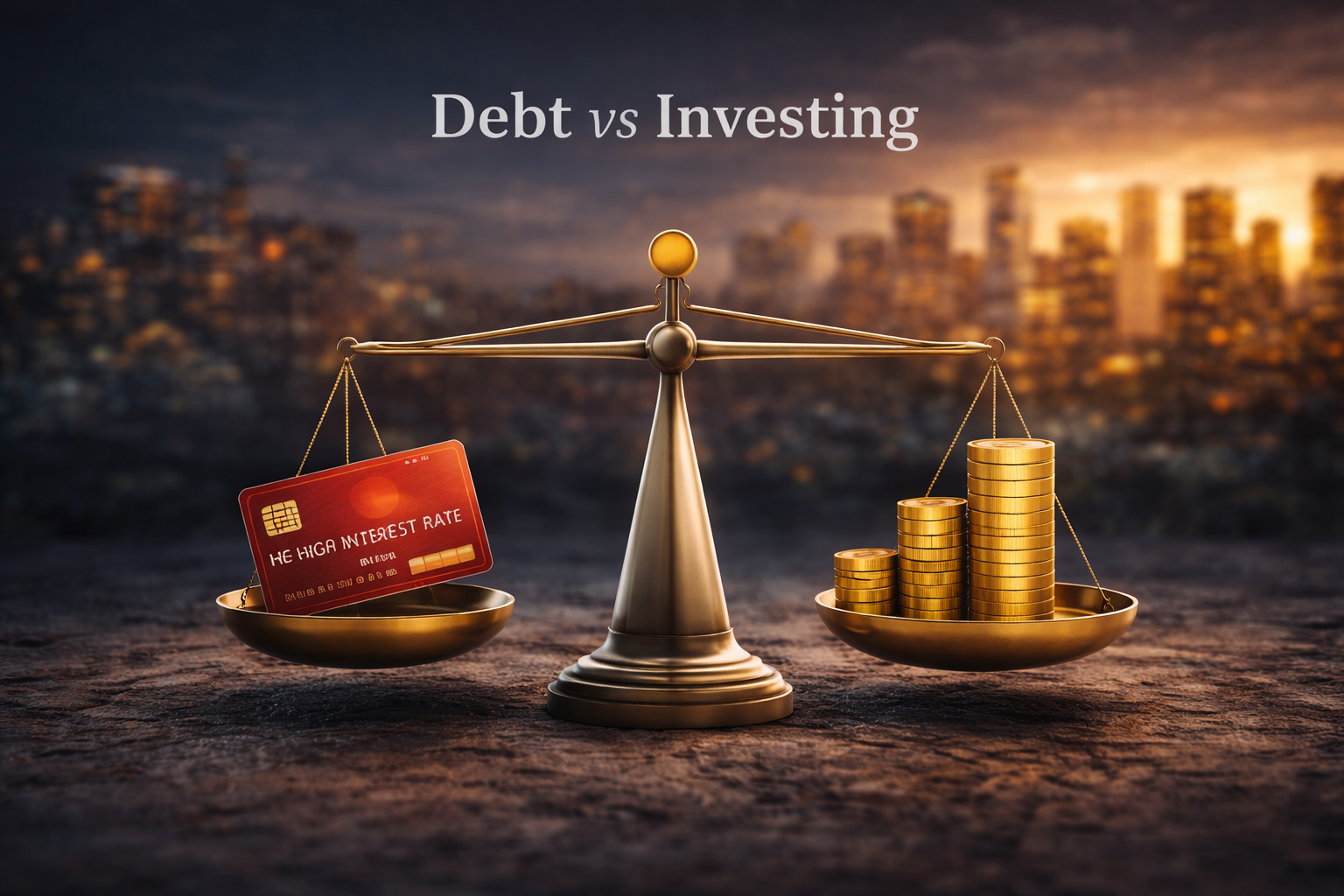
If you’re trying to build wealth in 2026, you’ve probably asked this question:
Should I pay off my debt first, or should I invest?
This isn’t just a math problem. It’s a risk management decision, a psychological decision, and a long-term strategy decision.
Disclaimer: This article is for educational purposes only and does not constitute financial advice. All investing involves risk.
Step 1: Understand the True Cost of Your Debt
Not all debt is equal.
| Type of Debt | Typical Interest | Priority Level |
|---|---|---|
| Credit Cards | 15–25%+ | Pay off aggressively |
| Personal Loans | 8–18% | High priority |
| Car Loans | 6–12% | Moderate priority |
| Home Loans | 5–10% | Case-by-case |
| Student Loans | 3–8% | Lower priority (context matters) |
If your debt interest rate is higher than what you realistically expect to earn from investing, mathematically it often makes sense to eliminate the debt first.
Step 2: Compare Expected Investment Returns (Realistically)
Markets fluctuate. Expected returns are not guaranteed returns.
Historically:
- Diversified stock portfolios have averaged mid-to-high single-digit returns over long periods.
- Crypto returns can be extremely volatile and unpredictable.
- Cash returns depend heavily on interest rate cycles.
According to Investor.gov, diversification reduces risk but does not eliminate loss.
If you’re paying 20% interest on a credit card, earning 8% in the market does not win mathematically.
Step 3: Factor in Psychological Relief
Debt creates mental drag.
Even if investing might theoretically outperform low-interest debt, being debt-free can:
- Reduce stress
- Increase risk tolerance
- Improve sleep
- Increase financial flexibility
Financial decisions are not made in spreadsheets alone.
Step 4: Consider the Hybrid Approach
In many real-life situations, the best solution is not “all debt” or “all investing.”
Example Hybrid Strategy:
- Pay minimums on low-interest debt
- Aggressively eliminate high-interest debt
- Invest a smaller percentage consistently
This keeps compounding alive while reducing financial risk.
Join the Weekly SPI Newsletter
Practical insights. Real opportunities. Zero fluff.
When You Should Prioritize Paying Off Debt
- Your interest rate exceeds realistic expected returns.
- You lack an emergency fund.
- Your income is unstable.
- You feel constant stress about repayments.
When Investing Can Make Sense
- Your debt interest is low and fixed.
- You have a stable income.
- Your emergency fund is intact.
- You’re investing long-term in diversified assets.
Related SPI reads:
The Real Question Isn’t “Debt or Investing?”
The real question is:
What improves your financial stability while allowing compounding to work?
Sometimes that’s paying off debt first.
Sometimes that’s investing steadily.
Often, it’s a structured combination of both.
Join the Weekly SPI Newsletter
Practical insights. Real opportunities. Zero fluff.
Final Thoughts
Wealth building in 2026 isn’t about maximizing returns at all costs.
It’s about reducing fragility while increasing long-term compounding.
Eliminate toxic debt. Build stability. Invest consistently.
That’s how you win sustainably.
Leave a Reply