
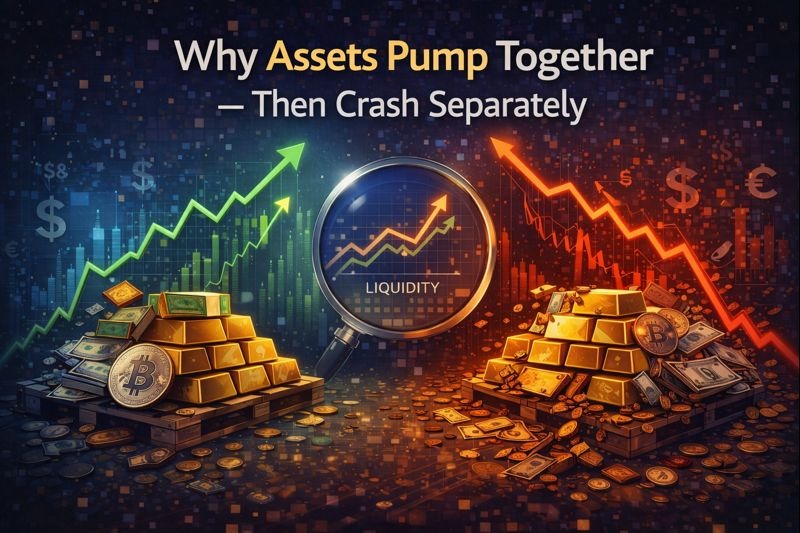
Why assets pump together is one of the most misunderstood dynamics in financial markets.
During strong market phases, it often feels like everything is going up at the same time — stocks, crypto, gold, silver, and even riskier assets.
This creates a powerful illusion: that fundamentals suddenly don’t matter.
But history shows a consistent pattern. Assets often pump together… and then they crash separately.
This article explains why that happens, what actually drives these synchronized rallies, and how understanding this cycle can help you avoid costly mistakes.
Why Assets Pump Together During Rallies
The primary reason why assets pump together is not fundamentals — it’s liquidity.
When liquidity increases or conditions ease, capital flows broadly into markets. Investors become less selective, and risk appetite expands.
This environment tends to lift:
- Equities
- Crypto assets
- Commodities
- Precious metals
Correlation rises because capital is chasing exposure, not value.
The Role of Liquidity and Psychology
Liquidity doesn’t just move markets — it shapes behavior.
As prices rise:
- Confidence increases
- Fear recedes
- Risk tolerance expands
This psychological shift reinforces the rally. Investors extrapolate recent performance and assume the trend is durable.
This is why assets pump together even when their fundamentals have nothing in common.
Why Fundamentals Get Ignored (Temporarily)
During liquidity-driven rallies, fundamentals don’t disappear — they’re postponed.
Markets stop asking:
- What is this asset worth?
- What risks does it carry?
- What happens if conditions tighten?
Instead, the only question becomes: “Is it going up?”
This phase rewards participation, not selectivity.
Why Assets Crash Separately
When liquidity conditions change, correlation breaks down.
Capital becomes selective again. Investors reassess risk. And suddenly, fundamentals matter.
This is where the divergence begins.
- Strong balance sheets hold up better
- Structural demand supports some assets
- Weak narratives unwind first
This explains why assets that rose together can fall very differently.
Gold, Silver, and the Divergence Effect
The precious metals complex offers a clear example.
Gold and silver often rise together during macro-driven rallies. But their behavior diverges when conditions tighten.
Gold tends to remain resilient because of:
- Central bank demand
- Its role as a reserve asset
Silver, meanwhile, is more volatile because it is also tied to industrial demand.
We explored this dynamic in detail in: Why Silver Is Surging and Why Gold Keeps Rising.
Why Crypto and High-Beta Assets Get Hit Harder
High-beta assets benefit most during the “everything up” phase.
But when conditions reverse:
- Liquidity dries up
- Speculative demand vanishes
- Price moves accelerate downward
This is why crypto and other risk assets often experience sharper drawdowns than stocks or gold.
The same psychological forces that push prices up amplify declines on the way down.
Why This Cycle Keeps Repeating
This pattern is not new.
It repeats because:
- Liquidity cycles repeat
- Human behavior doesn’t change
- Markets move faster than fundamentals
Understanding this doesn’t mean timing tops perfectly — it means recognizing the phase you’re in.
This mindset aligns closely with the principles explained in the psychology of money and long-term investing.
What Smart Investors Do Differently
Smart investors don’t fight rallies — but they don’t confuse them with safety either.
They:
- Reduce position size as volatility increases
- Focus on quality when correlation is high
- Prepare mentally for divergence
The goal isn’t to predict crashes. It’s to avoid being surprised when assets stop moving together.
Final Thought
When liquidity flows freely, assets pump together.
When reality returns, they separate.
Understanding this cycle is what turns market noise into clarity.
Disclaimer: This article is for educational purposes only and does not constitute financial advice.