
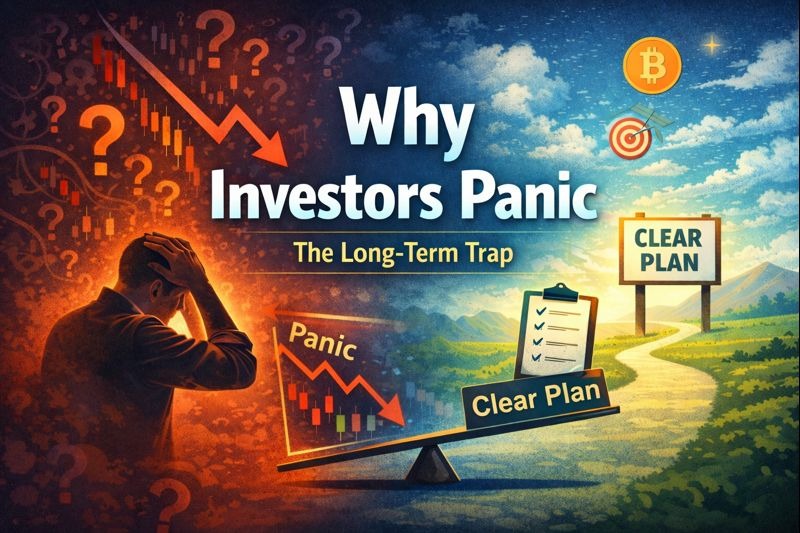
Why investors panic isn’t just about fear — it’s about uncertainty hitting you when you feel responsible for the outcome. That’s why even “long-term” investors still sell at the worst time in stocks, ETFs, and crypto.
You’ve heard it before:
- “I’m in this for the long term.”
- “I won’t panic during market crashes.”
- “Volatility doesn’t bother me.”
And yet… when markets drop hard, many long-term investors still panic. They sell too low, freeze, or abandon a plan they never fully defined.
The uncomfortable truth:
Investors don’t panic because they’re “weak.” They panic because their plan is incomplete — especially under stress.
The Myth of the Rational Long-Term Investor
Most people assume panic selling happens because of emotion. But the bigger issue is preparation: most investors define what they want to buy — not what they’ll do when reality gets ugly.
They define:
- What they want to buy
- How much they hope to make
- Why they believe in the asset
But they don’t define:
- What level of pain is acceptable
- What would justify selling vs. what is normal volatility
- What “sticking to the plan” actually means in real numbers
Why Investors Panic (It’s Not What You Think)
Panic happens when uncertainty meets responsibility.
When prices fall fast, your brain starts asking urgent questions:
- “What if this time is different?”
- “What if I was wrong?”
- “What if I don’t act now?”
And if your rules aren’t written down, every decision feels like an emergency. This is a major reason why investors panic even when they’re “in it for years.”
Why Volatility Feels Worse Than Expected
Most people understand volatility intellectually, but not emotionally. Losses feel heavier than gains — which is why your instincts push you toward “stop the pain” decisions at exactly the wrong time.
Translation: a 30% drop hurts more than a 30% gain feels good — so your brain becomes risk-averse during the sale.
This is why investors panic when their plan relies on vibes instead of boundaries.
The One Rule Most Investors Never Write Down
Here’s the line almost nobody defines before the crash:
“What exactly would make me sell — and what would NOT?”
If your answer is vague — “I’ll know when I see it” — you’re setting yourself up for the exact pattern of why investors panic under pressure.
The SPI Anti-Panic Framework
You don’t need predictions. You need simple rules you can follow when emotions spike.
- Time Horizon Rule
“I’m committed for ___ years unless fundamentals break.” - Max Pain Rule
“I expect drawdowns of up to ___% and won’t act emotionally.” - No-Decision Zone
“During sharp drops, I pause decisions for ___ days.” - Change-My-Mind Rule
“Only these events would make me exit.”
Same psychology across stocks, ETFs, and crypto. The wrapper changes — the behavior doesn’t.
If you want a neutral, non-hype refresher on risk and investing basics, Investor.gov is a solid reference: Investor.gov — Investing basics.
Final Thought
Long-term investing doesn’t fail because people lack discipline. It fails because people never define rules for stress. When the market drops, it doesn’t test your intelligence — it tests your preparation.
Write clarity in calm moments. That’s how you stop doing the thing you swore you wouldn’t do — and that’s the real fix for why investors panic.
Disclaimer: This content is for educational purposes only and is not financial advice.