
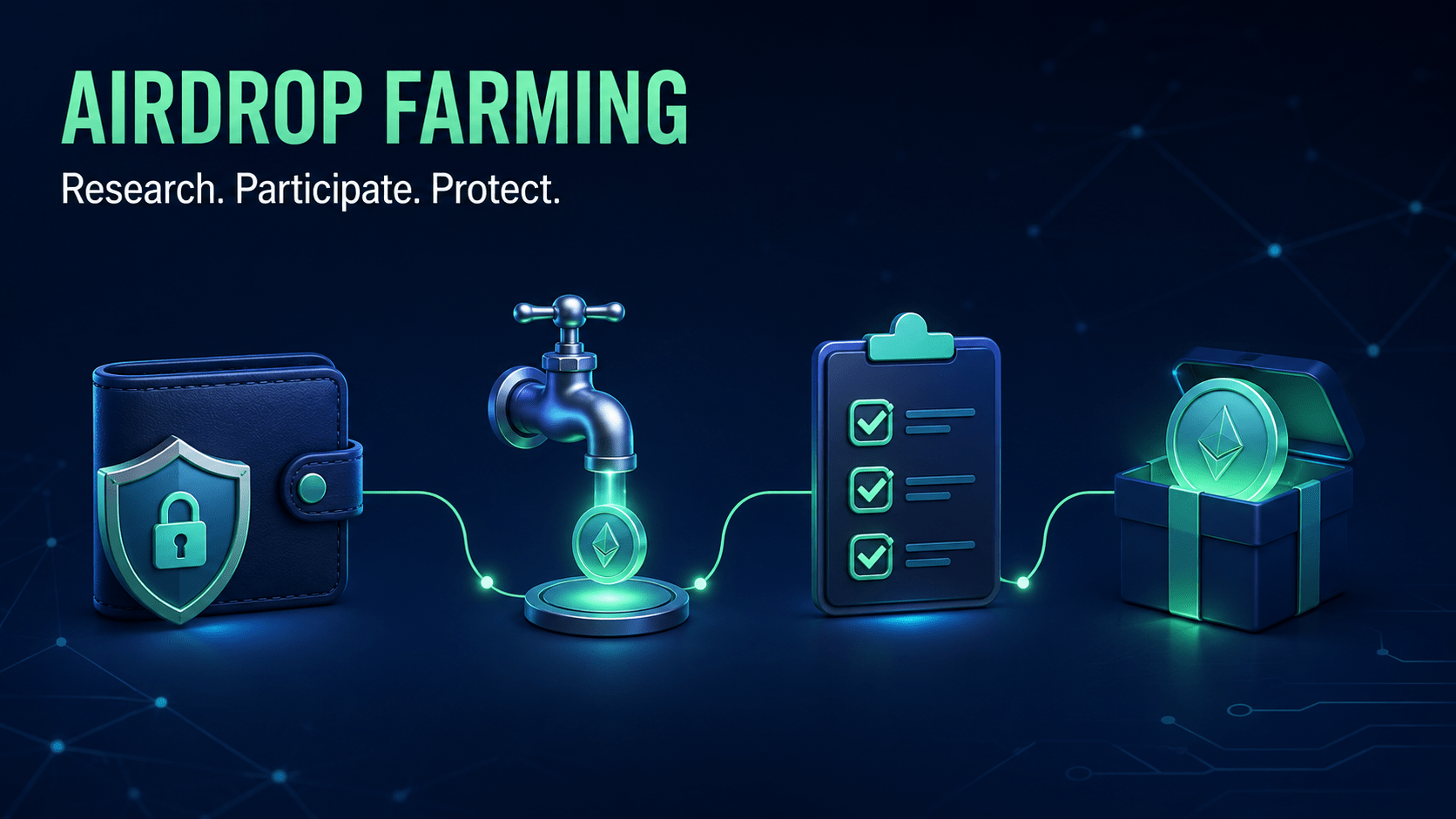
Airdrop farming is the process of using new blockchain networks, decentralized applications and Web3 platforms in the hope of qualifying for a future token distribution.
For someone who does not have much money to invest, the idea can sound almost perfect. Instead of buying a token and hoping its price rises, you spend time testing a product, completing quests, providing feedback or performing simple on-chain activities. If the project later launches a token, it may reward some of its early users.
However, airdrop farming is not guaranteed income, and it is not completely free. Some testnet opportunities require no cryptocurrency, but mainnet activity normally involves network fees. You are also investing time, attention and security risk without knowing whether a reward will ever arrive.
The sensible approach is therefore not to chase every rumoured airdrop. It is to identify credible projects, participate genuinely, protect your wallet and keep your costs under control.
If decentralized finance is still new to you, begin with our DeFi Essentials guide before connecting a wallet to unfamiliar applications.
What Is Airdrop Farming?
A crypto airdrop is a distribution of tokens to selected wallet addresses. A project may use an airdrop to introduce a governance token, reward contributors, distribute ownership or encourage people to explore its ecosystem.
Airdrop farming attempts to position a wallet for a possible future distribution. Participants may perform activities such as:
- Testing an application on a test network.
- Swapping small amounts through a decentralized exchange.
- Using an official bridge.
- Participating in governance.
- Completing educational or community quests.
- Trying different features of a protocol.
- Reporting bugs or providing useful feedback.
The word “farming” can be misleading. It may make the process sound as if every completed task produces a predictable harvest. In reality, the project controls the eligibility rules, and those rules may not be announced in advance.
A protocol can change its criteria, delay its token launch, exclude certain regions or decide not to distribute a token at all. Even eligible participants may receive rewards that are worth less than the fees they spent.
Why Do Crypto Projects Distribute Airdrops?
A well-designed airdrop is more than a giveaway. It can help a network distribute governance power and reward people who contributed before the project became popular.
To Reward Early Participation
Early users help developers discover problems that may not appear during internal testing. They test bridges, wallets, exchanges and other features under real-world conditions.
A project may decide that these users provided measurable value and deserve a share of its token distribution. Nevertheless, using a product early does not create an automatic right to receive tokens.
To Distribute Governance
Some tokens allow holders to vote on protocol upgrades, treasury spending and other governance decisions. An airdrop can place those tokens in the hands of people who have already used the network.
Arbitrum, for example, used several activity-based criteria for its historical ARB distribution. Its published criteria included factors such as bridging activity, transactions over different periods and interaction with smart contracts. It also applied anti-Sybil rules to reduce manipulation.
To Attract Users and Liquidity
Airdrops can introduce a project to a large audience. Token incentives may also encourage users and liquidity providers to explore a new network.
This strategy can create rapid activity, but not all of that activity remains after incentives end. A high transaction count does not necessarily prove that a project has sustainable demand.
To Recognize Community Contributions
Some distributions include developers, educators, governance participants, testers or community members. This is why airdrop research should extend beyond repeatedly pressing a swap button.
Can You Start Airdrop Farming With Zero Capital?
Some airdrop farming activities can be completed without purchasing cryptocurrency. This is most common on testnets, where users receive test tokens from faucets. These tokens do not have normal market value and are intended for product testing.
Mainnet opportunities are different. A live blockchain normally charges transaction fees, even when the application itself is free to use. Bridging, swapping, approving tokens and revoking permissions may all require gas.
| Activity | Possible Financial Cost | Main Risk |
|---|---|---|
| Testnet participation | Often no crypto required | Time spent without receiving a reward |
| Social or educational quests | Usually free | Phishing links and unnecessary data collection |
| Low-fee mainnet activity | Gas, bridging and trading fees | Smart contracts, scams and token losses |
| Liquidity provision | Requires capital and transaction fees | Impermanent loss, contract risk and market risk |
Therefore, “zero capital” should be treated as a starting category, not a promise. Your time, internet access and exposure to unfamiliar applications are also real costs.
The Most Important Step: Build a Safe Wallet Setup
Airdrop hunters connect to many websites, contracts and networks. That makes wallet separation more important than trying to predict the next big distribution.
Never use the wallet that holds your long-term savings for experimental activity.
Use Separate Wallet Roles
- Vault wallet: Holds long-term assets and does not connect to experimental applications.
- Activity wallet: Used for carefully researched testnets, quests and low-value interactions.
- Claim wallet: Used when a legitimate claim process requires interaction with a contract.
Separate wallet roles reduce exposure, but they cannot make an unsafe website safe. A malicious signature or token approval can still compromise the assets held in the connected wallet.
Read our crypto security and self-custody guide before starting.
Protect Your Recovery Phrase
No legitimate airdrop needs your recovery phrase or private key. Never enter either one into a website, online form, support chat or claim portal.
Store the recovery phrase offline. Avoid screenshots, cloud notes, email drafts and messaging applications.
Understand Token Approvals
A token approval gives a smart contract permission to access a specific type of token in your wallet. Some applications request a very large or effectively unlimited allowance.
Read the transaction before signing. When supported, limit the spending allowance to the amount required for the transaction. Afterwards, review permissions through your wallet or an established approval-management service.
Remember that disconnecting a website from your wallet does not automatically cancel an on-chain token approval. Revoking an approval is a separate blockchain transaction and normally requires gas.
A Four-Stage Airdrop Farming Process
Stage 1: Research the Project Before Connecting
Begin with the project’s official website, documentation, blog and verified social accounts. Do not rely on a link received through a direct message or an unofficial Telegram group.
Investigate the following:
- Does the project have a working product?
- Are its team, investors or contributors publicly documented?
- Does it solve a genuine problem?
- Has the smart-contract code been audited?
- Are the official contract addresses published?
- Is there clear documentation for the activity you plan to perform?
- Has the project actually discussed rewards, points or a token?
A project with no token may eventually launch one, but “tokenless” does not mean “confirmed airdrop.” Treat trackers and social-media threads as research leads rather than guarantees.
Stage 2: Start With Testnets and Educational Quests
Testnets allow developers and users to experiment before applications operate with assets that have real market value. Participants can request test tokens from an official faucet and use them to try swaps, lending tools, bridges or other features.
Quest platforms such as Galxe may also host campaigns that verify wallet, community or educational activities.
Before completing a quest, check who created it and what permissions it requests. The presence of a campaign on a quest platform does not remove the need for research.
Stage 3: Consider Mainnet Activity Carefully
Some projects reward genuine use on a live network. This could include using an official bridge, making a swap, participating in governance or exploring several useful features over time.
Do not manufacture meaningless transactions simply to inflate your activity. There is no universal formula such as “one transaction every week for eight weeks.” Each project designs its own criteria, and many never publish those criteria in advance.
If mainnet participation is appropriate, set a strict spending limit before you begin. Track gas, trading fees, slippage and bridge costs. Stop when the cost exceeds the educational or practical value you receive from using the product.
Stage 4: Track Activity Without Obsessing Over It
A simple spreadsheet can prevent confusion later. Record:
- Project name and official website.
- Network used.
- Wallet used.
- Date of each interaction.
- Type of activity completed.
- Transaction fees paid.
- Official announcement or documentation link.
- Claim status and important deadlines.
DeFiLlama’s airdrop section can help you discover tokenless protocols, but inclusion on a tracking page does not confirm a future reward.
How Sybil Filters Affect Airdrop Eligibility
A Sybil attack occurs when one person creates or controls many identities to gain an unfair share of a distribution. Projects may analyze funding patterns, transaction timing, wallet relationships and repeated behaviour to identify coordinated wallet clusters.
The safest and most ethical approach is straightforward:
- Use a genuine wallet identity rather than operating a farm of copied wallets.
- Follow the campaign’s published terms.
- Use the protocol because you understand its purpose.
- Avoid scripts, bots and identical transaction patterns.
- Do not attempt to disguise linked wallets or evade eligibility controls.
There is no need to imitate random “eligibility tricks” from social media. Rules such as holding a particular dust balance or completing an exact number of transactions may apply to one historical distribution and be irrelevant to another.
Common Airdrop Farming Scams
Fake Claim Websites
Scammers often copy the branding of popular projects and buy similar domain names. A fake claim page may ask you to connect your wallet and approve a malicious transaction.
Access claim pages through the project’s official website or documentation. Avoid links in unsolicited messages, search advertisements and replies beneath social-media posts.
Unexpected Tokens in Your Wallet
An unknown token or NFT appearing in your wallet is not automatically a reward. It may contain a website address designed to lead you to a malicious claim page.
Do not interact with unexpected assets simply because they appear valuable.
Requests for Your Recovery Phrase
A recovery phrase is never required to check eligibility. Anyone requesting it is trying to gain control of your wallet.
Dangerous Approvals and Signatures
Not every malicious request looks like a token transfer. A website may ask for an unlimited approval or a signature whose effect is difficult to understand.
Cancel the transaction if the wallet warning is unclear, the contract address does not match official documentation or the requested permission appears unrelated to the claim.
Fake Support Accounts
Scammers monitor public community channels and contact users who ask for help. Legitimate support representatives should not request private keys, recovery phrases or remote access to your device.
How to Decide Whether an Opportunity Is Worth Your Time
| Question | Positive Signal | Warning Signal |
|---|---|---|
| Is there a useful product? | Working application with clear documentation | Only referral posts and reward rumours |
| Is participation affordable? | Testnet or low, predictable fees | Repeated expensive bridging and swapping |
| Is a reward confirmed? | Official points or rewards documentation | Anonymous accounts promising a guaranteed allocation |
| Are security details available? | Published contracts, audits and warnings | Unverified contracts and urgent signing requests |
| Would you use it without an airdrop? | The activity teaches you something useful | The transaction has no purpose beyond speculation |
A strong opportunity should provide value even if no token arrives. You may learn how a bridge works, understand a new network or improve your ability to inspect blockchain transactions. That educational return makes the time less dependent on a speculative reward.
What to Do If You Receive an Airdrop
Receiving tokens creates a new decision. It does not automatically turn the reward into permanent wealth or passive income.
Verify the Official Contract
Confirm the token contract through official documentation. Tokens with identical names and symbols can be created by anyone.
Check Whether the Token Is Transferable
A displayed wallet value does not guarantee that the token has real liquidity. Investigate where it trades, how deep the liquidity is and whether selling would create significant slippage.
Use a Balanced Exit Plan
Instead of following a universal rule such as selling exactly 50%, consider several options:
- Sell a portion to recover your participation costs.
- Keep a portion if you understand the token’s utility and risks.
- Convert part of the reward into a more established asset.
- Avoid placing the entire reward into a complex yield strategy immediately.
If you later consider staking or liquidity provision, first read our Staking vs Farming beginner guide.
Keep Tax Records
Airdrops may create tax and reporting obligations depending on your country, the nature of the reward and what you do with it afterwards.
South African readers can review our crypto tax South Africa guide. Keep the token quantity, market value, receipt date, transaction hash and disposal records. For personal tax treatment, consult a qualified tax professional.
A Simple Beginner Airdrop Farming Routine
- Choose one or two credible ecosystems instead of chasing every rumour.
- Create a separate activity wallet with no long-term savings in it.
- Bookmark the official website and documentation.
- Begin with legitimate testnet or educational tasks.
- Read every transaction and signature request.
- Set a maximum monthly budget for any mainnet fees.
- Record activities and costs in a spreadsheet.
- Review unnecessary token approvals regularly.
- Monitor official announcements without trusting unsolicited messages.
- Assume no reward will arrive and treat any legitimate distribution as a bonus.
Frequently Asked Questions About Airdrop Farming
Is airdrop farming really free?
Testnet activities and some community quests may not require cryptocurrency. Mainnet transactions normally require gas, while every campaign requires time and carries some security risk.
Does a project without a token always launch an airdrop?
No. A tokenless project may launch a token later, but it can also operate without one, postpone its launch or distribute tokens using criteria that exclude your wallet.
How many transactions are needed to qualify?
There is no universal number. Eligibility rules differ between projects and may consider several types of activity. Repeating meaningless transactions does not guarantee qualification.
Should I use several wallets?
Wallet separation can protect long-term holdings from experimental activity. However, creating clusters of wallets to multiply rewards may violate campaign rules and lead to disqualification.
Is airdrop farming passive income?
Not in the traditional sense. Researching projects, completing tasks, managing wallets and monitoring announcements require active work. Any resulting tokens may later be used in an income strategy, but that introduces additional market and smart-contract risks.
Can an airdrop drain my wallet?
A token appearing in a wallet cannot normally drain it by itself. The danger begins when a user visits a malicious website, signs a harmful message or grants a dangerous token approval.
Final Thoughts: Treat Airdrop Farming as Research, Not Free Money
Airdrop farming can give beginners a practical way to learn about wallets, bridges, decentralized applications and blockchain networks. Some early users have received valuable rewards, but historical success does not create a reliable formula for future distributions.
The strongest strategy is built around selectivity. Research fewer projects, use them meaningfully, separate experimental activity from long-term savings and keep costs low.
If a reward arrives, you will be prepared to verify and manage it. If no reward arrives, you should still leave with useful knowledge rather than a collection of expensive transactions and risky wallet approvals.
In airdrop farming, protecting your wallet is more important than predicting the next token.
Leave a Reply