
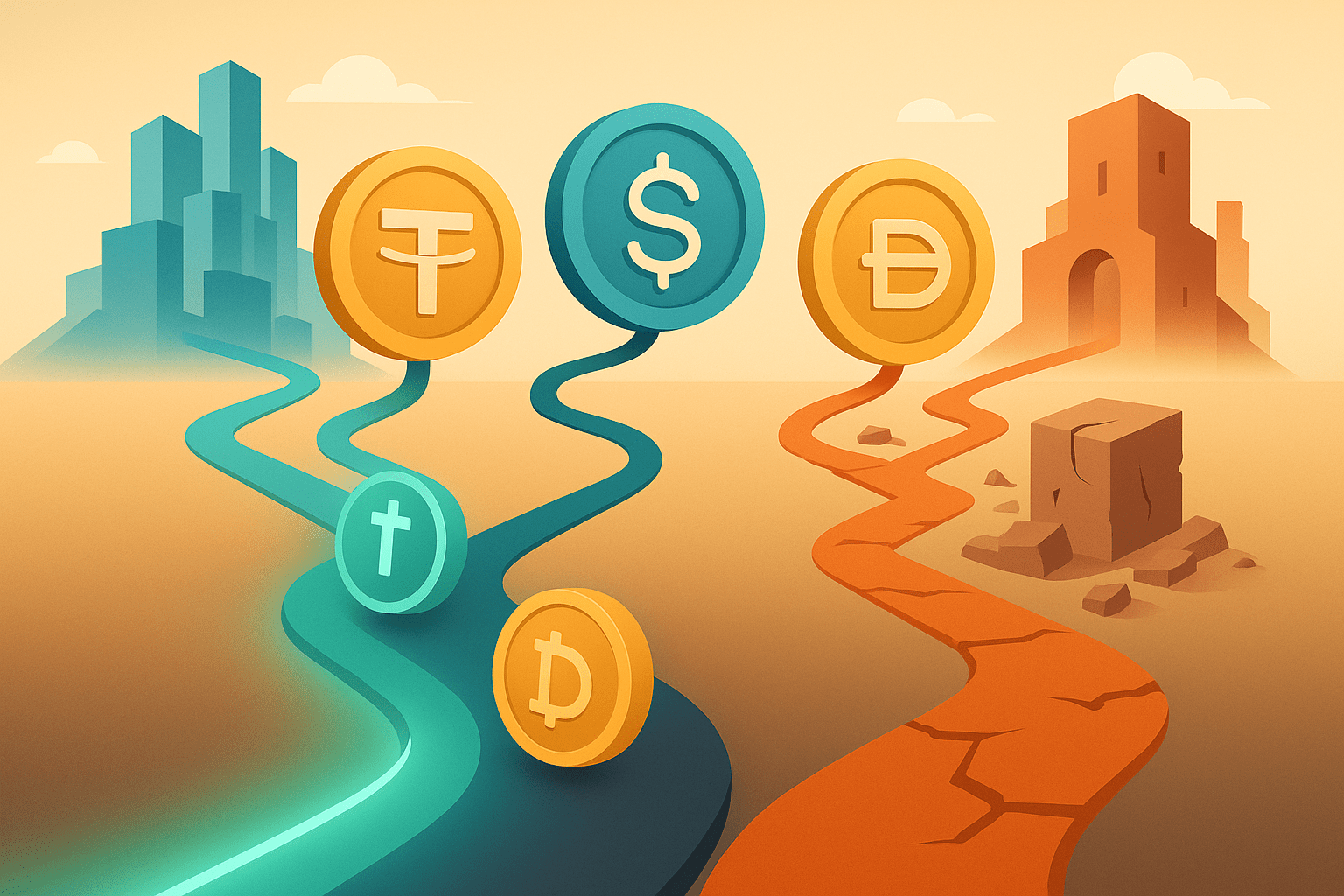
Stablecoin yield can look simple at first.
You hold a stablecoin. You place it into a platform, lending market, pool, exchange product, or DeFi protocol. After that, the platform shows a return.
At a glance, the idea feels calmer than many other crypto strategies.
Stablecoins are designed to track a stable value, often the U.S. dollar. Because of that, beginners sometimes assume stablecoin yield is safer than holding volatile crypto assets like Bitcoin, Ethereum, or smaller altcoins.
However, stablecoin yield is not risk-free income.
A stablecoin may be less volatile than many crypto tokens, but the strategy behind the yield can still carry serious risk. The stablecoin can depeg. The platform can fail. A protocol can be exploited. Liquidity can disappear. Withdrawal rules can change. In some cases, the return may come from risks that are not obvious on the surface.
That is why stablecoin yield needs a careful explanation.
This guide breaks down how stablecoin yield works, where returns may come from, what can go wrong, which routes may be more conservative, which traps beginners should avoid, and how to research yield opportunities without treating them like guaranteed income.
Disclaimer: This article is for educational purposes only and does not constitute financial advice. Stablecoins, crypto platforms, DeFi protocols, lending products, and yield strategies can carry serious risk. Always do your own research and consider your personal circumstances before making financial decisions.
Start Here: Stablecoin Yield Is Not the Same as Safety
Stablecoins were created to reduce price volatility inside crypto markets.
That does not mean every stablecoin strategy is safe.
For many crypto users, stablecoins are useful tools. They can help people park profits, move value between exchanges, access DeFi, reduce exposure to market swings, or manage liquidity during uncertain market conditions.
Once stablecoins are used to earn yield, the risk profile changes.
Now you are no longer only asking whether the stablecoin can hold its peg. You also need to ask where the stablecoins are going, who controls them, how the return is generated, what happens during stress, and how easily you can exit.
If you are new to stablecoins, start with the SPI guide on stablecoins explained. That article covers the foundation. This guide focuses specifically on yield risks.
What Is Stablecoin Yield?
Stablecoin yield is the return someone may earn from using stablecoins in a financial strategy.
That strategy may happen through a centralised exchange, crypto lending platform, DeFi lending market, liquidity pool, tokenized treasury product, or another blockchain-based service.
The basic idea is that your stablecoins are used somewhere else in the system.
For example, they may be lent to borrowers, supplied to a liquidity pool, deposited into a protocol, used by market makers, or connected to a real-world asset product.
In return, the user may receive interest, fees, incentive tokens, rewards, or another form of yield.
That sounds straightforward.
Nevertheless, the important question is not only “How much can I earn?”
A better question is:
Where does the yield come from, and what risks am I taking to earn it?
That question should guide the entire research process.
Why Stablecoin Yield Attracts Beginners
Stablecoin yield attracts beginners because it can feel less scary than other crypto strategies.
Bitcoin and altcoins can move sharply. DeFi tokens can rise and fall quickly. Meme coins can be extremely unpredictable. By comparison, stablecoins are designed to stay close to a stable value.
Because of that, some beginners assume stablecoin yield is naturally safer.
In some ways, stablecoin strategies may reduce exposure to token price swings.
However, lower price volatility does not remove other risks.
A person may avoid the price volatility of Bitcoin or altcoins but still face platform risk, smart contract risk, stablecoin issuer risk, liquidity risk, regulatory risk, counterparty risk, or withdrawal risk.
This is the part many beginners miss.
The stablecoin may look calm while the strategy underneath carries hidden risk.
Stablecoin Yield Is Not the Same as Bank Interest
One common mistake is comparing stablecoin yield directly with bank interest.
That comparison can be misleading.
Bank deposits, savings accounts, and regulated financial products operate under specific legal and regulatory systems. Depending on the country and product, there may be banking supervision, consumer protections, deposit protection rules, and clearer legal responsibilities.
Crypto yield products can work very differently.
Some involve lending to crypto borrowers. Others depend on smart contracts. Certain products rely on exchanges or custodians. DeFi pools can depend on code, liquidity, oracle data, collateral rules, and market behaviour.
In other words, the source of return is different.
The protections may also be different.
Investor.gov warns that crypto assets and crypto-related services can carry significant risks, including volatility, fraud, platform failures, and fewer protections compared with traditional financial products. You can read more here: Investor.gov: Crypto Assets.
For that reason, stablecoin yield should be researched as a crypto strategy, not treated like a normal savings account.
Where Stablecoin Yield Can Come From
Before using any stablecoin yield product, identify the source of the return.
If the yield source is unclear, that is already a warning sign.
| Yield Source | How It Works | Main Risk |
|---|---|---|
| Lending | Stablecoins are lent to borrowers who pay interest | Borrower default, platform failure, collateral issues |
| DeFi lending markets | Users supply stablecoins to lending protocols | Smart contract risk, liquidation issues, oracle risk |
| Liquidity pools | Stablecoins are supplied to trading pools that earn fees | Smart contract risk, pool imbalance, depeg risk |
| Exchange earn products | A centralised platform uses deposited assets in yield strategies | Custody risk, platform risk, withdrawal limits |
| Token incentives | Users earn extra rewards paid in another token | Reward token may fall in value |
| Tokenized real-world assets | Yield may come from treasuries, credit, invoices, or other assets | Issuer risk, legal risk, liquidity risk, custody risk |
This table shows why yield percentages alone are not enough.
A modest yield and a high yield may come from completely different risk sources.
Therefore, beginners should always ask what activity produces the return.
Safer Routes vs Common Traps
Stablecoin yield opportunities can sit on a wide spectrum.
On one side, some routes are more transparent, established, and conservative. On the other side, some products depend on complex structures, high leverage, unclear counterparties, or unsustainable incentives.
This does not mean any route is guaranteed safe.
Instead, it means some structures are easier to understand and evaluate than others.
More Conservative Routes to Study
- Established DeFi lending markets with long operating histories, visible collateral, transparent utilisation, and published risk parameters
- Protocols where the yield source can be clearly explained without relying on vague promises
- Stablecoin strategies with variable market-driven rates instead of fixed guaranteed returns
- Products with clear withdrawal rules, strong documentation, and visible risk disclosures
- Platforms or protocols where users can inspect at least part of the activity on-chain
Common Traps to Avoid
- Fixed high returns with no clear explanation
- “Guaranteed APY” language
- Yield that depends mainly on new users joining
- Opaque off-chain lending with unknown borrowers
- Reward tokens used to make the APY look higher than it really is
- Platforms that make deposits easy but withdrawals difficult
- Referral-heavy products that focus more on recruitment than risk disclosure
The goal is not to find the highest number.
Rather, the goal is to understand the return well enough to decide whether the risk makes sense for your situation.
The First Risk: Stablecoin Depeg Risk
A stablecoin depeg happens when the stablecoin moves away from its intended value.
For example, a stablecoin designed to trade near one U.S. dollar may fall below that value during stress, uncertainty, liquidity pressure, reserve concerns, or market panic.
Some depegs are temporary.
Others can be severe.
The risk depends on the stablecoin design, reserves, redemption process, issuer transparency, market confidence, and liquidity conditions.
Not all stablecoins work the same way.
Some are fiat-backed. Others are crypto-collateralized. A few use more complex mechanisms. Because of that, beginners should understand the design before using the stablecoin for yield.
Questions to Ask
- What backs the stablecoin?
- Who issues it?
- Are reserves disclosed?
- Can users redeem it directly?
- Has it depegged before?
- How liquid is it across exchanges and DeFi?
- What happens during market stress?
The stablecoin itself is the foundation of the strategy.
If that foundation is weak, the yield does not matter much.
The Second Risk: Platform and Custody Risk
Many stablecoin yield products require users to deposit assets into a platform.
That creates custody risk.
When you deposit stablecoins into a centralised exchange, lending platform, or earn product, you may no longer have direct control over the assets in the same way you do with self-custody.
The platform may control withdrawals, lending activity, risk management, reserves, and communication.
If the platform fails, freezes withdrawals, mismanages funds, or faces legal problems, users may struggle to recover their money.
This is one reason the phrase “not your keys, not your coins” remains important in crypto education.
However, self-custody also has risks.
If you hold your own wallet, you must protect your seed phrase, avoid phishing links, verify addresses, and understand how transactions work.
Therefore, there is no perfect option.
There are only different responsibilities and different risks.
Questions to Ask
- Who controls the assets after deposit?
- Can withdrawals be paused?
- Has the platform ever frozen withdrawals?
- Does the platform explain how yield is generated?
- Are there audits or proof-of-reserves reports?
- Is customer support responsive?
- What happens if the platform becomes insolvent?
Related SPI read: Crypto Project Vetting Checklist.
The Third Risk: Smart Contract Risk
DeFi stablecoin yield often depends on smart contracts.
A smart contract is code that runs on a blockchain.
That code may manage deposits, withdrawals, lending, collateral, liquidity pools, rewards, or other protocol functions.
Smart contracts can be useful because they can make certain processes transparent and automated.
However, code can fail.
A bug, exploit, oracle problem, admin-key issue, bridge failure, or poorly designed mechanism can put user funds at risk.
An audit can help, but it does not guarantee safety.
Audits reduce uncertainty. They do not remove it.
Questions to Ask
- Has the protocol been audited?
- Who performed the audit?
- Were critical issues found?
- Have the issues been fixed?
- How long has the protocol been live?
- How much value is locked in the protocol?
- Are admin controls clearly explained?
- Is there a bug bounty program?
Related SPI read: 10-Step DeFi Safety Checklist.
The Fourth Risk: Liquidity and Withdrawal Risk
Liquidity matters because entering a position is only half the story.
You also need to understand how you can exit.
Some stablecoin yield products allow quick withdrawals. Others may have lock-up periods, withdrawal queues, exit fees, minimum redemption amounts, or liquidity limits.
During normal market conditions, withdrawals may feel easy.
During stress, the experience can change quickly.
A platform may slow withdrawals. A DeFi pool may become imbalanced. A stablecoin may lose liquidity. A bridge may pause. A lender may not have enough available funds for immediate redemptions.
Questions to Ask
- Can you withdraw at any time?
- Are there lock-up periods?
- Do withdrawal fees apply?
- Is there enough liquidity in the pool?
- Can withdrawals be paused?
- What happens during market stress?
- Are there daily or monthly withdrawal limits?
A yield product that is easy to enter but difficult to exit deserves extra caution.
The Fifth Risk: Unsustainable Yield
High stablecoin yields can be tempting.
However, unusually high yield should always raise questions.
Sometimes high yield exists because there is strong borrowing demand, temporary incentives, or a specific market opportunity.
In other cases, high yield may depend on reward tokens, aggressive risk-taking, leverage, weak collateral, new deposits, or unsustainable economics.
That is why the source matters.
If a platform cannot explain where the yield comes from, slow down.
If the answer sounds vague, complicated, or secretive, slow down even more.
The Federal Trade Commission warns that crypto scams often promise big payouts, guaranteed returns, or easy money. You can read their guidance here: FTC: What To Know About Cryptocurrency and Scams.
Questions to Ask
- Is the yield fixed or variable?
- Who pays the yield?
- Why does the yield exist?
- Does it depend on new users?
- Does it depend on a reward token?
- Can the yield drop suddenly?
- Is the return realistic compared with the risk?
Yield without a clear source is not passive income.
It is uncertainty.
Centralised Stablecoin Yield vs DeFi Stablecoin Yield
Stablecoin yield can happen through centralised platforms or DeFi protocols.
Both options carry risk, but the risks are different.
| Area | Centralised Yield | DeFi Yield |
|---|---|---|
| Control | Platform usually controls deposited assets | User interacts with smart contracts through a wallet |
| Main risk | Custody, platform failure, withdrawal freezes, opaque activity | Smart contract, oracle, liquidity, wallet, and protocol risk |
| Transparency | Depends on platform reporting | Some activity may be visible on-chain |
| User responsibility | Trust platform operations and terms | Manage wallet safety and transaction risk |
| Withdrawal rules | Controlled by platform terms | Controlled by protocol liquidity and contract rules |
Neither option is automatically better.
A strong centralised platform may be easier for a beginner to use, but it can require more trust.
A DeFi protocol may offer more transparency, but it can require stronger technical understanding.
Because of that, beginners should choose based on understanding, not only yield percentage.
How to Research a Stablecoin Yield Opportunity
A stablecoin yield opportunity should be researched before money is deposited.
Do not rely only on screenshots, referral posts, social media claims, or high APY displays.
Use a structured process instead.
Step 1: Identify the Stablecoin
Start with the stablecoin itself.
Understand whether it is fiat-backed, crypto-collateralized, algorithmic, overcollateralized, or connected to another structure.
Then check liquidity, issuer transparency, historical depegs, reserve information, and market usage.
Step 2: Identify the Platform or Protocol
Next, research where the stablecoins will be placed.
Check the team, company, domain history, audits, support channels, public reputation, and withdrawal history.
If it is a DeFi protocol, inspect the smart contracts, audits, total value locked, security history, admin controls, and documentation.
Step 3: Identify the Yield Source
After that, find out why the return exists.
Is it lending income, trading fees, borrower demand, token incentives, treasury exposure, private credit, or something else?
When the yield source is unclear, the risk is unclear too.
Step 4: Understand the Exit
Before entering, understand how to leave.
Check lock-ups, withdrawal queues, exit fees, redemption terms, liquidity depth, and any conditions that may delay access to funds.
Step 5: Start With Education, Not Size
Finally, do not treat your first stablecoin yield experiment as a major allocation.
Beginners should learn the process first.
Understanding the mechanics is more important than rushing to earn a return.
Join the Weekly SPI Newsletter
Practical insights. Real opportunities. Zero fluff.
A Simple Stablecoin Yield Checklist
Use this checklist before exploring any stablecoin yield product.
| Check | Question |
|---|---|
| Stablecoin design | How does the stablecoin maintain its value? |
| Issuer | Who issues or manages the stablecoin? |
| Reserve transparency | Are reserves, audits, or attestations available? |
| Platform | Who controls the yield product? |
| Yield source | Where does the return come from? |
| Custody | Who controls the stablecoins after deposit? |
| Smart contract risk | Are contracts audited and battle-tested? |
| Liquidity | Can you exit easily under normal and stressed conditions? |
| Withdrawal rules | Are lock-ups, queues, fees, or limits clearly explained? |
| Risk disclosure | Does the platform explain what can go wrong? |
This checklist will not make every strategy safe.
However, it can help you avoid making decisions based only on attractive numbers.
Beginner-Friendly Ways to Approach Stablecoin Yield Research
Beginners do not need to rush into yield products.
A safer approach is to study the process before committing meaningful capital.
Start by learning how stablecoins work. Then study one platform or protocol at a time. After that, compare the yield source, custody model, withdrawal rules, and risk disclosures.
If you eventually test anything, keep the amount small enough that a mistake would not damage your financial life.
Also keep records from the beginning.
Track the platform, stablecoin, network, deposit date, withdrawal rules, fees, and reason for entering. This habit can help with discipline, tax records, and future decision-making.
Most importantly, do not scale a strategy just because the first few days went well.
Crypto risks often appear during stress, not during calm conditions.
Security Basics You Cannot Skip
Stablecoin yield research is not only about returns.
Security matters just as much.
A good opportunity can still become expensive if you use the wrong link, approve a malicious contract, send funds on the wrong network, or fail to protect your wallet.
Basic Security Rules
- Use trusted bookmarks instead of random links from social media.
- Check website URLs carefully before connecting a wallet.
- Test with small amounts before moving more funds.
- Review token approvals regularly.
- Use strong account security on exchanges.
- Keep seed phrases offline and private.
- Do not sign transactions you do not understand.
- Avoid rushing when money is involved.
Security mistakes can happen quickly.
Therefore, slow execution is often safer than fast execution.
Warning Signs Beginners Should Not Ignore
Some stablecoin yield offers deserve extra caution.
Watch for these warning signs:
- Guaranteed returns
- Very high yield with no clear explanation
- Pressure to deposit quickly
- No clear company or team information
- No audit or weak documentation
- Withdrawal complaints from users
- Rewards that depend heavily on referrals
- Vague claims about trading, AI, bots, or secret strategies
- No clear explanation of custody
- Complicated terms that make exit difficult
- Support that only responds before deposit
- Risk disclosures that are missing or hidden
One warning sign may not prove a scam.
Several warning signs together should make you pause.
A serious platform should be able to answer basic questions clearly.
Where Stablecoin Yield Fits in a Crypto Strategy
Stablecoin yield should not be the first thing a beginner chases.
Before yield, understand crypto safety basics.
That includes wallet security, exchange risk, stablecoin design, blockchain networks, transaction fees, platform due diligence, and withdrawal testing.
Only after that does yield research make more sense.
For some users, stablecoins may be useful mainly as a parking tool rather than a yield tool.
For others, stablecoin yield may become a small part of a wider strategy after careful research.
Either way, stablecoin yield should not replace basic financial planning.
Emergency savings, debt control, income stability, and long-term investing education still matter.
Related SPI reads:
- Stablecoins Explained
- Crypto Profit-Taking Strategy
- Crypto Project Vetting Checklist
- Passive Income Ideas for Beginners
Final Thoughts
Stablecoin yield can be useful to study, but it should never be treated as risk-free income.
The stablecoin may be designed to hold a steady value, but the yield strategy can still carry serious risk.
That risk may come from the stablecoin issuer, the platform, the custodian, the smart contract, the liquidity pool, the borrower, the reward token, the legal structure, or the withdrawal rules.
Therefore, the most important skill is not chasing the highest percentage.
The most important skill is understanding where the return comes from and what could go wrong.
Before using any stablecoin yield product, slow down.
Check the stablecoin. Research the platform. Understand the yield source. Review withdrawal rules. Look for audits and risk disclosures. Test small if you are still learning.
Most importantly, avoid guaranteed-return thinking.
Stablecoin yield is not magic.
It is a strategy that needs research, caution, and proper risk management.