
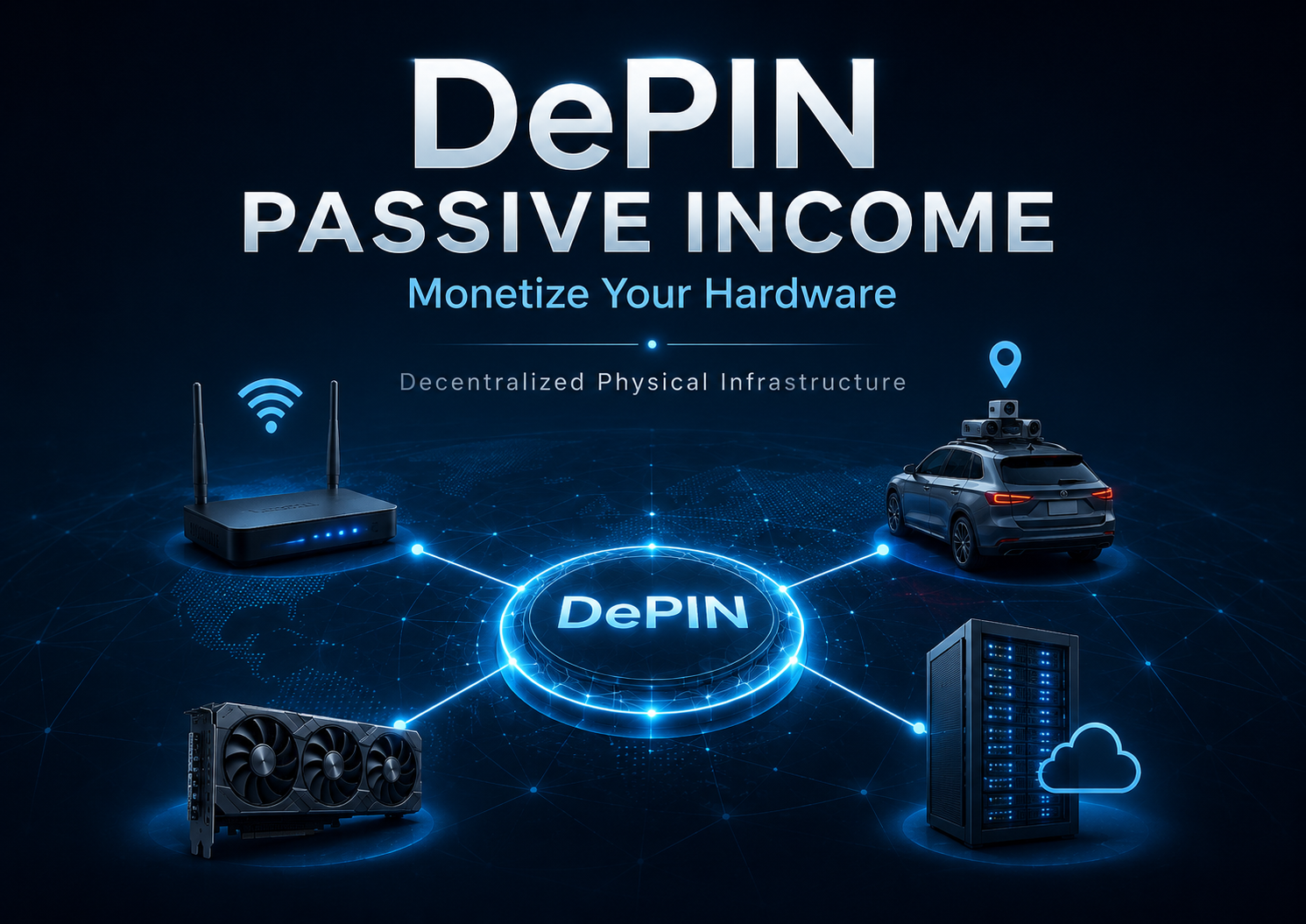
DePIN passive income introduces a completely different way to think about earning from crypto and blockchain technology. Instead of buying a token and simply hoping its price increases, some decentralized networks allow people to contribute useful real-world resources and potentially earn rewards for doing so.
Those resources could include unused internet bandwidth, computing power, server capacity, street-level mapping data, wireless coverage, storage, or other forms of physical and digital infrastructure.
In some cases, you may already own the resource.
Your internet connection may have unused capacity. A powerful computer may sit idle for much of the day. Your vehicle may travel roads that a decentralized mapping network wants to document. Meanwhile, a business may have servers that operate far below their full capacity.
DePIN attempts to connect those underused resources with networks that need them.
However, that does not mean every DePIN opportunity is truly passive, profitable, or suitable for beginners. Some models require little more than installing software and keeping a device connected. Others involve expensive equipment, electricity, technical knowledge, maintenance, and uncertain customer demand.
Therefore, the real opportunity is not simply to ask:
“Which DePIN project pays the most?”
A better question is:
“What useful resource does this network need, do I already have it, and does participating still make sense after all the costs and risks?”
What Is DePIN Passive Income?
DePIN passive income generally refers to potential earnings generated by contributing useful resources to a Decentralized Physical Infrastructure Network.
DePIN stands for Decentralized Physical Infrastructure Networks.
Although the name sounds technical, the underlying idea is fairly simple.
Traditional infrastructure usually requires a company to build and control most of the resources needed to provide its service.
For example, imagine a company that wants to create a large cloud computing platform. Traditionally, it might need to purchase servers, build or lease data centres, install networking equipment, secure electricity supply, employ technical teams, and continuously expand its infrastructure.
That requires enormous amounts of capital.
A decentralized infrastructure model takes a different approach.
Instead of one company owning every machine, independent participants can potentially provide computing capacity they already control. The network then coordinates that distributed supply and attempts to connect it with customers who need computing resources.
The same principle can apply to other types of infrastructure.
- A mapping network can use cameras operated by independent drivers.
- A bandwidth network can use internet capacity supplied by participants.
- A GPU network can coordinate computing resources from distributed machines.
- A wireless network can encourage individuals to provide connectivity in useful locations.
- A storage network can combine spare storage capacity from many providers.
Blockchain technology may help coordinate payments, incentives, ownership records, or network participation.
Nevertheless, the most important part of the economic model is not simply the blockchain.
The real value comes from the useful resource being provided.
How DePIN Passive Income Actually Works
To understand DePIN passive income, it helps to separate the model into two sides: infrastructure supply and customer demand.
The Supply Side
The supply side consists of individuals or businesses contributing useful resources.
Depending on the network, participants may provide:
- Internet bandwidth
- GPU computing power
- CPU capacity
- Server infrastructure
- Data storage
- Street-level imagery
- Wireless connectivity
- Sensor information
In return, the network may compensate contributors through tokens, credits, points, direct payments, or another reward mechanism.
The Demand Side
On the other side are the people and businesses that need the infrastructure.
Potential customers could include:
- Artificial intelligence companies
- Software developers
- Researchers
- Cloud computing customers
- Mapping businesses
- Content creators
- Data companies
- Other commercial users
Ideally, a healthy DePIN network creates a productive cycle.
Customers pay for a useful service. Infrastructure providers supply the resources required to deliver that service. As demand increases, additional providers may be encouraged to join the network.
However, not every network reaches that stage.
Some projects may initially depend heavily on token incentives to attract participants before meaningful customer demand develops.
For that reason, anyone researching DePIN should always ask one important question:
Who actually needs the resource being provided, and who ultimately pays for it?
Without genuine demand, a network can distribute large numbers of tokens while creating very little sustainable economic value.
DePIN Passive Income vs Real-World Assets
DePIN passive income fits naturally alongside the growing conversation about real-world assets, although the two concepts are different.
As discussed in our beginner’s guide to RWA investing, real-world asset tokenization generally focuses on connecting assets such as property, bonds, commodities, private credit, and other traditional investments with blockchain infrastructure.
DePIN approaches the physical world from another direction.
Rather than primarily representing ownership of an asset on-chain, DePIN attempts to coordinate the productive use of physical and digital resources.
| Concept | Main Idea | Example |
|---|---|---|
| Real-World Assets | Represent or connect real-world assets with blockchain infrastructure | Tokenized property, bonds, or private credit |
| DePIN | Coordinate infrastructure supplied by distributed participants | Bandwidth, mapping, GPU computing, or wireless infrastructure |
One simple way to understand the difference is this:
RWA asks: Can ownership or financial exposure to real-world assets operate on blockchain rails?
DePIN asks: Can decentralized networks coordinate people who provide useful real-world infrastructure?
Over time, these areas could overlap increasingly.
For example, a physical machine can be an asset. That machine may generate revenue, participate in a decentralized network, and eventually be connected to blockchain-based ownership or financing structures.
As a result, DePIN is potentially much bigger than another category of speculative crypto tokens.
The “Uber of Physical Infrastructure” Explained
The sharing-economy comparison provides one of the easiest ways to understand DePIN.
Uber built a transportation network without needing to own every vehicle used by its drivers.
Similarly, Airbnb created a global accommodation marketplace without owning every property listed on the platform.
DePIN applies a related idea to infrastructure.
A decentralized network may not need to own every internet connection, GPU, server, camera, storage device, or wireless hotspot contributing to its service.
Instead, many of those resources can be supplied by independent participants.
Consider how much partially unused infrastructure already exists.
- A gaming computer may have a powerful GPU that sits idle overnight.
- A household may pay for more internet capacity than it normally uses.
- A vehicle may travel hundreds of kilometres every week without collecting mapping data.
- A business may operate servers far below maximum capacity.
- A property may have suitable space for communications equipment.
Individually, each resource may seem relatively small.
Collectively, however, they can represent an enormous pool of infrastructure.
DePIN attempts to organize some of that fragmented capacity.
Still, unused capacity does not automatically equal income.
Someone must actually need the service.
There must be demand for the bandwidth, mapping information, computing power, storage, connectivity, or other resource being supplied.
Therefore, a strong DePIN network needs more than people willing to provide infrastructure.
It also needs customers willing to pay for that infrastructure.
Four Ways to Explore DePIN Passive Income
There is no single model for earning through DePIN passive income. Different networks require completely different resources, levels of investment, and amounts of ongoing involvement.
| DePIN Model | Resource Provided | Example | Typical Effort |
|---|---|---|---|
| Bandwidth | Unused internet capacity | Grass | Low after setup |
| Mapping | Street-level imagery and geographic data | Hivemapper | Low to moderate |
| GPU Compute | Graphics processing capacity | Render Network | Moderate to high |
| Cloud Compute | Servers, CPU, memory, storage, and GPUs | Akash Network | Moderate to high |
This comparison also highlights an important point.
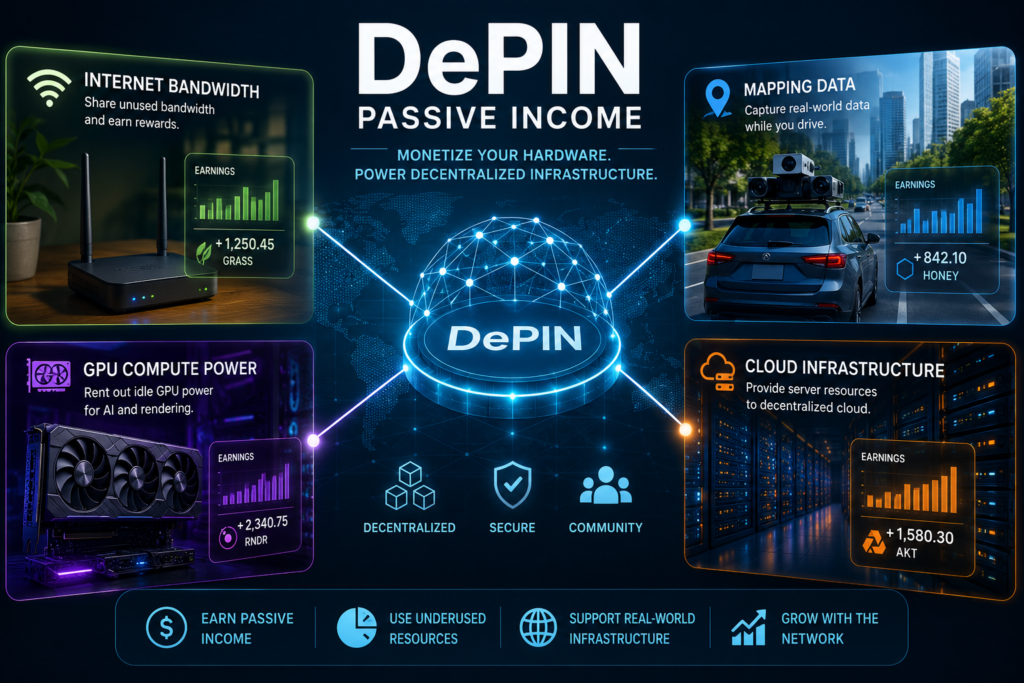
Running a lightweight bandwidth-sharing application is very different from maintaining server infrastructure.
Likewise, driving with a mapping camera is not comparable to managing high-performance computing equipment.
Therefore, each DePIN model needs to be evaluated separately.
1. Grass: DePIN Passive Income From Unused Bandwidth
Grass is one of the easier DePIN concepts for beginners to understand.
Many people pay for internet connections that provide more capacity than they continuously use.
Grass allows participants to contribute some of that unused internet bandwidth to its network.
According to Grass, its network uses contributed bandwidth as part of its infrastructure for accessing public web data.
From the participant’s perspective, the appeal is straightforward.
You may already have:
- An internet connection
- A compatible device
- Unused network capacity
Therefore, you may not need to purchase expensive dedicated equipment simply to participate.
Once the required application or software is running, the resource can potentially be contributed in the background.
For beginners exploring DePIN passive income, this type of model can appear much closer to traditional passive income than running complex infrastructure.
However, several important limitations still need to be understood.
Available Bandwidth Does Not Guarantee Usage
Keeping your connection available does not necessarily mean the network will use it continuously.
Factors such as location, demand, connection quality, uptime, and network requirements can influence participation.
Consequently, two people running similar equipment for the same length of time may have different results.
Points Are Not Guaranteed Cash Income
Points, credits, or potential future rewards should not automatically be treated as fixed income.
Unless a network explicitly provides a guaranteed payment structure, reward values may change.
Therefore, projecting future income based solely on accumulated points can create unrealistic expectations.
Internet Costs and Terms Still Matter
Before contributing bandwidth to any third-party platform, consider:
- Your internet service provider’s terms
- Data limits or fair-use policies
- Potential network performance effects
- Privacy and security considerations
- Applicable local rules
In other words, an underused resource is not necessarily a completely free resource.
2. Hivemapper: Earning From Decentralized Mapping
Hivemapper shows how an everyday activity can potentially become part of decentralized infrastructure.
The network uses compatible devices operated by contributors to collect street-level imagery and mapping information.
Instead of relying entirely on a centrally owned fleet of specialized mapping vehicles, independent drivers can help collect data from the roads they already travel.
According to the Hivemapper documentation, eligible contributors can receive HONEY rewards for useful contributions to the network.
The concept can be summarized simply.
A contributor installs compatible equipment, continues driving, and collects eligible imagery along the route.
That data can then contribute to the decentralized map.
However, the economics are more complicated than simply earning the same reward for every kilometre driven.
Not Every Road Has Equal Value
The usefulness of mapping contributions can depend on factors such as freshness, quality, coverage, and network demand.
For example, repeatedly capturing a road that already has recent imagery may provide less value than collecting high-quality information from an area that needs updated coverage.
This makes economic sense because a mapping network does not merely need more data.
It needs useful and relevant data.
The Existing-Routine Advantage
Hivemapper also demonstrates an important principle behind successful DePIN passive income.
Imagine one person already drives long distances every week for work. Another person rarely drives but begins making unnecessary journeys solely to chase mapping rewards.
The first person is adding potential income to an activity that already exists.
By contrast, the second person creates new fuel costs, vehicle depreciation, maintenance expenses, and time commitments.
Those are very different financial situations.
As a general rule, DePIN economics can be more attractive when you monetize an activity or resource that would exist even without the reward.
3. Render Network: Monetizing Idle GPU Capacity
Modern graphics processing units can be extremely powerful.
Depending on the hardware and workload, GPUs can support:
- 3D rendering
- Visual effects
- Graphics processing
- Artificial intelligence workloads
- Machine learning
- Other forms of accelerated computing
Yet powerful hardware often spends significant periods sitting unused.
The Render Network is built around connecting distributed GPU resources with workloads that require computing capacity.
At first glance, the model can sound extremely simple.
Own a GPU, connect it to a network, and potentially earn from unused capacity.
In practice, however, there are several additional considerations.
Hardware Requirements Matter
Not every graphics card is automatically suitable for every distributed computing network.
Requirements may include specific standards relating to:
- GPU model
- VRAM
- System memory
- Storage
- Operating system
- Internet connectivity
- Software configuration
Moreover, requirements can change as networks and workloads evolve.
Anyone considering providing GPU capacity should therefore review the current official Render Network information before purchasing equipment specifically for participation.
Idle Hardware Does Not Mean Free Computing
A GPU doing very little work may consume relatively modest power.
Once the same hardware begins processing demanding workloads, electricity consumption can rise significantly.
Therefore, the correct calculation is not:
Rewards = Profit
A more realistic calculation is:
Revenue − Electricity − Hardware Depreciation − Maintenance − Connectivity − Other Costs = Potential Net Income
This becomes particularly important in regions where electricity is expensive.
Utilization Matters More Than Hardware Alone
A powerful GPU only becomes financially productive when useful work is available.
The same principle applies in many other asset-based businesses.
For instance, an excellent rental property with no guests produces no rental revenue. Similarly, expensive computing hardware with no workloads produces no utilization income.
As a result, hardware specifications alone do not determine profitability.
Demand matters just as much.
4. Akash Network: Providing Decentralized Cloud Infrastructure
Akash takes decentralized infrastructure much closer to the world of traditional cloud computing.
The Akash Network operates as a marketplace where computing resources can be offered to customers who require infrastructure for applications and workloads.
Depending on their setup, providers may contribute:
- CPU capacity
- Memory
- Storage
- GPU capacity
- Server infrastructure
Rather than requiring every customer to purchase physical servers, cloud computing allows users to rent resources as needed.
Akash brings a decentralized marketplace structure into that relationship.
However, this model also demonstrates why describing all DePIN passive income as “set it and forget it” would be misleading.
Running Infrastructure Is Still a Business Activity
Operating provider infrastructure can involve:
- Suitable hardware
- Reliable internet connectivity
- System configuration
- Security
- Monitoring
- Maintenance
- Pricing decisions
- Technical troubleshooting
The official Akash provider guidance also encourages prospective providers to consider costs, demand, technical requirements, electricity, and the time it may take to generate returns.
Consequently, operating an Akash provider is better viewed as running infrastructure than installing a completely passive earning application.
That does not necessarily make the opportunity unattractive.
Instead, it means the model may be more suitable for someone who already owns servers, operates technical infrastructure, or has relevant experience.
For a beginner purchasing expensive equipment purely because of an advertised earning figure, the financial risk is significantly higher.
The DePIN Passive Income Spectrum
One of the biggest mistakes people can make when exploring DePIN passive income is assuming that every network requires the same level of work.
A better approach is to view DePIN opportunities on a spectrum.
| Model | Upfront Cost | Technical Difficulty | Ongoing Work | Passive Potential |
|---|---|---|---|---|
| Sharing existing bandwidth | Very low if equipment already exists | Low | Low | Higher |
| Mapping while already driving | Hardware purchase may be required | Low to moderate | Low once integrated into routine | Moderate to high |
| Providing GPU capacity | Potentially high | Moderate | Monitoring may be required | Moderate |
| Operating cloud infrastructure | Potentially high | Moderate to high | Regular maintenance | Lower |
The lesson is straightforward.
The more infrastructure you operate, the more your passive-income opportunity begins to resemble an infrastructure business.
Join the Weekly SPI Newsletter
Practical insights. Real opportunities. Zero fluff.
The Best DePIN Opportunity May Already Be Sitting in Your Home
Many people discover DePIN and immediately ask:
“What hardware should I buy?”
However, that may be the wrong starting point.
A better first question is:
“What underused resource do I already own?”
Perhaps you already have:
- A fast internet connection
- A daily driving route
- A high-performance computer
- Unused server capacity
- Technical infrastructure from an existing business
The economics can improve significantly when the major cost of an asset has already been justified for another purpose.
For example, purchasing a R30,000 computer solely to pursue uncertain rewards creates substantial financial risk.
Using a computer you already needed for work and monetizing genuinely unused capacity is a very different proposition.
The same principle applies to property.
A homeowner monetizing an unused guest suite has different economics from an investor purchasing an expensive property entirely on the assumption that future short-term rental income will cover every cost.
In both cases, an existing underused asset reduces the pressure on the new income stream to justify the full purchase price.
Therefore, the strongest DePIN strategy may not involve buying more equipment.
It may involve making better use of what you already own.
How to Calculate Potential DePIN Passive Income
Before spending money on hardware, calculate the opportunity realistically.
A useful basic framework is:
Potential Net DePIN Income = Gross Revenue or Rewards − Operating Costs − Hardware Depreciation − Maintenance − Fees − Taxes
Each part of the equation matters.
Gross Revenue
Start by researching what comparable participants may realistically earn.
However, avoid relying entirely on screenshots from unusually successful providers.
Utilization
Next, consider how often your resource is likely to be used.
A theoretical maximum earning figure means very little when actual customer demand is inconsistent.
Electricity
Power-intensive equipment can turn attractive gross revenue into weak net returns.
Therefore, local electricity costs should be included before estimating profitability.
Internet and Data
Bandwidth usage, data limitations, connection requirements, and business internet costs can also affect your final return.
Hardware Depreciation
Technology loses value over time.
Consequently, a GPU or server purchased today may be worth significantly less several years from now.
Maintenance
Hardware can fail, software requires updates, and network requirements can change.
In addition, downtime may reduce potential earnings.
Token Price Risk
When rewards are paid in a crypto asset, the real-world value of those rewards can fluctuate considerably.
Therefore, earning a large number of tokens does not necessarily mean generating a large or sustainable income.
The Biggest Risks of DePIN Passive Income
Although DePIN passive income can create interesting opportunities, the risks should never be ignored.
1. Buying Hardware Before Proving Demand
This may be one of the biggest mistakes beginners can make.
A new project launches, earning screenshots begin circulating online, and participants rush to purchase equipment.
Later, more providers may join the network while customer demand fails to grow at the same rate.
Meanwhile, reward structures can change or token prices can fall.
As a result, the expected payback period may become far longer than originally anticipated.
Never treat today’s rewards as a guaranteed forecast of future earnings.
2. Token Incentives Can Hide Weak Demand
Some networks use token rewards to encourage early infrastructure growth.
That can be useful during the development of a network.
Nevertheless, token emissions alone do not prove that customers genuinely need the service.
Always investigate whether real users are paying for the underlying infrastructure.
3. Hardware Can Become Obsolete
Technology develops rapidly.
Equipment that meets network requirements today may eventually become less efficient or unsuitable.
4. Geography Can Affect Earnings
Location can play a major role in some DePIN networks.
For example, mapping networks may need greater coverage in one region than another. Similarly, bandwidth or wireless demand may vary significantly between locations.
5. Operating Costs Can Reduce Returns
Electricity, data, repairs, replacement components, and downtime can quietly reduce profitability.
Therefore, gross rewards should never be confused with net income.
6. Reward Structures Can Change
Networks evolve over time.
Reward formulas, token economics, technical requirements, and customer demand may all change.
For that reason, a long-term financial plan should never assume today’s reward system will remain unchanged forever.
7. Crypto Prices Can Be Volatile
If a participant receives a volatile token, the real-world value of the income can change dramatically.
This remains true even when the number of tokens earned stays constant.
8. Projects Can Fail
A DePIN project can struggle to attract customers, lose market share, experience technical problems, or change its business model.
Therefore, research the network itself before spending money on specialized hardware.
You can use a structured due-diligence process such as the SPI Crypto Project Vetting Checklist before committing substantial capital.
For wider crypto risk management, our 10-Step DeFi Safety Checklist can also help you think more systematically about security and platform risk.
How to Evaluate a DePIN Passive Income Opportunity
Before installing software or purchasing equipment for DePIN passive income, work through the following questions.
| Question | Why It Matters |
|---|---|
| What useful resource am I providing? | You should understand exactly where the network’s value comes from. |
| Who actually needs this resource? | Real customer demand matters more than social media hype. |
| Who pays for the service? | This helps identify the true source of sustainable revenue. |
| Do I already own the required hardware? | Existing resources can dramatically improve the economics. |
| What are my real operating costs? | Gross rewards and actual profit are not the same thing. |
| How is demand measured? | Infrastructure does not generate income simply because it exists. |
| How are rewards calculated? | Location, quality, uptime, and utilization may influence earnings. |
| Can the reward system change? | Network economics often evolve over time. |
| What happens if the token price falls? | Your real-world income may decline substantially. |
| Can I use the hardware elsewhere? | Flexible equipment can reduce the risk of a failed investment. |
The SPI DePIN Rule: Resource First, Reward Second
A simple principle can prevent many poor DePIN decisions.
Start with the resource, not the advertised reward.
First, identify what you already own.
Next, determine whether a legitimate network genuinely needs that resource.
Then calculate whether participating still makes sense after operating costs, risks, and maintenance are considered.
This approach is much safer than beginning with an impressive income screenshot and purchasing whatever equipment appears necessary to reproduce it.
An attractive DePIN opportunity often has several characteristics:
- You already own the resource.
- The resource is genuinely underused.
- The network has real demand for it.
- Additional operating costs are manageable.
- You are not relying on rewards to repay expensive equipment.
- The hardware still has another useful purpose.
- You understand that rewards can change.
When several of those conditions are missing, the opportunity becomes increasingly speculative.
Is DePIN Passive Income Really Passive?
DePIN passive income can be genuinely low effort in some situations, but the label does not apply equally to every network.
At one end of the spectrum, software may run quietly on an existing device while contributing unused bandwidth.
At the other extreme, a provider may need to maintain servers, manage networking equipment, monitor uptime, secure systems, and replace expensive components.
Calling both models completely passive would therefore be misleading.
A more useful classification is:
Passive DePIN: Monetizing a resource you already own with minimal ongoing involvement.
Semi-Passive DePIN: Operating equipment that requires occasional monitoring and maintenance.
Active Infrastructure Business: Purchasing and managing equipment specifically to provide network services.
Any of these models may potentially be worthwhile.
However, they involve very different levels of capital, skill, time, and risk.
Why DePIN Could Become Bigger Than Crypto Mining
Crypto mining introduced millions of people to the idea that privately owned hardware could participate directly in blockchain networks.
DePIN expands that concept considerably.
Instead of hardware primarily performing calculations related to blockchain consensus, decentralized infrastructure can potentially deliver services that businesses and consumers genuinely need.
Examples include:
- Internet infrastructure
- Artificial intelligence computing
- Cloud hosting
- Mapping information
- Wireless coverage
- Distributed storage
- Data collection
Therefore, the long-term opportunity is not merely about earning additional crypto tokens.
The bigger question is whether decentralized networks can become competitive marketplaces for useful infrastructure.
If they succeed, participants would not simply be investors or token holders.
They could become infrastructure providers.
The Bigger Shift: From Owning Assets to Activating Assets
Most traditional passive-income discussions focus heavily on ownership.
You own property and collect rent.
You own shares and may receive dividends.
Similarly, you can own bonds, funds, crypto assets, or other investments.
DePIN introduces another way to think about assets.
An asset may become more productive when technology connects it to a network that needs its capabilities.
A vehicle can transport people, but it may also collect useful mapping information.
A computer can perform personal tasks while its unused capacity may potentially process external workloads.
An internet connection transfers your data, yet unused capacity could potentially support another network.
Likewise, servers can host business applications while spare capacity may become available to external users.
The important question is whether technology can make it easier for ordinary asset owners to connect underused resources with genuine demand.
That is where DePIN becomes more than another crypto narrative.
Instead, it becomes part of a broader economic shift toward making existing infrastructure more productive.
Final Thoughts on DePIN Passive Income
DePIN passive income represents one of the more interesting areas where blockchain technology connects with real-world economic activity.
Rather than relying entirely on purchasing tokens and waiting for prices to rise, participants can potentially provide useful resources to decentralized networks.
Grass explores unused internet bandwidth.
Hivemapper uses distributed contributors to build mapping infrastructure.
Render Network connects GPU capacity with computing demand.
Meanwhile, Akash creates an open marketplace for cloud infrastructure.
Although these models differ considerably, they share one important principle:
The participant is not only an investor. The participant can also become a supplier.
For beginners, the smartest approach is not to rush out and purchase specialized equipment.
Instead, begin by looking at what you already own.
Which resources sit underused?
Could a legitimate network make productive use of them?
What would participation actually cost?
How much ongoing work would be required?
Most importantly, where does the underlying demand come from?
These questions are far more useful than a screenshot showing how many tokens somebody earned during one particularly successful month.
Ultimately, the most attractive DePIN opportunity may not involve buying more hardware at all.
It may simply involve discovering that something you already own can become more productive than you previously realized.
Disclaimer: This article is for educational purposes only and does not constitute financial advice. DePIN networks, cryptocurrency rewards, hardware investments, and infrastructure businesses involve financial and operational risks. Rewards are not guaranteed, token values can fluctuate, network rules may change, and equipment can lose value. Always research official documentation and calculate your full costs before committing money or resources.