
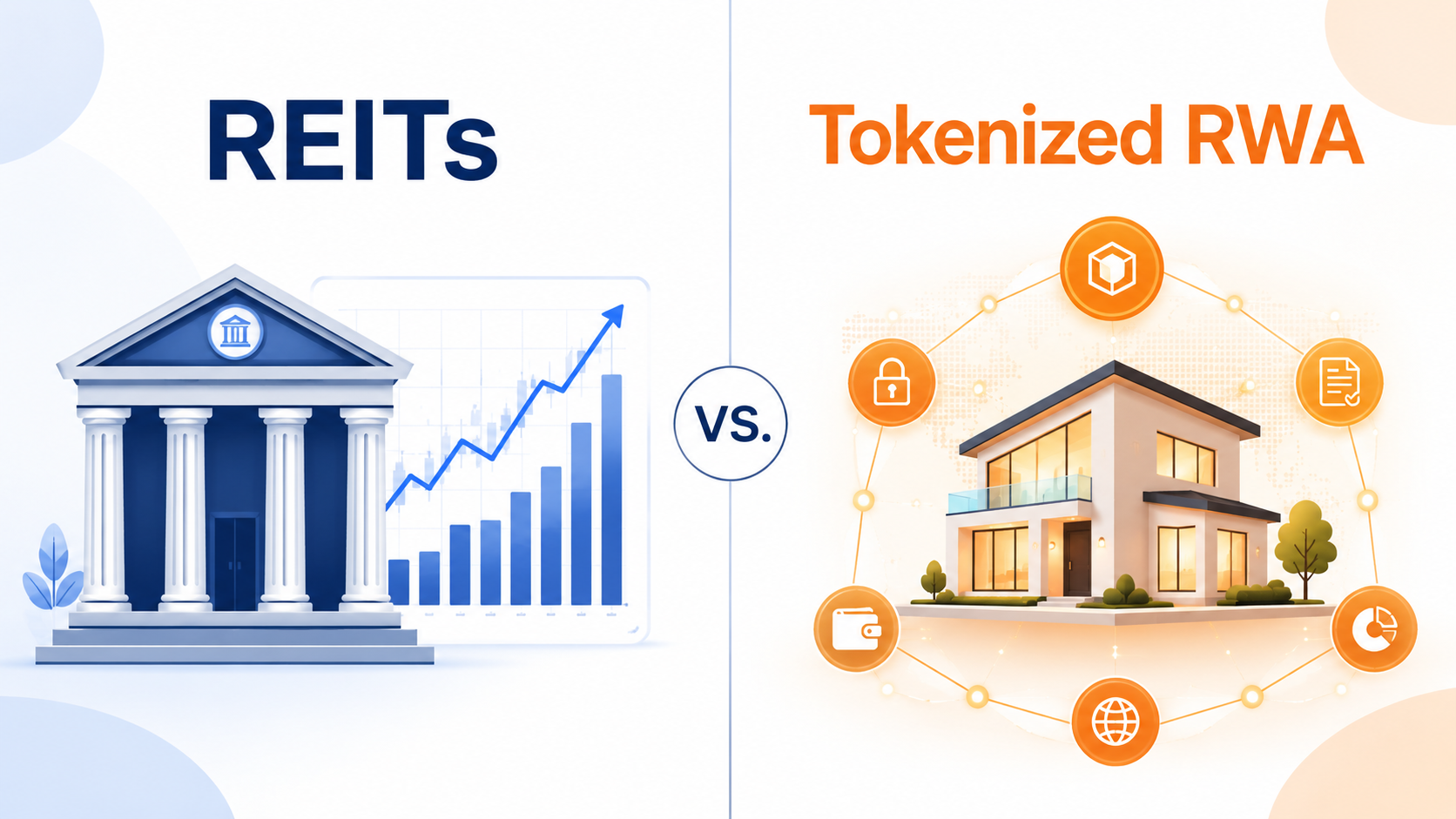
For decades, investing in real estate meant choosing between two extremes. You either needed massive capital to buy a physical property, or you had to buy shares in a Real Estate Investment Trust (REIT) and surrender all control to a fund manager. Today, the blockchain has introduced a third option: real-world asset (RWA) tokenization. Tokenized real estate platforms are transforming physical properties into fractional digital tokens, allowing regular investors to earn passive rental income and benefit from property appreciation without dealing with mortgages, tenants, or traditional banking gatekeepers.
In this guide, we will break down exactly how these platforms compare to traditional REITs, provide a non-negotiable safety checklist for evaluating projects, and review the leading platforms where you can research these assets today.
How Tokenized Real Estate Platforms Compare to REITs
Beginners often assume that a tokenized property is just a digital REIT. This is a dangerous misconception. The underlying mechanics, legal structures, and fee models are entirely different.
When you buy a traditional REIT through a stockbroker, you are buying a share in a corporate entity that happens to own real estate. You do not own the property. You have no say in which specific buildings are bought or sold. In exchange for this convenience, the REIT management team takes a significant percentage of the profits before distributing dividends.
When you use tokenized real estate platforms, you are typically buying a digital security that represents direct, fractional ownership in a specific property via a Special Purpose Vehicle (SPV) or Limited Liability Company (LLC). You choose the exact house, apartment, or commercial building you want exposure to.
| Feature | Traditional REITs | Tokenized Real Estate (RWA) |
|---|---|---|
| Asset Control | None. Fund managers decide the portfolio. | High. You select specific properties to back. |
| Middleman Fees | High (Management, administrative, broker fees). | Low (Smart contracts automate distribution). |
| Yield Distribution | Usually quarterly or annually. | Often daily or weekly via stablecoins. |
| Barrier to Entry | Varies by broker, usually requires a traditional brokerage account. | Often as low as $50 (approx. R900), accessible via a crypto wallet. |
| Liquidity | High during stock market hours. | Variable. Depends on the platform’s secondary market liquidity. |
The 5-Step RWA Safety Checklist
Because tokenized real estate operates outside traditional brokerage accounts, the responsibility of due diligence falls entirely on you. Do not deposit capital into any platform until it passes this five-step safety check.
1. Verify the Legal Structure (The SPV/LLC)
A token is useless if it has no legal connection to the physical building. Legitimate tokenized real estate platforms create a distinct legal entity, like a Wyoming LLC or Delaware Series LLC, for each property. The tokens you buy represent membership interests in that specific LLC. If the platform goes bankrupt, the LLC (and your ownership of the property) remains legally intact and separate from the platform’s corporate assets.
2. Look for Off-Chain Asset Audits
In standard DeFi, you verify a smart contract. In RWA, you must verify the physical world. Does the platform provide independent, third-party property appraisals? Do they upload the actual title deeds, property tax receipts, and insurance documents to their dashboard? If this documentation is hidden, walk away.
3. Understand the Secondary Market Liquidity
Real estate is historically an illiquid asset. Tokenization makes it easier to trade, but only if there is a buyer on the other side. Check how the platform handles selling. Do they have an internal secondary marketplace with 24/7 listing capabilities, or do you have to wait for a public DEX buyer?
4. Check for KYC and AML Compliance
In the decentralized finance world, Know Your Customer (KYC) requirements are often viewed negatively. However, in the RWA sector, KYC is a vital safety feature. Tokenized real estate is considered a security in almost every jurisdiction. If a platform allows you to buy property tokens anonymously without verifying your identity, they are likely operating illegally and risk being shut down by regulators.
5. Review On-Chain Smart Contract Audits
Even if the physical house is perfectly secure, a bug in the code can drain your funds. Ensure the platform’s smart contracts have been audited by reputable blockchain security firms. You can read more about evaluating protocol safety in our 10-Step DeFi Safety Checklist.
Don’t Navigate RWA Blindly
The landscape of tokenized assets is changing fast, and regulatory rules are shifting globally. Join the Simple Passive Income newsletter to get my latest platform reviews, safety checklists, and yield strategies delivered straight to your inbox.
Join the Weekly SPI Newsletter
Practical insights. Real opportunities. Zero fluff.
Top Tokenized Real Estate Platforms in 2026
If you are ready to research live markets, the following platforms have established themselves as industry leaders in the tokenized real estate sector in 2026. For a broader look at platform-level supply and activity, you can always cross-check data on rwa.xyz.
1. Lofty (Algorand Network)
Lofty.ai is widely considered one of the most beginner-friendly tokenized real estate platforms. It focuses heavily on residential real estate across the United States. You can purchase fractional tokens for as little as $50, with no mandatory holding period. Because it is built on the Algorand blockchain, transaction fees are fractions of a cent, and rental income accrues daily directly to your wallet in USDC.
2. RealT (Gnosis Chain)
RealT is one of the pioneers of the RWA movement, running the longest-established fractional rental program. They focus primarily on single-family and multi-family homes in the U.S. Each listing is a separate LLC, and the token is a membership interest in that LLC. RealT is known for its extreme transparency and pays out rental yields on a weekly basis using xDai or USDC on the Gnosis Chain, which makes micro-distributions economically realistic.
3. Landshare (Binance Smart Chain)
Landshare operates slightly differently by blending traditional real estate investment with DeFi mechanics. Built on the Binance Smart Chain (BSC), Landshare allows users to buy RWA tokens backed by residential properties. What makes it unique is its integration with DeFi; users can take their real estate tokens and stake them in auto-compounding yield farms to boost their overall passive income. This adds a layer of complexity but caters well to users already familiar with yield farming.
4. Securitize (Multi-Chain Institutional Standard)
While Lofty, RealT and Landshare cater heavily to retail investors, Securitize operates as the institutional standard for RWA tokenization. With regulatory licenses across major markets including SEC registration in the U.S., Securitize is built for compliance automation and investor accreditation. This platform is best suited for institutional-grade private securities or investors looking for full regulatory certainty.
Practical Example: The R5,000 RWA Investment Flow
To understand how this works in practice, let us look at a practical scenario. Imagine Thabo has R5,000 (roughly $275) that he wants to invest in real estate, but he cannot afford a deposit on a physical house in Cape Town.
- Onboarding: Thabo creates an account on one of the leading tokenized real estate platforms and completes the mandatory KYC identity verification.
- Funding: Thabo uses a local crypto exchange to convert his R5,000 into USDC (a dollar-pegged stablecoin) and sends it to his non-custodial Web3 wallet.
- Asset Selection: He browses the marketplace and finds a fully tenanted multi-family home in Ohio with a projected annual yield of 9%.
- Execution: Thabo purchases $275 worth of tokens for that specific property using his USDC.
- Passive Income: The smart contract automatically deposits his proportional share of the rent into his wallet, depending on the platform’s distribution schedule. He can then withdraw this, or reinvest it using on-chain crypto tools.
Final Thoughts
Tokenized real estate bridges the gap between the physical stability of property and the high-speed efficiency of decentralized finance. It offers unprecedented access, allowing anyone to build a globally diversified real estate portfolio from their laptop.
However, it is vital to remember that these are still real houses in the real world. Roofs leak, tenants occasionally miss rent, and property values fluctuate. The blockchain wraps the ownership, but it does not eliminate the foundational risks of real estate investing. Start small, demand legal transparency from the platforms you use, and never invest money you cannot afford to have locked up during market downturns.