
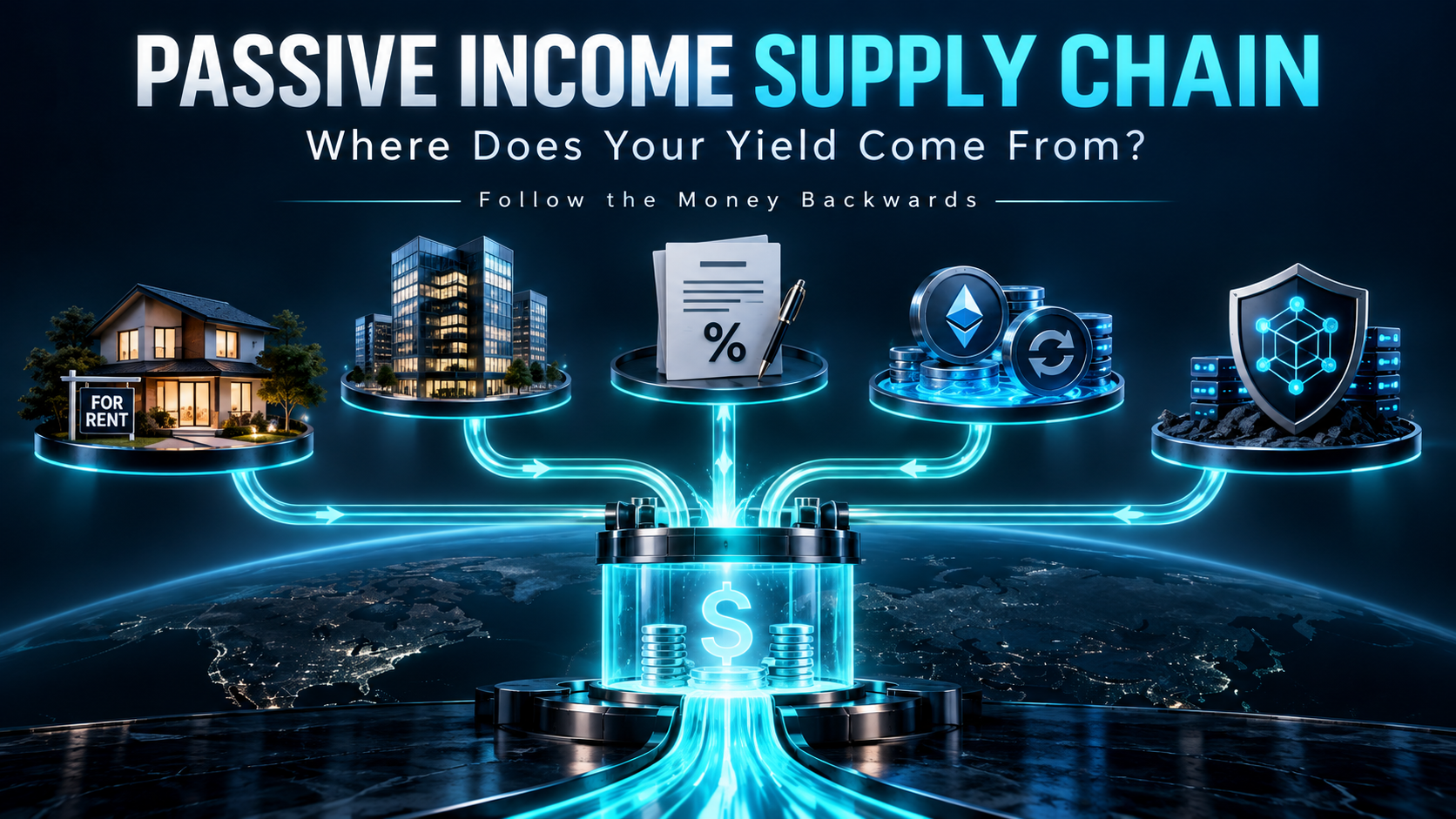
Where does passive income come from? It sounds like a simple question, yet it is one of the most important questions an investor can ask.
Every passive-income payment has an economic source.
A tenant pays rent because they need somewhere to live. A company may distribute part of its financial resources to shareholders. A borrower pays interest because they need access to capital. Meanwhile, traders pay fees because they need liquidity to complete transactions.
However, when people compare passive-income opportunities, they often ignore this underlying activity and focus almost entirely on one number:
How much does it pay?
For example, a property might advertise an 8% rental yield.
Meanwhile, a dividend stock could offer a 5% dividend yield.
A lending platform may show 7%, while a liquidity pool displays 18%.
Elsewhere, a staking opportunity could advertise 10%.
At first glance, those percentages may appear directly comparable.
In reality, they are not.
Each return is generated differently. As a result, each one depends on a different economic engine and exposes you to different risks.
This is where the idea of the passive income supply chain becomes useful.
Instead of looking only at the yield displayed on the surface, we follow the money backwards until we understand what actually generates the income.
This approach also complements our guide to DeFi income layers, where we explore why the source of a return matters just as much as the percentage displayed on a dashboard.
Once you can answer where passive income comes from, you can begin asking an even more important question:
Can this source of income reasonably continue?
What Is the Passive Income Supply Chain?
The passive income supply chain is a simple framework for tracing investment income back to the economic activity that ultimately supports it.
Think about an ordinary physical supply chain.
A product sitting on a supermarket shelf did not simply appear there. Before reaching the customer, it may have passed through manufacturers, suppliers, distributors, logistics companies, and retailers.
Passive income works in a similar way.
The payment arriving in your account is usually the final step in a much larger economic process.
For example:
Tenant needs accommodation → Tenant pays rent → Property produces revenue → Expenses are deducted → Owner receives net income.
Alternatively:
Business sells products → Business earns revenue → Costs are paid → Board approves a dividend → Shareholder receives income.
In lending, the chain looks different again:
Borrower needs capital → Lender supplies capital → Borrower pays interest → Lender receives income.
Therefore, an advertised yield should be the beginning of your research rather than the end of it.
Where Does Passive Income Come From?
Whenever you encounter an income-producing investment, start with two questions:
Who is paying me?
Why are they willing to pay me?
Those questions immediately reveal more than the advertised percentage alone.
If a tenant pays you, they are paying for the use of property.
When a company pays a dividend, the payment ultimately depends on the economics and financial position of that business. Investor.gov explains that dividends occur when a company distributes some of its earnings to shareholders. You can read its official explanation of stocks and dividends for additional background.
Likewise, a borrower pays interest because they value access to capital.
In a liquidity pool, traders may pay fees because they need available liquidity to execute swaps.
With proof-of-stake networks, rewards are connected to participating in or supporting the network’s consensus and security mechanisms.
Therefore, “yield” is not simply money appearing from nowhere.
Yield is usually payment for providing capital, property, liquidity, infrastructure, risk-bearing capacity, or another useful resource.
Yield Is Not Free Money
It is easy to think of yield as something an investment simply produces.
However, sustainable investment income normally exists because useful economic activity is taking place somewhere underneath the investment.
| Income Type | What You Provide | What Supports the Income |
|---|---|---|
| Rental income | Property | Tenant payments |
| Dividend income | Equity capital | Business economics and distributions |
| Bond interest | Loan capital | Borrower interest payments |
| REIT distributions | Investment capital | Income-producing real estate |
| DeFi lending | Crypto liquidity | Borrowing demand and interest |
| Liquidity provision | Tradable liquidity | Trading fees |
| Staking rewards | Staked assets and network participation | Protocol rewards and network economics |
| Tokenized income products | Investment capital | Income from underlying assets |
Therefore, the yield itself is not the investment.
The yield is the financial result of an underlying mechanism.
Understanding that mechanism is one of the foundations of intelligent income investing.
1. Rental Income: The Tenant Is the Economic Engine
Property provides one of the easiest examples of the passive income supply chain.
Suppose a property generates R15,000 in rent each month.
It is tempting to say:
“The property produces R15,000 per month.”
However, the building itself does not create money.
The tenant pays because the property provides accommodation.
The supply chain therefore looks more like this:
Property provides accommodation → Tenant receives value → Tenant pays rent → Owner receives revenue → Costs are deducted → Net rental income remains.
As a result, the sustainability of rental income depends on more than the headline yield.
For example, investors should consider tenant demand, affordability, vacancy levels, maintenance costs, insurance, rates, levies, and management expenses.
Most importantly, the figure that matters is not simply gross rent.
Net income after expenses is what ultimately reaches the owner.
Short-Term Rentals Have Their Own Supply Chain
The same principle applies to short-term rentals.
A guest may pay R3,000 for a weekend stay. However, that payment is made in exchange for accommodation, location, convenience, amenities, and service.
Before any real profit remains, the booking revenue may need to cover cleaning, laundry, utilities, maintenance, platform fees, consumables, management costs, and vacant nights.
Consequently, gross booking revenue and sustainable passive income can be very different numbers.
If you want to compare those economics with other ways of earning from property, our guide to short-term rentals vs REITs vs tokenized real estate breaks down the costs, control, risks, and income models side by side.
This gives us our first major rule:
Always follow the income beyond the headline yield.
2. Dividend Income: The Business Must Create Value
Dividend investing can look deceptively simple.
You buy shares, hold them, and occasionally receive a dividend.
Yet the dividend still has an economic source.
A business sells products or services. It receives revenue and then pays employees, suppliers, lenders, taxes, and other expenses.
If the company remains financially healthy, its board may decide to distribute part of the available earnings or financial resources to shareholders.
The simplified supply chain looks like this:
Customers buy products or services → Company generates revenue → Expenses are paid → Financial resources remain → Dividend may be declared → Shareholder receives income.
As Investor.gov explains, dividends are payments that can occur when a company distributes some of its earnings to shareholders.
Consequently, a high dividend yield does not automatically mean an excellent investment.
Imagine two companies.
Company A offers a 4% dividend yield and has a strong balance sheet, stable revenue, and consistent cash generation.
Company B offers an 11% dividend yield, but its revenue is falling while debt is increasing.
If you compare only the percentages, Company B looks more attractive.
However, once you examine the underlying business, the picture can change completely.
Why a Falling Share Price Can Increase Dividend Yield
Dividend yield is generally calculated relative to the share price.
Therefore, if a share price falls sharply while the dividend remains unchanged, the displayed dividend yield can rise.
An unusually high yield may sometimes reflect opportunity.
However, it can also reflect investor concern about the company.
For that reason, investors should investigate whether the business can continue supporting the dividend.
Again, the solution is simple:
Follow the money backwards.
3. Bond Interest: Borrowers Pay for Access to Capital
Bonds make the source of yield relatively easy to understand.
When you purchase a conventional bond, you are effectively lending money to an issuer.
That issuer might be a government, municipality, corporation, or another qualifying borrower.
Investor.gov describes a bond as a debt security similar to an IOU: investors lend money to an issuer, which generally promises interest payments and repayment of principal according to the bond’s terms. Its official bond guide provides a useful beginner overview.
The supply chain is therefore straightforward:
Investor supplies capital → Borrower receives financing → Borrower pays interest → Investor receives bond income.
More importantly, this immediately reveals where much of the risk lies.
The borrower must remain capable of meeting its financial obligations.
Therefore, higher bond yields often need to be considered alongside credit risk.
If one borrower must offer significantly more interest than another to attract capital, there may be a reason.
Sometimes the additional yield is compensation for accepting additional risk.
This leads to an important principle:
Yield is often the price investors receive for taking a particular type of risk.
4. REIT Income: Property Cash Flow Behind a Share
Real Estate Investment Trusts can make property investing feel similar to stock investing.
Instead of purchasing an entire building, investors buy shares in a company or trust that owns income-producing real estate.
Depending on the REIT, the portfolio may contain shopping centres, warehouses, apartments, hotels, offices, healthcare facilities, data centres, or other property-related assets.
Investor.gov’s REIT guide similarly describes REITs as companies that own and typically operate income-producing real estate or related assets.
Although investors hold shares, the economic engine can still be real estate.
The simplified passive income supply chain looks like this:
Properties provide useful space → Tenants pay rent → REIT collects property income → Expenses are paid → Eligible distributions may reach shareholders.
Therefore, analysing a REIT requires more than checking its distribution yield.
Investors should also understand occupancy levels, tenant strength, property quality, debt, refinancing requirements, and operating expenses.
For readers who want to explore property exposure without purchasing an entire building, the SPI Real Estate Passive Income Portfolio Guide compares REITs, ETFs, crowdfunding, and tokenized property approaches.
Ultimately, the visible yield is only the final output of a much larger property business.
5. DeFi Lending: Borrowing Demand Sits Behind the Yield
Decentralized finance can make investment yield appear more complicated because smart contracts automate much of the process.
Nevertheless, the underlying economic logic can still be familiar.
In a decentralized lending market, users may supply crypto assets that become available to eligible borrowers under the protocol’s rules.
Borrowers pay interest for access to that liquidity.
Consequently, part of the interest generated by borrowing activity can support the return earned by suppliers.
The simplified supply chain becomes:
Lender supplies assets → Borrower accesses liquidity → Borrower pays interest → Protocol allocates interest according to its rules → Supplier earns yield.
Aave provides a useful real-world example. Its official supply documentation explains that supplied assets enter liquidity pools where they can become available to borrowers. Supply rates can change according to factors including borrowing utilization.
In principle, this is not fundamentally different from many traditional lending arrangements.
The technology may be different, and smart contracts can change how the system operates.
Likewise, collateral structures and specific risks can vary considerably.
Nevertheless, the core economic question remains familiar:
Who wants to borrow this asset badly enough to pay interest for it?
For a complete breakdown of collateral, borrowing rates, liquidations, and major lending markets, see our DeFi Lending Protocols Explained guide.
Why DeFi Lending Rates Change
Many decentralized lending rates are variable.
When borrowing demand rises relative to available liquidity, rates may increase.
Conversely, when borrowing demand falls or additional capital enters the market, supplier rates may decline.
Therefore, a 9% lending rate today does not necessarily mean investors will receive 9% for an entire year.
The rate may change as market conditions change.
That is another reason why an advertised APY should never be treated like a guaranteed salary.
6. Liquidity Pools: Traders Can Be the Source of Your Fees
Liquidity provision provides another useful example of where passive income comes from.
Decentralized exchanges need liquidity so users can swap one token for another.
Liquidity providers supply assets that help make those trades possible.
When traders execute swaps, they may pay transaction or trading fees.
For example, Uniswap’s official documentation on fees explains that swap fees compensate liquidity providers whose liquidity is active at the time of the trade, although exact fee structures vary between protocol versions and pools.
The passive income supply chain therefore looks like this:
Liquidity provider supplies tokens → Trader executes a swap → Trader pays a fee → Eligible liquidity providers receive a share of applicable fees.
As a result, liquidity-provider income depends heavily on actual trading activity.
A pool with little volume may generate relatively little fee income.
By contrast, an actively traded market can generate significant fees.
However, liquidity providers may still face risks such as price movement, impermanent loss, smart-contract vulnerabilities, and changing market conditions.
Concentrated Liquidity Makes the Relationship Even Clearer
With concentrated liquidity, providers may choose a specific price range for their capital.
While the market trades inside that range, the position may actively facilitate swaps and earn applicable fees.
If the market moves outside the chosen range, fee generation may stop until the position becomes active again. Uniswap’s concentrated liquidity documentation explains this relationship between active price ranges and fee generation in more detail.
This illustrates an important point.
Your capital is performing a job, and the income depends on whether that job is actually being used.
If you want to go deeper into range selection, fee tiers, active liquidity, and the risks involved, read our full Concentrated Liquidity Provision guide.
7. Staking Rewards: Capital Supports Network Security
Staking is often described as locking cryptocurrency and earning more cryptocurrency.
That explanation is convenient, but it is incomplete.
On proof-of-stake networks, validators perform important functions that help the blockchain operate.
Depending on the network, these functions can include proposing blocks, verifying transactions, attesting to blocks, and helping the network reach consensus.
Ethereum’s official staking guide, for example, explains that validators propose blocks, check the work of other validators, and attest to the correct state of the chain.
Capital is placed at stake to help align economic incentives with honest behaviour.
The simplified supply chain may therefore look like this:
Participant stakes assets → Validator performs network duties → Network rewards successful participation → Staker receives rewards.
Importantly, staking yield is fundamentally different from lending yield.
In lending, borrowers usually pay for access to capital.
With staking, rewards are connected to participating in or supporting the blockchain’s consensus and security system.
Both strategies may display an APY.
However, the source of that APY is different.
Our Staking vs Farming beginner’s guide explores this distinction further, including how staking rewards, trading fees, lending interest, token incentives, and impermanent loss differ.
8. Tokenized Yield: New Technology, Familiar Economics
Tokenization can make traditional investment income appear completely new.
A fund interest may exist on blockchain infrastructure, while ownership records or settlement processes operate digitally.
Nevertheless, the underlying economic source of the yield can remain very familiar.
For example, if a tokenized product holds government securities or other interest-bearing assets, the income ultimately comes from those underlying investments.
The blockchain does not magically create the interest.
Instead, blockchain technology may change how ownership, transfers, recordkeeping, or settlement works.
The passive income supply chain may look like this:
Investor acquires tokenized fund interest → Fund owns income-producing assets → Underlying assets generate income → Fund reflects or distributes that income → Investor receives the economic benefit.
This distinction is central to RWA investing. A token may represent exposure to property, bonds, private credit, commodities, or another asset, but investors still need to understand what sits underneath the digital wrapper.
Therefore, whenever a token advertises yield, ask:
What sits underneath the token?
If the answer is unclear, further investigation is necessary.
Four Economic Engines Behind Most Passive Income
Once you start tracing income backwards, several recurring patterns become visible.
Many passive-income strategies depend on one or more of four broad economic engines.
1. Productive Assets and Businesses
The first engine is productive economic activity.
Examples include rent from property, profits generated by companies, infrastructure revenue, and other forms of business income.
In each case, a productive asset or business sits behind the payment.
2. Borrowing Demand
The second engine is demand for capital.
A borrower needs money and is willing to pay interest for access to it.
This model can appear in bonds, private credit, bank lending, peer-to-peer lending, and DeFi lending.
3. Transaction Activity
The third engine comes from users paying for transactions or services.
Examples can include exchange fees, marketplace fees, infrastructure usage fees, and certain network transaction fees.
4. Incentives and New Issuance
Finally, some returns depend partly on promotional rewards, token emissions, subsidies, or incentive programmes.
However, this category requires particular attention.
Incentives can help a new platform or network attract users during its early stages.
Nevertheless, incentive-funded yield is not automatically the same as yield supported by recurring customer revenue.
This distinction leads to one of the most important concepts in income investing.
Productive Yield vs Promotional Yield
Not every high yield has the same level of economic support.
Imagine a platform advertising a 30% annual return.
Before getting excited about the number, ask where the 30% comes from.
Suppose customers are borrowing capital and paying enough interest to support much of the return.
That represents one economic model.
Now imagine that most of the return is being paid through newly issued platform tokens.
Although the displayed percentage may initially look identical, the economics underneath it can be completely different.
Productive Yield
Productive yield is broadly supported by real economic activity.
Examples may include tenant rent, borrower interest, company profits, trading fees, or infrastructure usage fees.
Incentive-Driven Yield
By contrast, incentive-driven yield may depend heavily on token emissions, promotional rewards, temporary subsidies, or user-acquisition programmes.
Of course, that does not automatically make the opportunity bad.
Early-stage networks often need incentives to grow.
However, problems begin when investors mistake temporary incentives for permanent income.
If the subsidy disappears, the advertised yield may fall sharply.
This is one of the reasons our DeFi Income Layers guide encourages readers to separate the visible APY from the underlying source of the return.
The Yield Illusion: High APY Does Not Always Mean High Profit
Suppose an investment advertises a 40% annual yield.
At first glance, that sounds extraordinary.
However, imagine the asset producing that yield falls by 60% in value.
You may earn additional units while still losing money overall.
This creates what we can call the yield illusion.
The investor focuses on the rewards while ignoring what is happening to the underlying capital.
Consider a simplified example.
You invest R10,000 and earn R3,000 in rewards during the year.
Meanwhile, the underlying position falls to R5,000.
Before considering other factors, the combined value would be approximately R8,000.
Therefore, you generated income but still lost capital overall.
The lesson is clear:
High yield does not automatically mean high total return.
Why Extremely High Yield Should Create More Questions
When an investment offers dramatically more income than similar alternatives, there is usually a reason.
Sometimes the opportunity may genuinely be attractive.
However, the higher return may also compensate investors for additional risk.
That risk could involve credit quality, smart contracts, token volatility, liquidity, leverage, counterparties, currency exposure, or early-stage business uncertainty.
Therefore, do not ask only:
“How can they afford to pay this much?”
Also ask:
“What risk am I being paid to accept?”
That question turns yield chasing into actual investment analysis.
Four Investments Can All Pay 10% and Still Be Completely Different
Imagine four opportunities that each advertise approximately 10% annual income.
| Opportunity | Advertised Yield | Possible Economic Source | Key Risk to Investigate |
|---|---|---|---|
| Rental property | 10% | Tenant rent | Vacancy, expenses, property value |
| Corporate debt | 10% | Borrower interest | Credit and default risk |
| DeFi lending | 10% | Borrowing demand | Smart-contract, collateral, and market risk |
| Crypto reward programme | 10% | Token incentives | Token dilution and sustainability |
Although the percentage is the same, the economic reality is completely different.
Therefore, you are not comparing four versions of the same 10% return.
You are comparing four separate income engines with different sources, risks, and levels of sustainability.
The SPI Yield Sustainability Test
Whenever you encounter a new passive-income opportunity, run it through the following framework.
| Question | What You Are Trying to Discover |
|---|---|
| Who pays me? | The immediate source of the income |
| Why are they paying? | The economic service being provided |
| Where does the money originate? | The underlying revenue engine |
| Is there genuine external demand? | Whether customers actually need the product or service |
| Would the yield exist without incentives? | Dependence on subsidies or token emissions |
| Can the yield change? | Income predictability |
| What happens if demand falls? | Downside sensitivity |
| What happens to my principal? | Capital risk |
| What risk am I accepting? | The real price of the yield |
| Is the return supported by productive activity? | Potential long-term sustainability |
You do not necessarily need a perfect answer to every question.
However, if you cannot explain where the income comes from in simple language, you probably do not understand the investment well enough yet.
For crypto and DeFi opportunities in particular, combine these questions with the SPI 10-Step DeFi Safety Checklist, which covers audits, liquidity, tokenomics, withdrawals, and other risks that yield alone cannot reveal.
The One-Sentence Yield Test
Another useful exercise is to explain the source of an investment’s income in one sentence.
Rental property: Tenants pay for the right to use the property.
Dividend stock: A company may distribute part of its financial resources to shareholders.
Bond: The borrower pays interest for access to your capital.
DeFi lending: Borrowers pay for access to crypto liquidity.
Liquidity provision: Traders pay fees when they use available liquidity.
Staking: The network rewards participation that helps support proof-of-stake consensus and security.
If your explanation sounds more like:
“I deposit money here and somehow they pay me 25%,”
then more research is needed.
What If You Cannot Identify the Source of Yield?
At this point, one situation deserves special attention.
Suppose a platform promises regular returns but cannot clearly explain who generates the revenue, what service creates the revenue, how rewards are financed, or why the advertised return should be sustainable.
That does not automatically prove the investment is fraudulent.
However, it creates a serious information problem.
When your capital is involved, unclear economics should increase caution rather than reduce it.
Complex technology should never become an excuse for an unexplained business model.
You may not need to understand every line of code.
Nevertheless, you should understand the economic story.
Before trusting an unfamiliar platform, the SPI Crypto Project Vetting Checklist provides a structured way to investigate the team, business model, transparency, tokenomics, withdrawals, and on-chain evidence.
New Investor Money Is Not the Same as Customer Revenue
In fact, this distinction is one of the most important lessons in passive-income investing.
Imagine two businesses.
The first receives money from customers who willingly pay for a useful product or service.
The second receives most of its money from new investors joining an opportunity.
Those cash flows are not economically equivalent.
Customer revenue comes from people paying for value.
By contrast, investor capital comes from people expecting a future return.
Therefore, whenever an income opportunity appears heavily dependent on continuous inflows from new participants, investigate the structure very carefully.
A sustainable model should have a clear explanation for how economic value is created beyond simply attracting the next investor.
Real Yield Does Not Mean Risk-Free Yield
However, there is another mistake worth avoiding.
Once investors understand the idea of productive or “real” yield, they sometimes assume that genuine revenue automatically makes an investment safe.
It does not.
A business with real customers can still fail.
Similarly, a tenant can stop paying rent, a borrower can default, a smart contract can contain vulnerabilities, or a property can become vacant.
Likewise, a liquidity pool can suffer adverse price movements, while a protocol may lose users and revenue.
Therefore, identifying real economic activity helps us understand the source of the yield.
It does not eliminate investment risk.
How the Passive Income Supply Chain Helps With Diversification
Moreover, the framework is useful for more than analysing individual investments.
It can also reveal whether your passive-income portfolio is genuinely diversified.
Imagine an investor owns three dividend stocks, two REITs, a rental property, a DeFi lending position, and a staking position.
At first glance, the portfolio appears highly diversified.
However, several income streams may still depend on the same underlying economic forces.
For example, multiple property investments may all suffer when occupancy weakens or financing costs increase.
Likewise, several crypto-income strategies may all struggle during the same market downturn.
Meanwhile, multiple lending positions could depend on continued borrowing demand.
Therefore, diversification should not only measure how many assets you own.
It should also consider how many different economic engines support your income.
Do You Own Multiple Assets or Multiple Income Engines?
Consequently, this leads to an even more useful question.
Suppose you own five investments.
Are they truly five different sources of passive income?
Or are they five different wrappers around the same underlying economic activity?
Consider someone who owns three property funds, a listed property company, and a rental apartment.
Technically, that person owns five investments.
Nevertheless, a large portion of the income still depends on property markets, tenant demand, and financing conditions.
Another investor might receive income from business profits, property rents, borrower interest, and transaction fees.
Those income streams depend on more varied economic activities.
This does not automatically make the second portfolio better.
However, the passive income supply chain helps reveal the difference.
How to Use the Framework Before Investing
Therefore, the next time you encounter an investment opportunity, ignore the advertised yield for the first few minutes.
Start with the underlying economics instead.
Asset: What am I actually buying or providing?
Customer: Who receives value from it?
Payer: Who ultimately supplies the money?
Economic activity: Why does that person or business willingly pay?
Costs: What expenses occur before the income reaches me?
Risk: What could interrupt the flow of money?
Incentives: How much of the return depends on temporary subsidies?
Principal: What can happen to the value of the underlying investment?
Only after answering those questions should the advertised yield return to the conversation.
At that point, the percentage usually becomes much more meaningful.
From Yield Chasing to Income Investing
Ultimately, this framework represents a shift in mindset.
A yield chaser asks:
“Which investment pays the highest APY?”
An income investor asks:
“What economic activity supports this return, what could interrupt it, and am I being compensated appropriately for the risk?”
The difference may sound subtle.
In practice, it is enormous.
One approach begins with the reward.
The other begins with understanding.
That understanding becomes increasingly important because modern investors now have access to traditional savings products, bonds, dividend shares, REITs, rentals, private credit, staking, DeFi lending, liquidity pools, tokenized securities, and decentralized physical infrastructure networks.
The technology can change dramatically.
However, the basic economic question remains the same:
Where does passive income come from?
The Passive Income Supply Chain in One Table
| Income Strategy | Immediate Payer | Underlying Economic Driver | Important Risk |
|---|---|---|---|
| Long-term rental property | Tenant | Demand for accommodation | Vacancy and property expenses |
| Short-term rental | Guest | Travel and accommodation demand | Occupancy and operating costs |
| Dividend stocks | Company | Business economics | Falling profits or dividend cuts |
| Bonds | Issuer | Borrowing demand | Default and interest-rate risk |
| REITs | REIT | Underlying property income | Occupancy, debt, and property markets |
| DeFi lending | Borrowers through protocol | Demand for crypto liquidity | Smart-contract and market risk |
| Liquidity provision | Traders | Trading activity | Price movement and liquidity risk |
| Proof-of-stake | Blockchain network | Network consensus and security | Token price and validator risk |
| Tokenized income fund | Underlying assets | Interest or income from holdings | Issuer, liquidity, and structural risk |
| DePIN | Network users and possible incentives | Demand for physical infrastructure | Utilization, hardware, and token economics |
The SPI Rule: Follow the Money Backwards
If there is one principle to remember from this article, make it this:
Never evaluate an investment by its yield alone. Follow the money backwards.
Start with the payment arriving in your account.
Next, identify who sent it.
Then determine where that person, company, protocol, or network obtained the money.
After that, ask why someone willingly paid them in the first place.
Finally, identify the asset, service, risk, or activity that made the payment possible.
By the time you reach the beginning of the supply chain, you should understand far more about the investment than its APY.
Final Thoughts: Every Yield Tells an Economic Story
Passive income can look effortless when we only see the final payment.
A dividend appears in an investment account.
Elsewhere, rental income reaches a bank account.
Meanwhile, interest accumulates on a lending position.
In another market, traders generate liquidity-provider fees.
At the same time, staking rewards may increase a wallet balance.
However, none of these payments exists in isolation.
In one situation, somebody rented an asset.
Elsewhere, a borrower paid for access to capital.
Another customer purchased a product or service.
Meanwhile, a trader paid to use available liquidity.
In other cases, customers paid for access to useful infrastructure.
Alternatively, a network created incentives to reward participants for performing an important function.
Therefore, the quality of a passive-income opportunity depends on far more than the percentage displayed beside the word “yield.”
It depends on the strength of the economic engine underneath it.
Once you learn to identify that engine, investing becomes less about chasing percentages and more about understanding how money actually moves.
That may be one of the most valuable passive-income skills an investor can develop.
Disclaimer: This article is for educational and informational purposes only and does not constitute financial, investment, tax, or legal advice. All investments involve risk. Yields, dividends, interest rates, rental income, token rewards, and distributions can change or stop entirely. Always research the underlying investment, understand how returns are generated, and consider professional advice where appropriate before committing capital.
Leave a Reply